


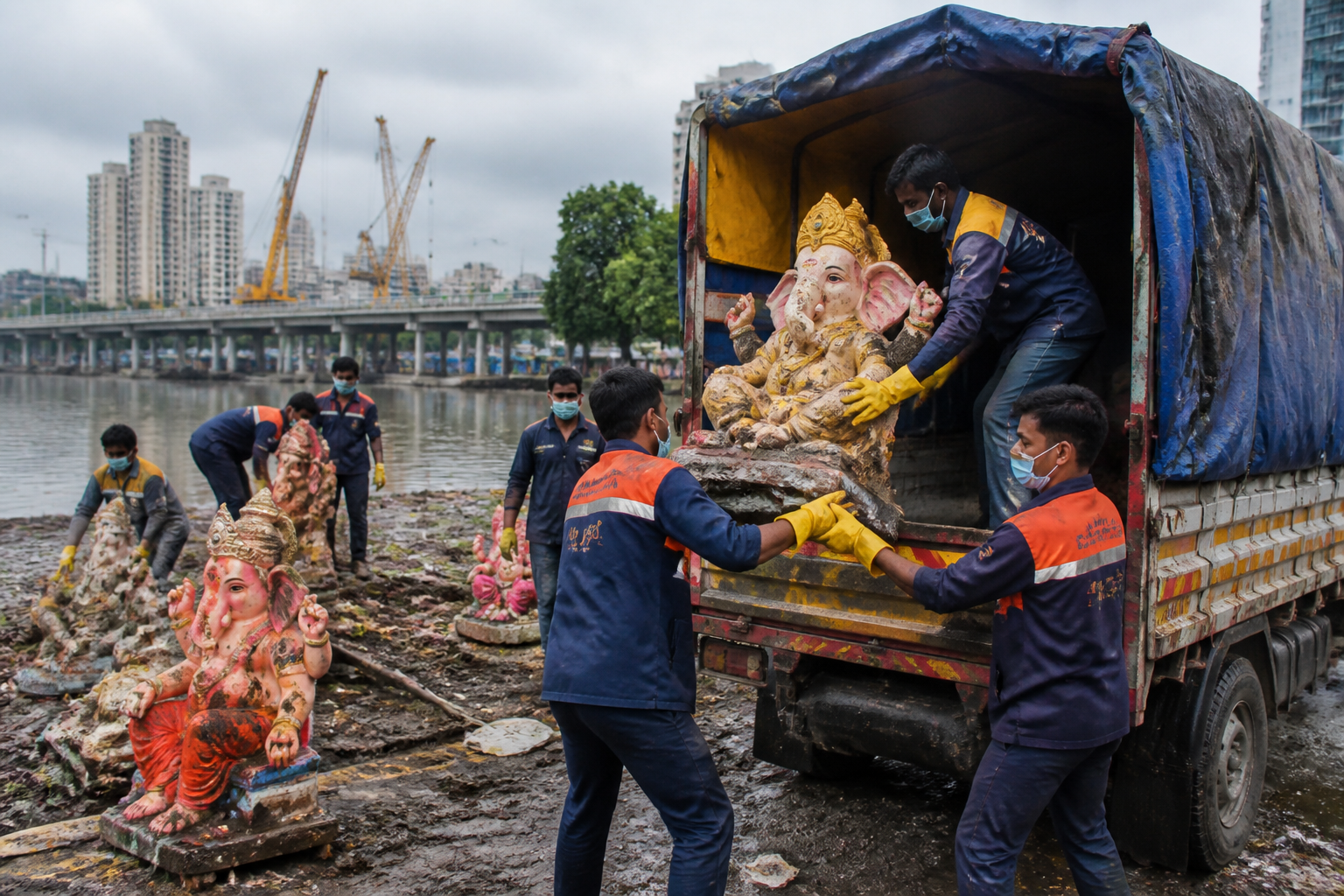
Mumbai’s Brihanmumbai Municipal Corporation has begun implementing a system to collect, safely store, scientifically process and recycle plaster of Paris Ganesh idols after immersion, following directions from the Bombay High Court. The civic body has issued a standard operating procedure to all departmental assistant commissioners and invited tenders for handling an estimated 2,850 tonnes of material.
Under the SOP, idols immersed in artificial ponds, temporary immersion tanks and water bodies must be removed within 24 hours. The collected idols will be transported to a designated storage and unloading facility in Mulund, where the material will be processed for reuse.
The BMC said the processed plaster of Paris can be used to make new idols, plasterboard, ceramics, medical plaster, bricks and filler material for the cement industry. The proposed system covers the chain from collection after immersion to scientific recycling and reuse.
The process also applies to large idols immersed in natural water bodies. The Bombay High Court’s August decision allowed Ganesh idols taller than six feet to be immersed in natural water sources, as was permitted the previous year. The BMC’s solid waste management department has now issued procedures for collecting these idols and ensuring their environmentally responsible disposal.
Each municipal ward will have to appoint a coordinating officer and arrange the required workforce, personal protective equipment, cranes and properly covered vehicles. The civic administration has specified that removed idols must be transported securely to the Mulund facility. The use of covered vehicles is intended to support safer movement of the material through the city.
The SOP also requires ward-level records of the operation to be maintained. These records will include details of the work carried out in each ward, weighbridge receipts, photographs and video documentation. Assistant commissioners will monitor daily operations under the supervision of zonal deputy municipal commissioners.
The system places the responsibility for post-immersion management on the municipal administration rather than treating idol removal as a standalone clean-up activity. Its implementation will depend on coordination between ward offices, the solid waste management department, transport and handling teams, and the facility designated in Mulund.
The BMC’s next steps include awarding tenders for the handling of the material and carrying out collection, transportation, storage and processing according to the issued SOP. The civic body’s records and operational reports will document the quantity collected and the progress of the recycling process.
