


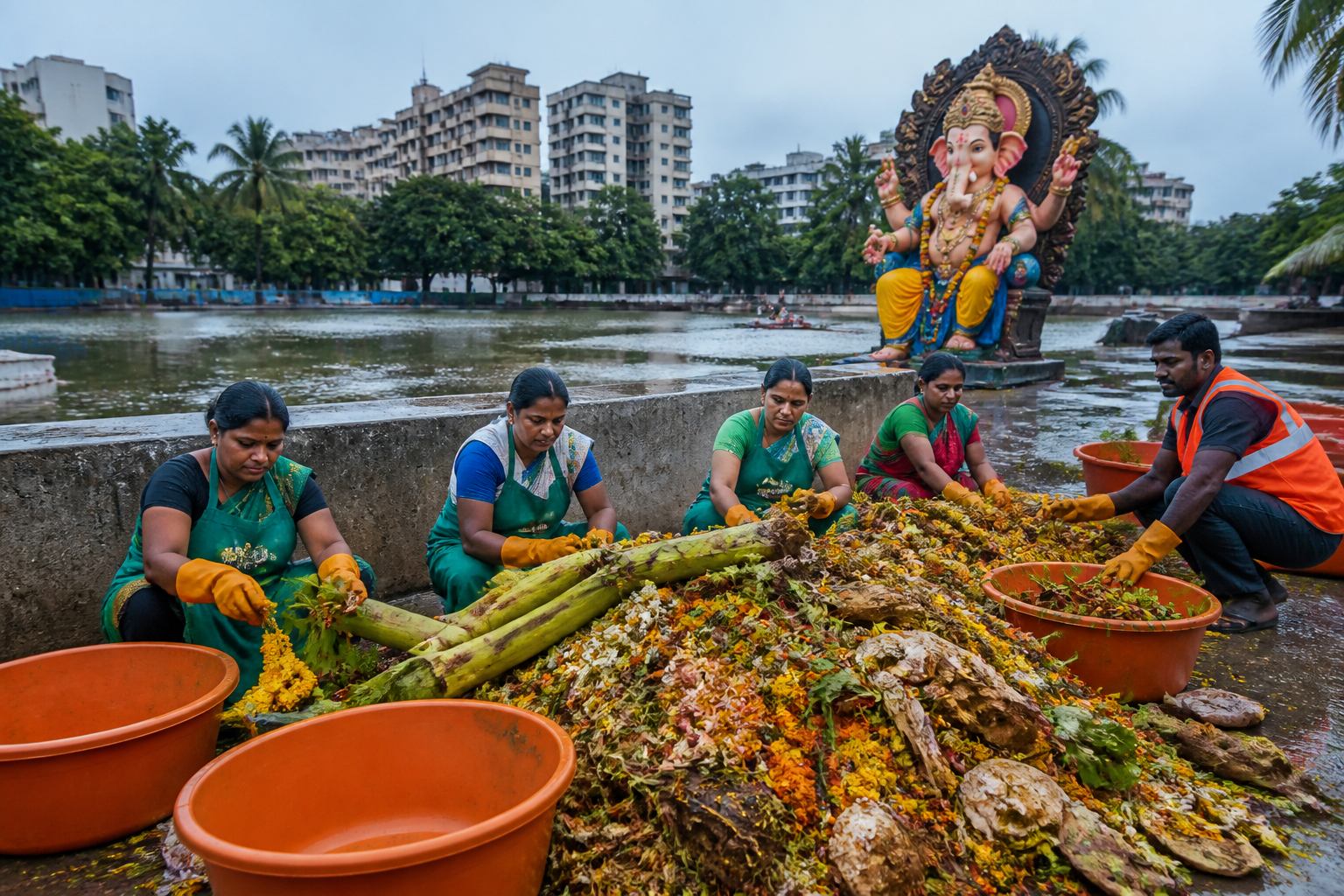
The Vasai-Virar Municipal Corporation will again collect floral offerings and other organic material generated during Ganeshotsav and process them into compost, with nirmalya collection urns planned at 128 artificial immersion ponds across the city. The civic body said the initiative, carried out successfully for the past three years, will be implemented with the support of women’s self-help groups.
The material collected during immersion activities will include garlands, flowers, banana stems and other offerings used during worship. The corporation plans to gather the material centrally before sorting it for further processing. Flowers, strings, other puja material and plastic will be separated as part of the process.
The initiative forms part of the municipal corporation’s effort to promote an environment-friendly Ganesh festival. The civic body has already been encouraging the use of artificial immersion ponds and the concept of donating idols. The collection and processing of nirmalya is the latest measure in this programme.
During the festival, floral offerings and other material are often discarded in ponds, the sea, rivers and creeks after immersion. According to the report, plastic bags and other non-organic material can also enter the waste stream along with the offerings. When the organic material decomposes in water, it can contribute to pollution and affect biodiversity.
The corporation’s stated plan is to prevent this material from being disposed of directly in water by ensuring collection during the immersion period. Once brought together, the waste will be classified so that organic material can be processed and plastic and other unsuitable items can be separated.
Women’s self-help groups will assist with the segregation and processing work. Their involvement gives the municipal programme an operational role beyond collection, linking festival waste management with a local community group-based implementation model.
The use of 128 artificial immersion ponds also creates a citywide collection network rather than limiting the programme to a small number of major immersion locations. The report does not provide the expected quantity of nirmalya, the processing capacity, the number of participating self-help groups or the final distribution plan for the compost.
The corporation’s immediate implementation will take place during the current Ganeshotsav, when the collection of nirmalya from the artificial ponds is scheduled to begin. The next steps will involve installing or placing the collection urns, gathering the material and completing segregation before processing.
