


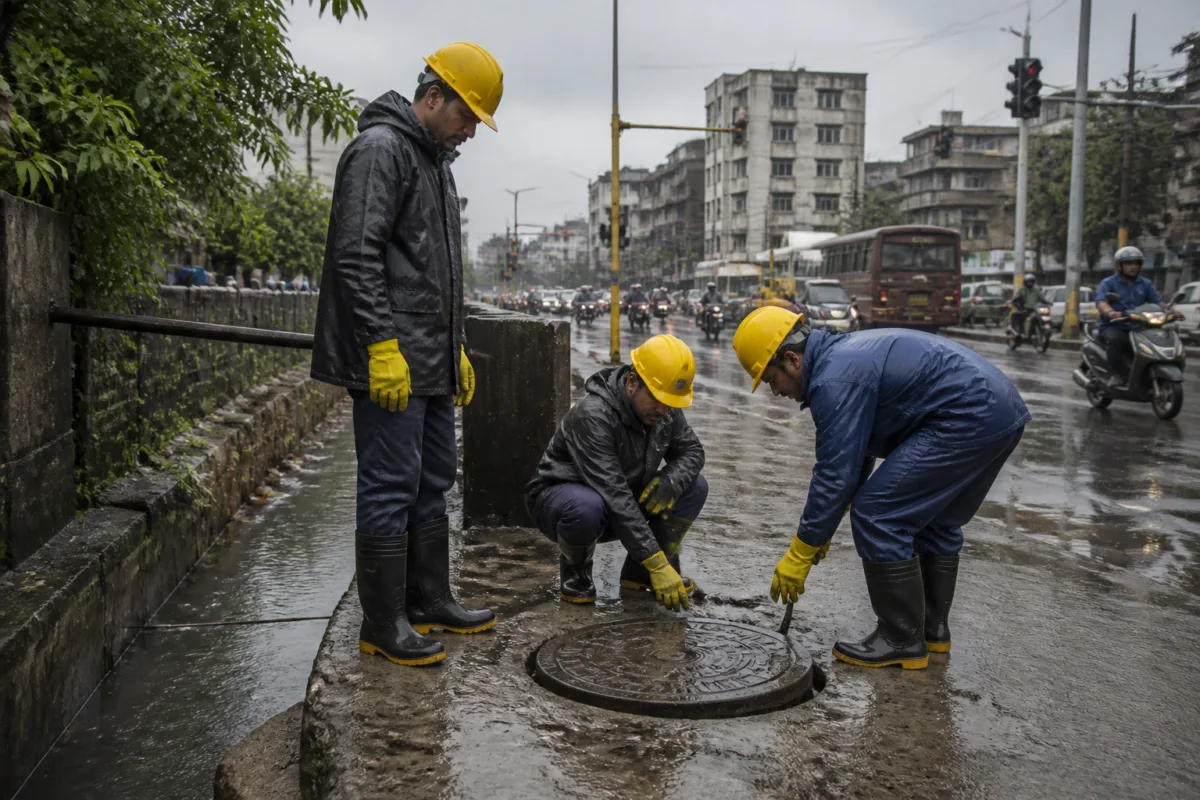
Mumbai’s manual scavenging vigilance system is failing at the point where oversight should become action. Committees meant to monitor implementation of the law, verify incidents and support the rehabilitation of sanitation workers have missed mandatory meetings, repeated the same unresolved discussions and struggled to establish responsibility across civic bodies, railways, public agencies and private premises.
Documents reviewed by the Times of India show that the vigilance committees for Mumbai City, Mumbai Suburban and Thane did not consistently meet once every three months, as required under Section 24(4) of the Prohibition of Employment as Manual Scavengers and their Rehabilitation Act, 2013. Mumbai City’s committee went 10 months and 25 days without a meeting between 2025 and 2026. Mumbai Suburban’s longest recent gap was six months, between December 2025 and June 2026. Thane’s committee met in July and November 2025 and again in June 2026.
The gaps matter because these panels are not advisory forums with an optional schedule. Their statutory responsibilities include monitoring implementation of the Act, overseeing rehabilitation and addressing grievances. The law’s design assumes that regular meetings will create an administrative record, identify violations and push agencies towards corrective action. When meetings are delayed or their minutes merely repeat earlier discussions, the formal system can continue to exist without producing timely intervention.
That weakness becomes more consequential when viewed against the deaths recorded during the same period. Between January and October 2026, two people died while cleaning manholes or septic tanks in Mumbai. Shamim Razak Gazi, 26, died on February 4 while cleaning a 25-foot-deep drain in Goregaon. The Dalit Adivasi Shakti Adhikar Manch identified him as a contract worker engaged in “BMC sewerage operations”. Santosh Kashte, 47, died after entering a manhole at a building in Santacruz on September 28.
The cases also expose a recurring problem in urban sanitation governance: the difference between how work is experienced on the ground and how it is classified by institutions. The Brihanmumbai Municipal Corporation reported zero manual scavenging deaths between 2021 and 2024, saying that no municipal employee or worker directly hired by a contractor had died in such incidents. It treats cases on private premises or involving informal hires as outside its scope.
That administrative definition may produce a clean departmental record without establishing whether hazardous work is actually taking place within the city’s sanitation system. Municipal sewerage operations, building-level maintenance, contracted drain cleaning and informal hiring can overlap in practice, particularly when responsibility for a task is passed from one entity to another. The available material does not establish how each death was classified under the law, but it does show that the boundary between municipal responsibility and private or informal work is contested.
Vikramkumar Chandeliya, a non-government member of the Mumbai Suburban committee representing the Akhil Bharatiya Safai Mazdoor Congress, said he had repeatedly raised concerns about workers clearing clogged drains without gloves or gumboots in Kurla. He said some workers told him they had been hired through BMC contracts, while civic officials denied that manual scavenging was occurring.
This disagreement is not simply about terminology. It affects whether an incident is recorded, which agency is expected to investigate it, whether a worker is recognised as eligible for rehabilitation and whether a contractor or establishment faces scrutiny. A vigilance committee can only perform those functions if it has current information, authority to inspect sites and access to records from the agencies that control the work.
The committee minutes indicate that information-sharing has itself become a prolonged institutional problem. Mumbai Suburban’s committee repeatedly sought information from Central and Western Railways about manual scavenging at stations, tracks, depots and offices. The issue was discussed in December 2025 and June 2026, but the report found no documented response. Requests to BEST similarly did not produce a documented reply.
Chandeliya said railway officials had failed to provide information over three years and sent new representatives to meetings. According to his account, representatives would say they had not attended earlier meetings and therefore did not know which records or documents were expected. Whether or not every such exchange can be independently established from the supplied material, the reported pattern points to a basic weakness in committee functioning: attendance does not automatically create institutional continuity.
For an oversight body, minutes are useful only when they record decisions, assign responsibility and track whether commitments have been completed. The report describes minutes that contain almost the same discussions, with little evidence of action. Jagdish Kharalia, a member of the Thane committee from Shramik Janta Sangh, said committees were meant to visit sites, verify incidents, submit reports and recommend action, but that these functions were not being carried out properly. He also said members had repeatedly sought action-taken reports on decisions made at meetings.
Kharalia further argued that committee members lacked the authority to intervene in cases of manual scavenging and needed official powers, as well as transport or travel allowances, to conduct inspections. This identifies a structural gap between a committee’s assigned responsibility and its operating capacity. A body may be legally empowered to monitor implementation, but without travel support, inspection powers, access to records or a mechanism to compel responses, its work can remain confined to discussion.
The meeting schedule itself illustrates how procedural explanations can replace institutional accountability. One source attributed the Mumbai City committee’s failure to meet to a “low caseload”. The Mumbai Suburban committee’s gap was attributed to the March year-end account-closing period. Neither explanation addresses the legal requirement of quarterly meetings or explains how a low reported caseload should affect the committee’s duty to verify whether cases are being detected and reported.
The representation problem adds another layer. Section 24(2)(f) permits up to four social workers or community representatives on district committees, including at least two women. Mumbai Suburban has only one non-government member after another died. The social welfare department said it would advertise for applicants with relevant field experience.
Representation is significant because the committee’s information is not likely to come only from official files. Workers, community organisations and local representatives may see unsafe cleaning practices before they appear in municipal records. Their participation can help bring complaints into the system, but that role is weakened when positions remain vacant or when members lack the means to visit sites and verify claims.
The Mumbai experience also demonstrates how urban sanitation is governed across fragmented jurisdictions. Municipal departments, contractors, building owners, railway authorities, BEST and social welfare officials may each control part of the chain. A worker entering a drain or manhole can therefore be connected to several institutions at once, while each institution may define the task as belonging to someone else. The supplied report does not establish that every agency involved breached the law. It does show repeated difficulty in assembling a common record of where such work occurs and who is responsible for preventing it.
The statutory structure attempts to address this fragmentation through district-level vigilance committees. Their value depends on routine institutional practices: meetings held on time, complete attendance, records obtained from relevant agencies, site inspections, documented decisions, action-taken reports and adequate representation. The evidence in the report shows weaknesses across each of these steps. Meeting intervals were missed; earlier discussions were repeated; information requests remained unanswered; members sought action-taken reports; and one non-government seat remained vacant.
The numbers are limited but revealing. Mumbai City recorded a gap of 10 months and 25 days between meetings. Mumbai Suburban recorded a six-month gap. Two deaths were reported in Mumbai between January and October 2026. The suburban committee discussed railway information at least in December 2025 and June 2026 without a documented response. These figures do not measure the full scale of hazardous sanitation work. They measure the visible failures of a system that is supposed to detect and respond to it.
That distinction is important. A low number of recorded cases cannot by itself demonstrate that unsafe cleaning has declined. It may also reflect weak reporting, narrow institutional definitions, lack of inspections or poor coordination between agencies. The source material does not provide a citywide inventory of sanitation workers, the number of manholes or septic tanks inspected, the number of complaints received, or the number of prosecutions and rehabilitation cases. Those gaps limit what can be concluded about the overall prevalence of manual scavenging.
What can be concluded is narrower and more concrete: the oversight mechanism has not been operating with the regularity and follow-through prescribed by the law, while people have continued to undertake hazardous cleaning work. The civic body and committee members also disagree over whether some of that work qualifies as manual scavenging and whether it falls within municipal responsibility. Without a shared evidentiary record, the disagreement is unlikely to be resolved through meetings alone.
The larger urban question is whether a city can claim to have eliminated a dangerous practice when its monitoring institutions do not meet regularly, agencies do not reliably share information and workers operating through contractors or private premises fall between administrative categories. Mumbai’s committees were created to close that gap. The evidence reviewed by the Times of India suggests that their current functioning is instead reproducing it.
The next developments to monitor are the proposed recruitment of social workers and community representatives, the scheduling of overdue committee meetings, responses from Central and Western Railways and BEST, and whether the committees begin recording site inspections and action-taken reports. Those steps will indicate whether the system moves beyond repeated minutes towards verifiable oversight.

