


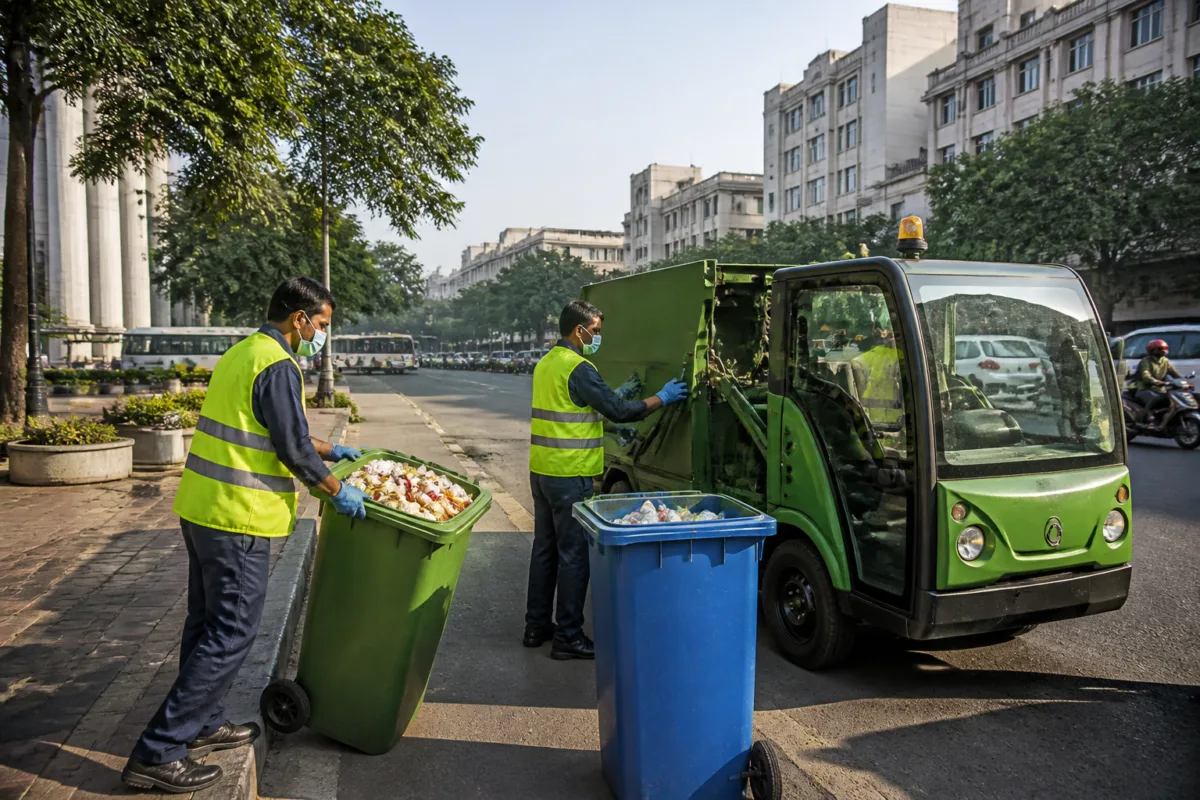
A new Central Delhi waste management project covering 25 wards has deployed more than 2,000 workers and been designed to handle up to 1,080 tonnes of waste a day under a public-private partnership between Renvion and the Municipal Corporation of Delhi (MCD).
The project was flagged off by Delhi Chief Minister Rekha Gupta. It covers approximately 98 square kilometres and provides door-to-door collection from residential, commercial, institutional and bulk waste generators. The service will also handle street sweeping waste, desilted drain waste, horticulture waste and domestic hazardous waste, including sanitary waste.
The initiative is being implemented through a cost-of-service-delivery approach. The exact project cost and MCD’s financial contribution have not been specified in the information provided.
The workforce includes operational, supervisory and frontline personnel. According to Renvion, the project is intended to create livelihood opportunities, increase women’s participation in frontline waste management and support skill development. Renvion CEO Ishaan Alla said the company would work with the MCD to meet the project’s service commitments.
Electric vehicles are being used for primary and secondary waste collection. The stated objective is to reduce tailpipe emissions and noise in densely populated neighbourhoods while improving the movement of waste from collection points to processing and transfer facilities.
A central control room will monitor operations through GPS tracking, radio-frequency identification, weighbridge-based weighment, geofencing and infrared monitoring. A mobile application will provide operational updates and assist with grievance handling. These systems are intended to make collection and transportation activities more traceable and improve accountability in service delivery.
The project’s infrastructure includes Fixed Compactor Transfer Stations, Material Recovery Facilities and decentralised composting units. Its coverage of multiple waste streams means the contract extends beyond routine household collection to include waste generated by commercial, institutional and bulk users, as well as specific municipal activities such as drain desilting and horticulture maintenance.
The rollout places technology and monitoring alongside manpower and physical infrastructure. GPS and geofencing can track vehicle movement, while RFID identification and weighbridge records can create operational records for collection and transportation. The supplied information does not specify the project’s performance benchmarks, collection frequency, processing capacity or grievance-response timelines.
The project aligns with the objectives of the Swachh Bharat Mission. The MCD partnership also places the civic body and the private operator at the centre of implementation, with the stated service commitments to be delivered across the 25-ward area.
The next phase will involve operating the collection, transfer, recovery and decentralised composting systems across the designated service area. Further details on the project’s cost, MCD funding contribution and measurable service outcomes have not been provided.

