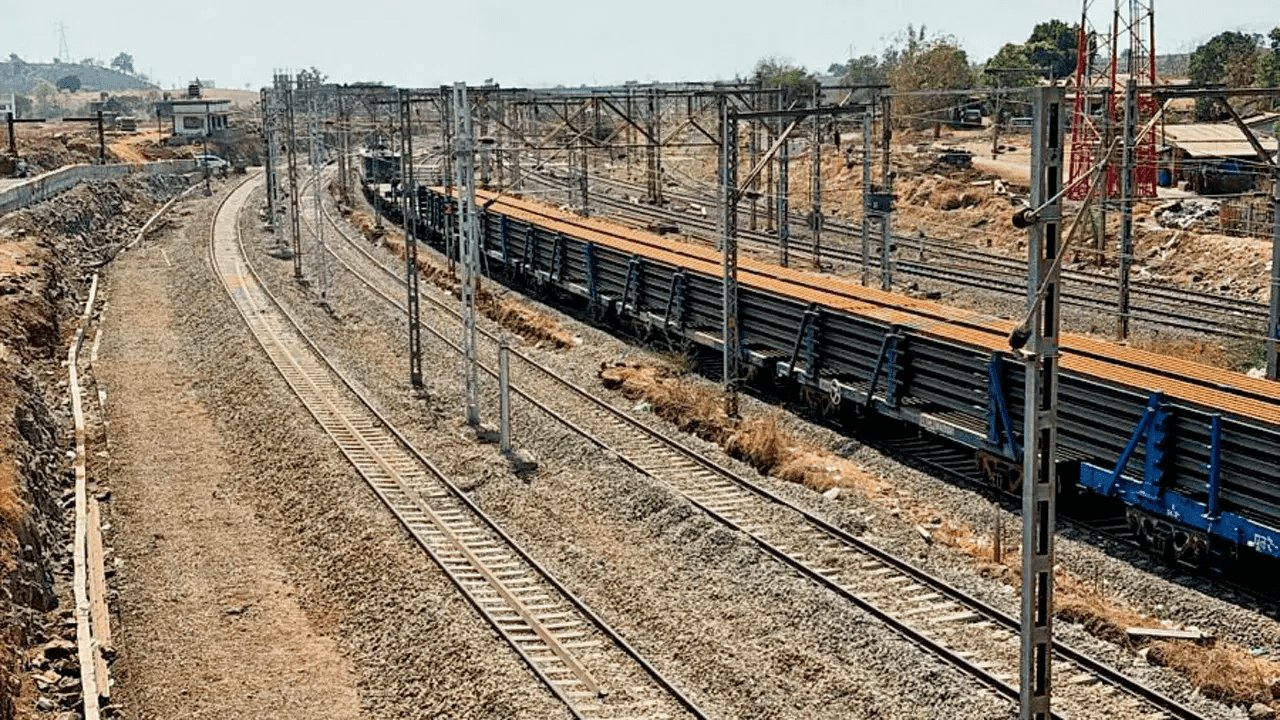
A major rail capacity upgrade is underway on Mumbai’s Central corridor, with a third track being developed between Kalyan and Kasara to ease congestion and improve operational efficiency on one of the region’s most critical suburban routes. The investment, estimated at nearly ₹800 crore, signals a renewed push to modernise high-density rail infrastructure as commuter demand continues to surge. The 67-km alignment forms a crucial link connecting the extended suburban network with long-distance and freight corridors heading towards northern Maharashtra and beyond. At present, multiple train categories operate on shared tracks, often leading to cascading delays, scheduling conflicts and overcrowded services during peak hours. The additional line is expected to help segregate traffic flows, a move that transport planners say is essential for improving reliability.
A portion of the corridor is already approaching completion, with construction progressing in phases. Officials indicate that the project is being designed to support a higher frequency of suburban services while also reducing interference from nMost Usedon-suburban operations. For daily commuters travelling through this belt, especially those dependent on rail connectivity from peripheral towns, this could translate into shorter waiting times and more predictable journeys. Urban mobility experts highlight that Mumbai’s suburban rail system remains one of the most energy-efficient mass transit modes in the country, but it faces immense pressure due to population growth and spatial expansion. Enhancing track capacity, rather than only adding new services, is seen as a practical step towards improving throughput without significantly increasing operational complexity. The Kalyan–Kasara upgrade also fits into a broader programme of rail infrastructure expansion under long-term transport planning frameworks. Proposals for an additional fourth line on the same stretch and parallel investments under regional mobility programmes indicate a layered approach to capacity building.
Such measures aim to future-proof the network against rising commuter volumes while supporting regional economic integration. From a sustainability perspective, improving suburban rail infrastructure has wider implications. Efficient rail systems can reduce reliance on road-based transport, lowering emissions and easing pressure on urban road networks. For rapidly urbanising regions like the Mumbai Metropolitan Region, strengthening public transport corridors is critical to achieving more balanced and climate-resilient mobility patterns. However, challenges remain around timely execution, land constraints and coordination between multiple agencies. Infrastructure specialists note that while capacity expansion projects are essential, they must be complemented by station upgrades, last-mile connectivity and integrated planning to deliver meaningful improvements for passengers.
As work progresses, the success of the Mumbai Kalyan Kasara third line will likely be measured not just by added track length, but by its ability to transform daily commuting conditions. For millions relying on the suburban network, the promise of a less congested, more dependable rail system remains central to the city’s long-term mobility vision.