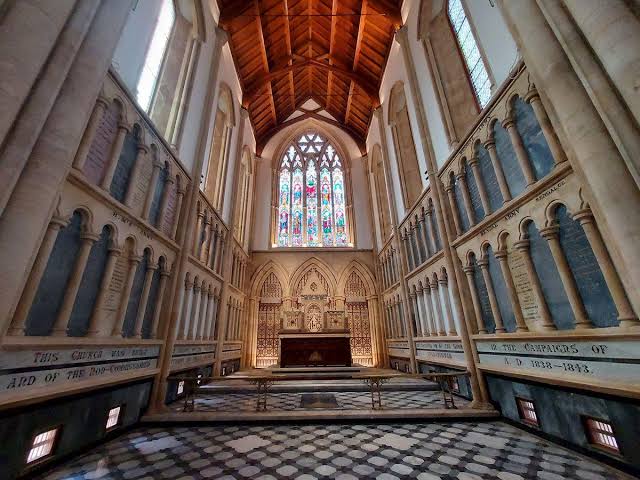
Mumbai’s Afghan Church in Colaba will host an immersive projection-mapping installation from August 27 to 29, bringing digital art into one of the city’s historic religious landmarks. The three-evening programme will use projected light and celestial imagery across the church’s Gothic interiors, creating a public experience that also raises a larger urban question: how can technology help residents engage with heritage without compromising the character of protected buildings? The installation, titled ASCENSION, is scheduled between 7pm and 10pm during the Mumbai Light Festival. Visitors will experience changing visual compositions across architectural elements including arches and stained glass, with the building remaining central to the presentation rather than functioning simply as an event venue.
For Mumbai, the event is notable because heritage buildings often compete for public attention with newer commercial and cultural destinations. Turning an existing landmark into a temporary cultural space can create another way for residents to experience the historic city, particularly in neighbourhoods where architectural heritage is surrounded by intense redevelopment and rising land values. The Afghan Church projection mapping also illustrates how cultural programming is increasingly intersecting with urban placemaking. Instead of constructing a new attraction, the installation uses an existing building and its architectural qualities as the setting for a contemporary experience. Urban planners say such interventions can strengthen public engagement with older neighbourhoods when they are carefully designed around the physical and cultural constraints of heritage structures.
That balance is particularly important for a Grade I heritage building. Projection equipment, visitor movement, temporary installations and increased footfall must be managed without causing physical damage or disrupting the building’s functioning. The organisers have said the visual treatment was developed around the church’s architectural features, with the intention of complementing rather than obscuring them. There is also a sustainability dimension to the approach. Reusing an existing urban asset for cultural activity can reduce the need for new event infrastructure, although the overall environmental impact will still depend on equipment efficiency, electricity consumption, crowd management and temporary installation practices. The Afghan Church projection mapping therefore represents more than a visual event. It offers Mumbai an example of how heritage, technology and public culture can intersect without requiring another permanent structure. The longer-term value will depend on whether such initiatives encourage sustained interest in conservation and make historic spaces more accessible to the wider public.
As the three-day programme approaches, attention will remain on how effectively the event balances spectacle with stewardship. For a city undergoing rapid redevelopment, that balance is increasingly central to keeping its historic identity visible within the modern urban landscape.