


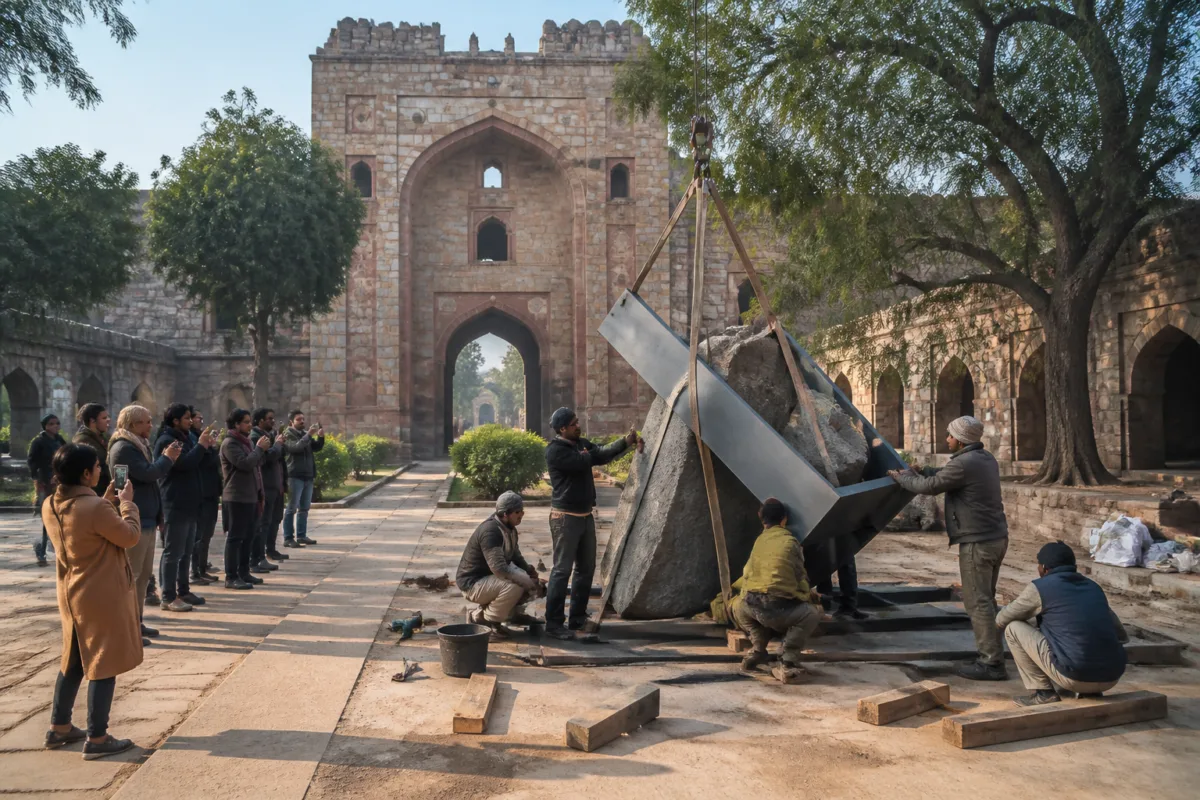
The second edition of the India Biennale will open in Delhi on December 4, bringing contemporary art, architecture, design and cultural exchange to historic monuments, museums, galleries, gardens, public spaces and cultural institutions across the capital. Organised by the Ministry of Culture, the programme will run for 108 days and conclude on March 21.
Centred on Purana Qila, the biennale will extend to the Red Fort, Qutub Minar, Humayun’s Tomb, Safdarjung Tomb, Lodhi Garden, Mehrauli, the National Gallery of Modern Art, the National Museum and Lalit Kala Akademi. The ministry said the programme would create a dialogue between Delhi’s architectural and historical legacy and contemporary creative practices.
The curatorial theme for the 2026 edition is “Tat Tvam Asi (You Are That) – Reconnecting in an Age of Distraction”. Artists, architects and designers have been invited to create works across multiple mediums, including handmade and digital practices, traditional craft and immersive new media. The ministry said the installations were intended to encourage visitors to slow down, engage with the city and encounter creative work in different urban settings.
The biennale builds on the inaugural India Art, Architecture and Design Biennale held in 2023 and the India Pavilion’s participation in the 61st Venice Art Biennale in 2026. Presentations will involve institutions including Bihar Museum, Kiran Nadar Museum of Art, Nita Mukesh Ambani Cultural Centre, Serendipity Arts, Devi Art Foundation, Gujral Foundation, Abheraj Baldota Foundation, DRONAH Foundation and the Public Arts Trust of India.
Among the announced presentations are DAG’s “Anant: A Rare 18th Century Mahabharata Scroll”, Devi Art Foundation’s “The Infinite Circle” and Gujral Foundation’s “A Woven Line of Control” at Purana Qila, along with “The Eternal Fold” at Lodhi Garden. NMACC will present “Kingdom of Earth”, while Bihar Museum will showcase “The Sacred Waters: Chhath Puja and Pind Daan” at Purana Qila. Serendipity Arts will present “The Charpai Project” and the “Hakchang-Polang” performance at the fort complex.
Several projects will directly engage with Delhi’s urban and architectural heritage. The Cultural Resource Conservation Initiative’s “Shehr Mehrauli: Where Memory Meets Water” will extend across the Mehrauli Archaeological Park and adjoining historic precincts. DRONAH Foundation, in association with the National Institute of Urban Affairs and the Indira Gandhi National Centre for the Arts, will present “Our Cities Speak” at sites including Qutub Minar, Mehrauli, Feroz Shah Kotla and India Habitat Centre.
At Qutub Minar, artist Paresh Maity and designer Ritu Beri will present “Varanasi the Timeless”, placing their interpretations of Varanasi in dialogue with one of Delhi’s most significant monuments. The ministry said the wider programme would bring art, architecture, design, craft, material culture and cultural memory into a shared public arena.
The Ministry of Culture will also introduce the India Biennale Pass, described as an integrated access system covering participating monuments, museums and cultural institutions across Delhi. The ministry said the pass would connect the different venues through a common visitor framework. Further operational details, including access arrangements for individual venues, were not specified in the announcement.
Culture Minister Gajendra Singh Shekhawat described the biennale as an expression of India’s cultural diversity and creative communities, and invited artists, architects, designers and visitors from India and abroad to participate. The programme is scheduled to begin at Purana Qila on December 4 and continue across Delhi’s heritage and cultural network until March 21.

