


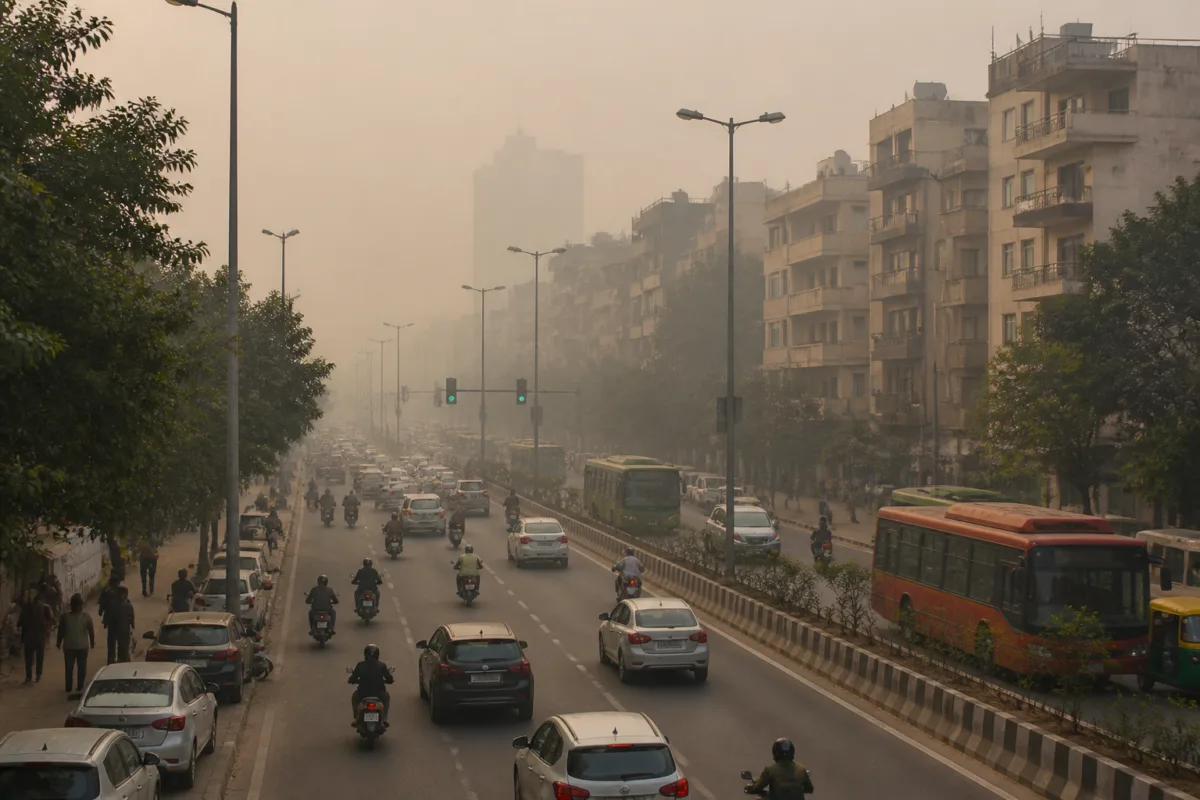
Delhi recorded an overall Air Quality Index (AQI) of 249 at 8 am on Monday, placing the national capital in the ‘poor’ category, while Punjabi Bagh recorded the highest reading among the listed monitoring stations at 282, according to the Central Pollution Control Board (CPCB).
Bawana recorded an AQI of 273 and Chandni Chowk 271, with both stations also in the ‘poor’ category. Other stations reporting poor air quality included Anand Vihar at 237, Ashok Vihar at 240, Narela at 239, Okhla Phase 2 at 213, Rohini at 252, Sonia Vihar at 215, Patparganj at 208, Mandir Marg at 225, Major Dhyan Chand Stadium at 202, Alipur at 246, IGI Airport Terminal 3 at 217 and RK Puram at 252.
Vasundhara Enclave recorded a relatively better AQI of 170, which falls within the ‘moderate’ category under the CPCB classification. An AQI of 201 to 300 is classified as poor, while 101 to 200 is considered moderate.
The immediate conditions are likely to remain challenging for morning commuters and residents. The India Meteorological Department (IMD) has forecast mainly clear skies across Delhi-NCR over the next five days, with mist and shallow fog likely on November 23 and 24. Its district-wise forecast, issued by the Regional Meteorological Centre in New Delhi on November 22, indicated similar conditions across Delhi’s North, South, East, West, Central and New Delhi districts, as well as Noida, Ghaziabad, Gurugram and Faridabad.
The IMD has forecast mist and shallow fog at many places across the region on November 25 and 26. Moderate fog is likely at isolated places on November 25 and at a few places on November 26 during the morning. The forecast points to the possibility of more widespread fog and reduced visibility during the latter part of the five-day period, although it does not quantify the resulting effect on pollution levels or transport operations.
The AQI readings coincide with wider concerns over the implementation of pollution-control measures in the national capital region. The Commission for Air Quality Management (CAQM) has begun assessing and ranking Delhi and neighbouring states on their performance under the State Action Plan-2026. Its report card, covering progress up to October, identified gaps in industrial inspections, waste management, public transport and pollution-monitoring infrastructure.
One of the clearest shortfalls was in the planned development of green crematoriums. Against a combined target of 421 facilities across Delhi, Haryana, Rajasthan and Uttar Pradesh, the achievement was zero as of October 31, according to the report card.
Industrial inspections also remained below the combined target. Delhi, Haryana, Rajasthan and Uttar Pradesh had a combined annual target of 11,607 inspections, but 2,584 had been completed by October 31, leaving a gap of 9,023. Delhi exceeded its own target, conducting 1,609 inspections against a target of 979. Haryana completed 177 of its 3,865 targeted inspections, Rajasthan 68 of 2,974 and Uttar Pradesh 730 of 3,789.
CAQM classifies performance of 100 per cent as satisfactory, achievement between 75 per cent and less than 100 per cent as needing improvement, and progress below 75 per cent as unsatisfactory. The report card is not the final annual assessment. CAQM is scheduled to release its final report card in January 2027, allowing the governments concerned to improve implementation during the remaining period of the year.
For residents, the figures connect daily exposure to a broader implementation problem. Monitoring stations continue to show poor air quality across several parts of Delhi, while the regional action plan records uneven progress on inspections and pollution-control infrastructure. The available assessment therefore presents both an immediate air-quality concern and a measurable governance challenge for Delhi-NCR.

