


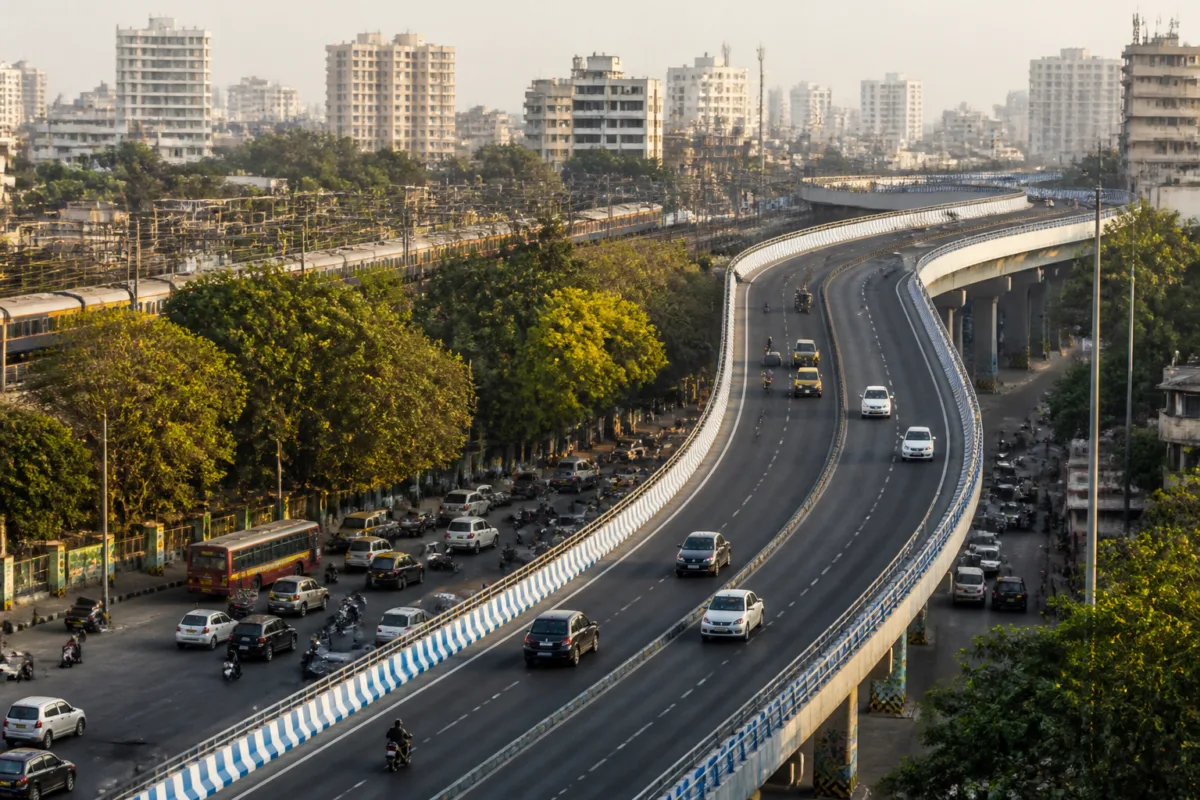
Mumbai’s traffic network received three new links on Thursday after Maharashtra Chief Minister Devendra Fadnavis inaugurated the Sion Railway Overbridge, the Vidyavihar Railway Overbridge and a flyover on the Goregaon-Mulund Link Road. The projects are intended to improve east-west connectivity and reduce pressure on some of the city’s heavily used routes.
Deputy Chief Ministers Eknath Shinde and Sunetra Pawar joined the inauguration virtually, while Brihanmumbai Municipal Corporation Commissioner Ashwini Bhide was present. The projects are part of the state’s wider effort to create an integrated connectivity network across the Mumbai Metropolitan Region, linking north-south and east-west travel corridors.
The Vidyavihar Railway Overbridge is expected to produce the clearest immediate reduction in travel time. According to the report, the bridge connects Ramchandra Chemburkar Marg on the eastern side of Vidyavihar railway station with Lal Bahadur Shastri Marg on the western side. The journey, which previously took about 30 minutes, can now be completed in around 10 minutes.
The new connection is also expected to reduce traffic pressure on the flyover near Ghatkopar station. The project addresses a longstanding problem created by the railway tracks, which separated the eastern and western sides of Vidyavihar and forced road users to rely on longer or more congested routes.
The reconstructed Sion Railway Overbridge connects roads towards Dharavi and Bandra with the Eastern Express Highway. Its role is to improve movement between local roads and one of Mumbai’s key north-south arterial roads. The bridge is among the city’s important railway-crossing projects, where road traffic must share limited crossing points with rail infrastructure.
The third project is the Goregaon-Mulund Link Road flyover in Goregaon East. It runs between Dindoshi Court and Dadasaheb Phalke Chitranagari, commonly known as Film City. The flyover is intended to ease traffic pressure in the western suburbs and strengthen the east-west connection towards Mulund.
Fadnavis said the projects were strategically important for Mumbai’s mobility network. He said the government was working towards a continuous connectivity system across the metropolitan region and linked the infrastructure programme to a broader vision of enabling travel across Mumbai in 59 minutes once ongoing infrastructure works are completed.
The three openings do not represent a single corridor but address different bottlenecks: railway crossings at Sion and Vidyavihar, and traffic movement along the Goregaon-Mulund route. Their operational effect will therefore depend on how traffic is distributed across connecting roads and junctions after the facilities open.
The inauguration places the next focus on the use of the new links and the completion of other infrastructure works included in the 59-minute travel-time vision. The state government and civic authorities are expected to integrate the projects into Mumbai’s wider road and metropolitan connectivity network.

