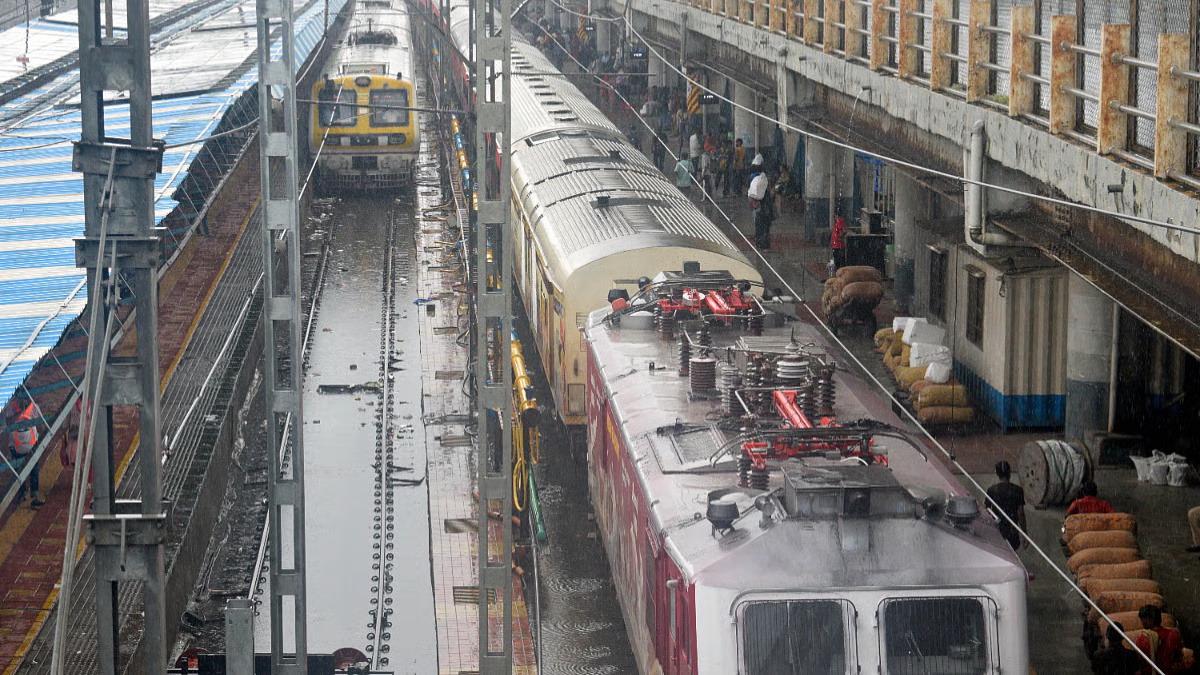
Rail operations on Mumbai’s Central Railway corridor were severely disrupted after ongoing drain widening work between Bhandup and Nahur led to water accumulation on suburban tracks, exposing long-standing weaknesses in the city’s fragmented drainage and transport infrastructure systems. Train movement on one of Mumbai’s busiest commuter corridors slowed for several hours after waterlogging affected both suburban and long-distance services. Railway officials confirmed that dozens of suburban local trains and multiple mail and express services were delayed or impacted as floodwater accumulated near low-lying rail sections.
The disruption occurred during civic work aimed at expanding a major stormwater drain corridor connecting eastern suburban catchments to the Airoli creek and Arabian Sea. Urban infrastructure experts said temporary narrowing of water channels during construction likely reduced drainage flow capacity, resulting in rapid water build-up near the railway alignment. The affected drainage corridor lies in a highly urbanised zone where multiple stormwater channels pass beneath railway tracks and adjoining road infrastructure. Experts familiar with the area noted that several drains carrying substantial rainwater volumes become constricted at crossing points beneath roads and rail lines, creating recurring flood vulnerabilities during periods of heavy rainfall or construction activity. The Mumbai rail flooding incident has once again raised concerns around coordination gaps between transport agencies and civic infrastructure departments. Urban planners argue that large-scale drainage interventions in dense metropolitan zones require integrated execution strategies that account for hydrology, rail operations, traffic management and ecological flow systems simultaneously. The Bhandup-Nahur stretch has experienced similar flooding episodes in recent years, particularly during the monsoon season. Following earlier incidents, authorities had reportedly initiated joint reviews involving railway and municipal officials, though infrastructure observers say long-term corrective action has remained slow.
Field inspections around the site revealed extensive construction activity, debris accumulation and temporary diversions surrounding the drain expansion project. Water pumping systems deployed by railway authorities reportedly struggled to manage the inflow as surrounding drainage channels remained saturated. Urban resilience specialists warn that infrastructure bottlenecks in flood-prone transport corridors could become more frequent as climate variability intensifies across coastal cities such as Mumbai. Increasing rainfall intensity combined with constrained urban waterways places additional stress on ageing drainage systems already impacted by encroachment, construction pressure and fragmented planning. The incident also underscores the vulnerability of Mumbai’s suburban railway network, which serves as the primary mobility lifeline for millions of daily commuters. Even short disruptions on key corridors can trigger cascading delays, overcrowding and economic losses across the metropolitan region. Environmental planners further point to the ecological significance of the Airoli creek and adjoining mangrove systems, which function as natural flood buffers for eastern Mumbai. Reduced drainage efficiency or poorly managed construction activity near these channels can affect broader urban water movement patterns.
Urban transport analysts say future infrastructure projects in Mumbai will require stronger climate-sensitive engineering standards and coordinated planning frameworks that integrate drainage resilience with transport continuity. As the city expands critical infrastructure networks, balancing construction activity with uninterrupted mobility and ecological stability is expected to become a defining challenge for metropolitan governance.