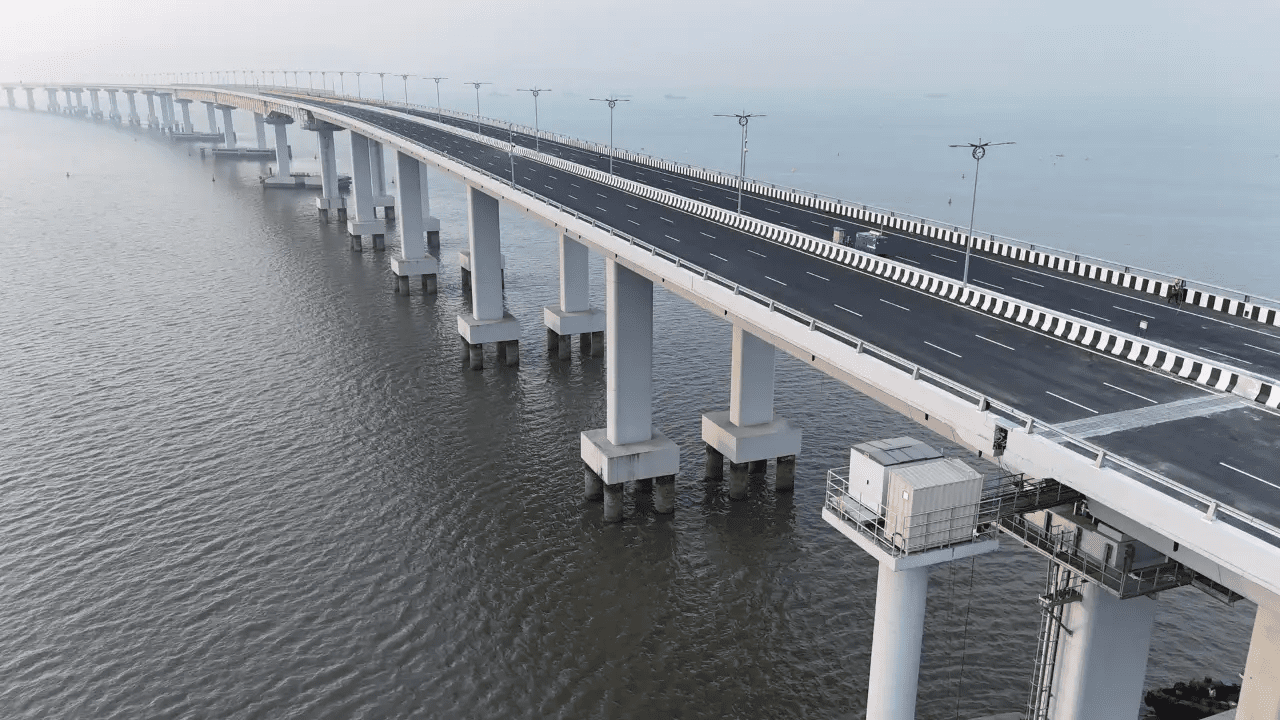
Construction of a critical road link connecting the Mumbai Trans Harbour corridor to the Mumbai–Pune Expressway is gathering momentum, with authorities reporting steady progress across multiple engineering stages. The project, targeted for completion by early 2027, is expected to significantly improve regional mobility and strengthen connectivity between emerging urban nodes in Navi Mumbai and the wider metropolitan region. The elevated corridor, stretching over seven kilometres, is designed to provide a direct route between the Atal Setu landing point and the expressway network near Panvel. Infrastructure officials indicate that foundational work is nearing completion at most designated sites, while a substantial portion of structural components—including piers and precast girders—has already been installed. This phased progress reflects a coordinated push to meet construction timelines amid growing transport demand in the Mumbai Metropolitan Region.
The Atal Setu connector is being developed as a high-capacity, six-lane link intended to reduce travel time and ease congestion on existing arterial roads. Urban planners note that the corridor will play a pivotal role in redistributing traffic flows, particularly as new economic zones and residential developments expand across Navi Mumbai. With the upcoming international airport located in proximity to the alignment, the connector is expected to serve as a key access route for both passengers and freight movement. Parallel improvements are also being undertaken at ground level to support the elevated structure. Road widening and service lane enhancements near Palaspe aim to streamline entry and exit points, reducing bottlenecks that often arise at junctions with mixed traffic patterns. Experts suggest that such integrated planning—combining elevated corridors with surface-level upgrades—is essential for maintaining traffic efficiency in rapidly urbanising areas.
From a broader perspective, the Atal Setu connector highlights the increasing focus on multimodal connectivity within India’s urban infrastructure strategy. By linking major highways, ports, and airport infrastructure, the project is positioned to enhance logistics efficiency and support economic activity across the region. Improved connectivity is also likely to influence real estate dynamics, with areas along the corridor witnessing increased interest from developers and investors. However, infrastructure expansion of this scale also raises questions around sustainability and land use. Urban development specialists emphasise the importance of balancing mobility improvements with environmental considerations, including minimising construction-related emissions and preserving local ecosystems. Incorporating green construction practices and ensuring efficient traffic management post-completion will be critical to achieving long-term benefits.
As work progresses towards its 2027 deadline, the project represents both an opportunity and a test for urban infrastructure delivery. Its success will depend not only on timely completion but also on how effectively it integrates with existing transport systems and supports inclusive, resilient urban growth across the Mumbai metropolitan landscape.