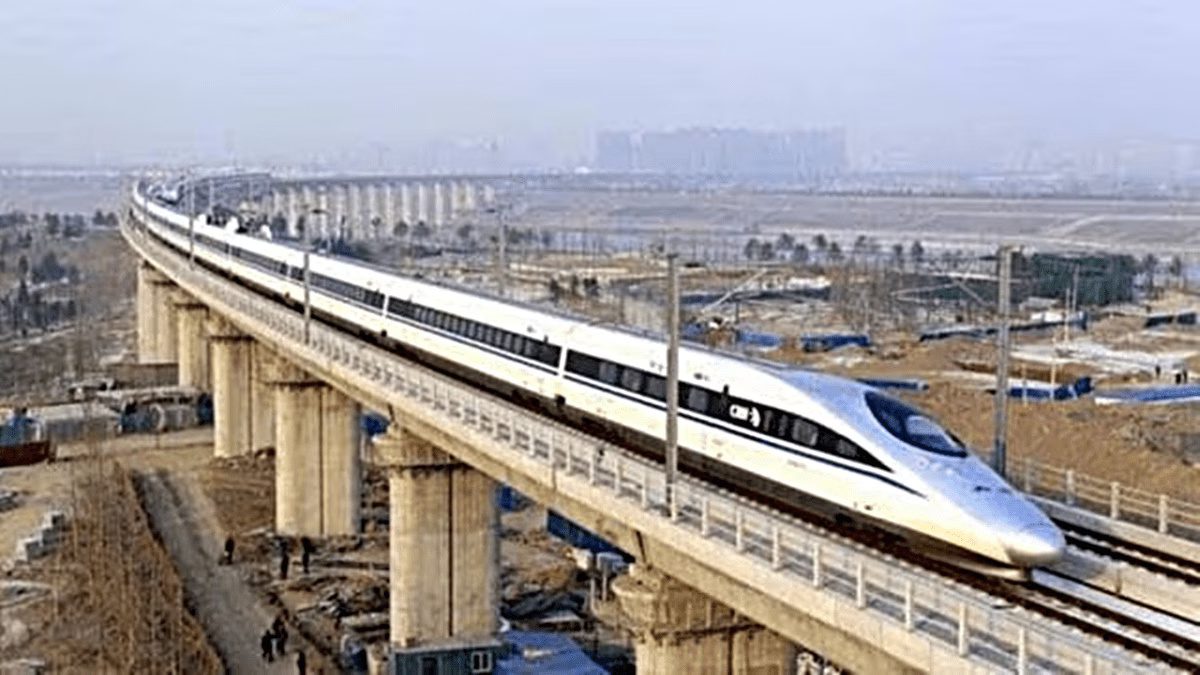
Hyderabad bullet train plan promises faster regional travel
Construction of India’s first high-speed rail corridor is entering a critical phase, with track installation gathering pace along the Mumbai–Ahmedabad route. The adoption of a ballastless slab track system—commonly used in Japan’s high-speed rail network—marks a significant technological shift in how rail infrastructure is being built in the country. The corridor, which links major economic centres across Maharashtra and Gujarat, is designed for trains operating at speeds of up to 320 kmph. Unlike conventional rail tracks that rely on crushed stone ballast, the slab-based system uses reinforced concrete foundations to deliver greater stability, lower maintenance requirements, and improved ride quality. For dense urban regions where reliability and safety are essential, this approach is expected to set new benchmarks in rail engineering.
Project authorities indicate that track bed construction has progressed across a substantial portion of the alignment, while manufacturing of pre-cast slabs is underway at dedicated facilities in Gujarat. These slabs are produced with tight tolerances to ensure uniformity, then transported to installation sites using specialised logistics systems. Such precision-led construction reflects a broader shift towards industrialised infrastructure delivery, where on-site variability is minimised. The execution process is highly mechanised, relying on advanced equipment to assemble long welded rail panels and position track slabs on elevated viaducts. This reduces manual intervention and enhances consistency across long distances. Industry observers note that the integration of global technology with domestic manufacturing capabilities could have wider implications for India’s infrastructure sector, particularly in scaling up high-quality construction practices. Beyond engineering, the project carries broader economic and environmental implications.
Faster intercity travel has the potential to reshape commuting patterns, reduce dependence on short-haul aviation, and lower per capita emissions over time. Urban planners suggest that high-speed rail corridors can also encourage more balanced regional development by connecting secondary cities to major economic hubs, easing pressure on megacities like Mumbai. However, the scale and cost of such projects continue to invite scrutiny. Questions around affordability, land acquisition, and long-term ridership demand remain central to the debate. Experts argue that the success of high-speed rail in India will depend not only on speed but also on integration with existing transport networks, last-mile connectivity, and pricing strategies that ensure accessibility. The ongoing construction phase highlights both the ambition and complexity of introducing next-generation rail systems in a developing urban landscape. As work progresses, attention is likely to shift towards operational readiness, safety certification, and network integration.
If executed as planned, the Mumbai–Ahmedabad high-speed rail line could redefine intercity mobility in India, offering a faster and potentially more sustainable alternative to current modes of travel. The coming years will determine whether this model can be expanded to other corridors, shaping the future of transport infrastructure across the country.