


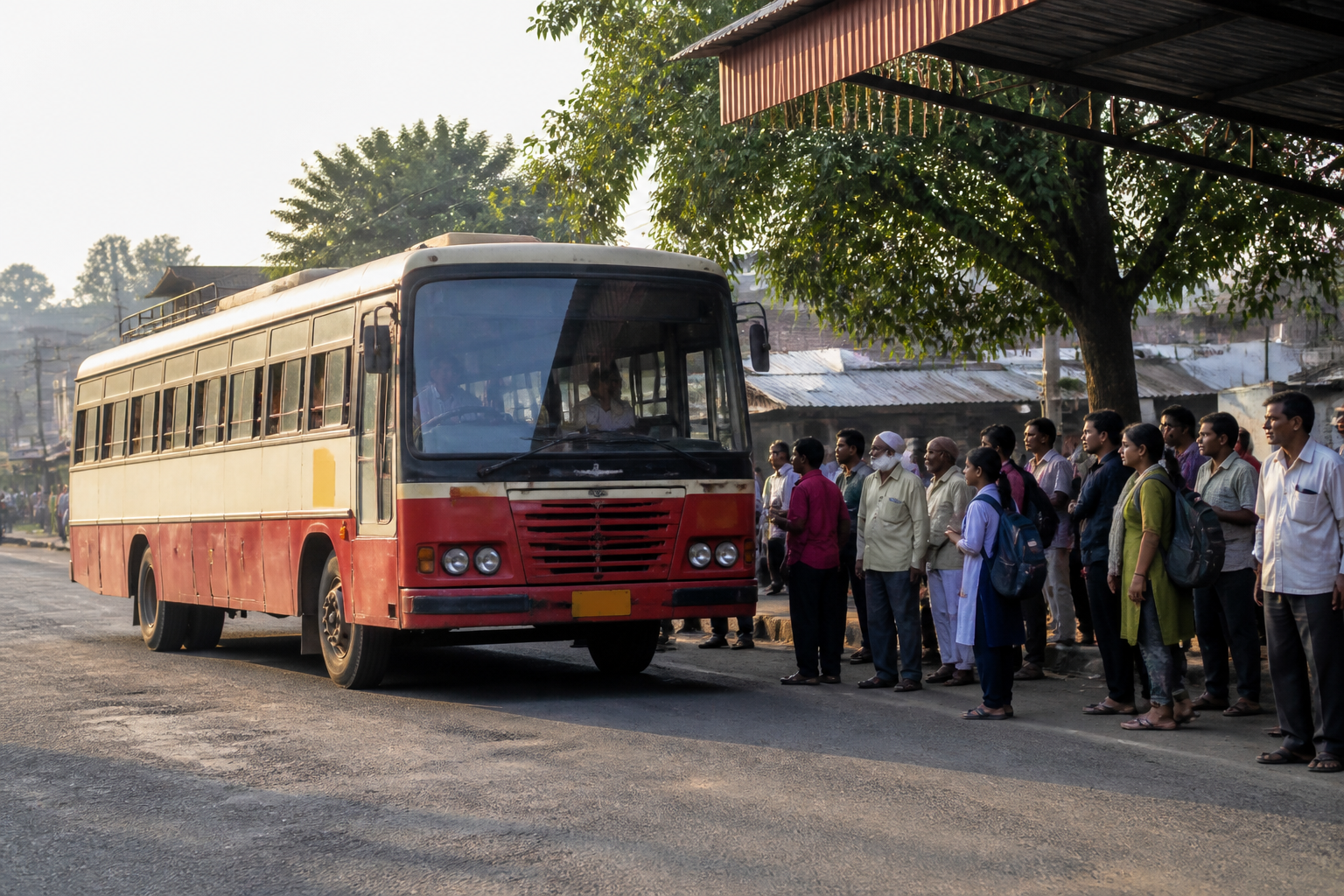
Subheadline: Maharashtra’s state bus operator increased August revenue by Rs 66 crore after depots began adjusting services to passenger demand, but the financial gains will depend on whether the model can be sustained.
Standfirst: Maharashtra State Road Transport Corporation’s August revenue performance offers a focused example of how a public bus operator can attempt to align its network with actual passenger movement. The corporation reported a Rs 66 crore increase over July, a record daily collection of Rs 45 crore on August 31 and monthly revenue above Rs 1,000 crore for the first time. The immediate change was operational: depots were asked to revise schedules and add services where passenger numbers were higher, including routes used by commuters, farmers, students, women and senior citizens. The larger question is whether demand-based planning can improve MSRTC’s finances without weakening the public-service role of a network that serves local and regional travel across Maharashtra.
The Maharashtra State Road Transport Corporation’s August revenue increase was presented as evidence that bus services can become more financially effective when they are planned around passenger demand rather than the number of services operated. According to the corporation, revenue rose by Rs 66 crore compared with July after depots began revising schedules and routes. Monthly revenue crossed Rs 1,000 crore for the first time, while daily ticket sales reached a record Rs 45 crore on August 31.
The figures followed review meetings and directions from Maharashtra Transport Minister and MSRTC Chairman Pratap Sarnaik, who has been pressing the corporation to improve revenue and reduce operating losses. Sarnaik attributed the improvement to changes intended to place buses where passengers are more likely to use them. The corporation’s account therefore describes August not simply as a strong revenue month, but as an early test of a different approach to transport planning.
That approach begins with the travel profile of MSRTC’s passengers. The corporation said more than 85 per cent of its passengers travel less than 100 km. This makes local and regional services central to the network, even though the corporation said that greater emphasis had previously been placed on long-distance routes. Some of those routes did not consistently generate enough passenger traffic to cover their operating costs, according to MSRTC.
The distinction matters because a bus network is not only a collection of vehicles and routes. It is also a system of decisions about frequency, timing and the locations where public transport capacity is placed. When services are scheduled without sufficient regard to passenger numbers, buses may continue to operate with relatively low occupancy while demand elsewhere remains concentrated at particular times or on particular days. MSRTC’s August changes sought to address that mismatch by using route-level passenger numbers and travel patterns as a basis for adjusting services.
The operational changes were assigned to individual depots. Each depot is responsible for providing services to the population in its area, and depots were asked to focus more closely on local travel demand. The revised schedules included services for daily commuters, farmers, women, students and senior citizens, particularly in rural and semi-urban areas. Additional buses were also to be introduced on routes that experience higher movement during weekly markets, fairs and other occasions that attract larger crowds.
This is a narrower and more localised model than one based primarily on maintaining long-distance connectivity. It does not mean that long-distance routes disappear from the system. Rather, the reported shift places greater emphasis on where passenger movement is recurring, concentrated or linked to everyday activities. Weekly markets and fairs, for example, create travel patterns that may not be visible if schedules are assessed only through a uniform daily timetable.
The August figures also coincided with increased travel during the Raksha Bandhan period. On August 31, MSRTC recorded ticket sales of Rs 45 crore, its highest daily collection since the corporation was established. The corporation said its average daily revenue was then around Rs 34 crore to Rs 35 crore, putting the August 31 collection about Rs 10 crore above the usual daily level.
The record day is important, but it should not be treated as proof that the operational changes alone produced the entire increase. The report explicitly links the period to higher travel during Raksha Bandhan, while also attributing part of the collection to the deployment of buses on routes where demand was higher. The available information therefore establishes a combination of seasonal travel and revised service allocation, rather than isolating the precise contribution of each factor.
The more significant indicator is the monthly result. MSRTC said revenue exceeded Rs 1,000 crore in August, crossing that threshold for the first time. Compared with the July figure, the reported increase was Rs 66 crore. A monthly measure provides a broader basis for assessing operations than a single high-collection day, although one month is still insufficient to establish whether the improvement represents a durable change in the corporation’s financial position.
MSRTC’s own assessment reflects that uncertainty. The corporation said continued revenue growth could help it cover current operating losses within two to three months, but it also acknowledged that this would depend on whether higher collections could be sustained. That qualification is central to interpreting the announcement. A rise in revenue improves the immediate position, but it does not by itself demonstrate that the corporation has resolved the structural relationship between fares, passenger demand, route costs and service obligations.
The public-service role makes that relationship especially complex. MSRTC serves passengers across rural and semi-urban areas, where bus access may be essential for work, education, health-related travel and access to markets. A route with limited financial returns may still provide an important connection for residents who have few alternatives. Demand-based planning can help direct additional services to busy routes, but the available material does not establish how MSRTC will assess routes that are socially necessary but financially weak.
That question is implicit in the corporation’s stated shift away from unproductive services and towards routes with stronger passenger movement. If the objective is to reduce operating losses, route performance becomes a key consideration. If the objective is also to maintain broad public access, route decisions must account for more than ticket revenue. The source material does not specify whether MSRTC has adopted a formal framework for balancing these goals, nor does it provide route-by-route occupancy, cost or service data.
The August changes nevertheless indicate a move towards more granular transport administration. Instead of measuring performance primarily by the number of services operated, the corporation is emphasising the relationship between services and passenger requirements. Sarnaik described matching services to passenger needs, rather than running more services regardless of demand, as the effective formula for improving revenue and moving towards the avoidance of operating losses.
This model also places greater responsibility on depots. Local staff must identify changes in passenger movement, recognise recurring peaks and revise schedules without compromising the reliability of the wider network. The report does not detail the technology, data systems or monitoring procedures being used to make those decisions. It does, however, show that the corporation expects route and depot-level adjustments to become a central part of its response to financial pressure.
The use of local travel patterns is particularly relevant to a network in which more than 85 per cent of passengers reportedly travel less than 100 km. That figure suggests that the financial and operational performance of the corporation is closely tied to short and regional journeys, not only to the visibility of long-distance routes. Services connected to daily commuting, agricultural activity, education and periodic market events may collectively determine whether buses are being used where passenger demand is strongest.
The evidence available from August supports three conclusions. First, MSRTC recorded a substantial improvement in revenue, including a Rs 66 crore month-on-month increase and monthly collections above Rs 1,000 crore. Second, the corporation linked the improvement to schedule and service changes that responded more closely to passenger demand, alongside a period of higher travel. Third, the financial effect remains provisional because the corporation itself has tied the prospect of covering operating losses to the continuation of higher collections.
What remains uncertain is whether the August performance can be repeated outside a period that included Raksha Bandhan travel, whether the changes improved service reliability for passengers, and how the corporation will protect essential links that may not be commercially strong. Those questions will determine whether demand-based planning becomes a sustained operating model or remains a short-term revenue intervention. The next meaningful test will be the performance of the revised schedules over subsequent months, across both ordinary travel periods and recurring local demand peaks.
