


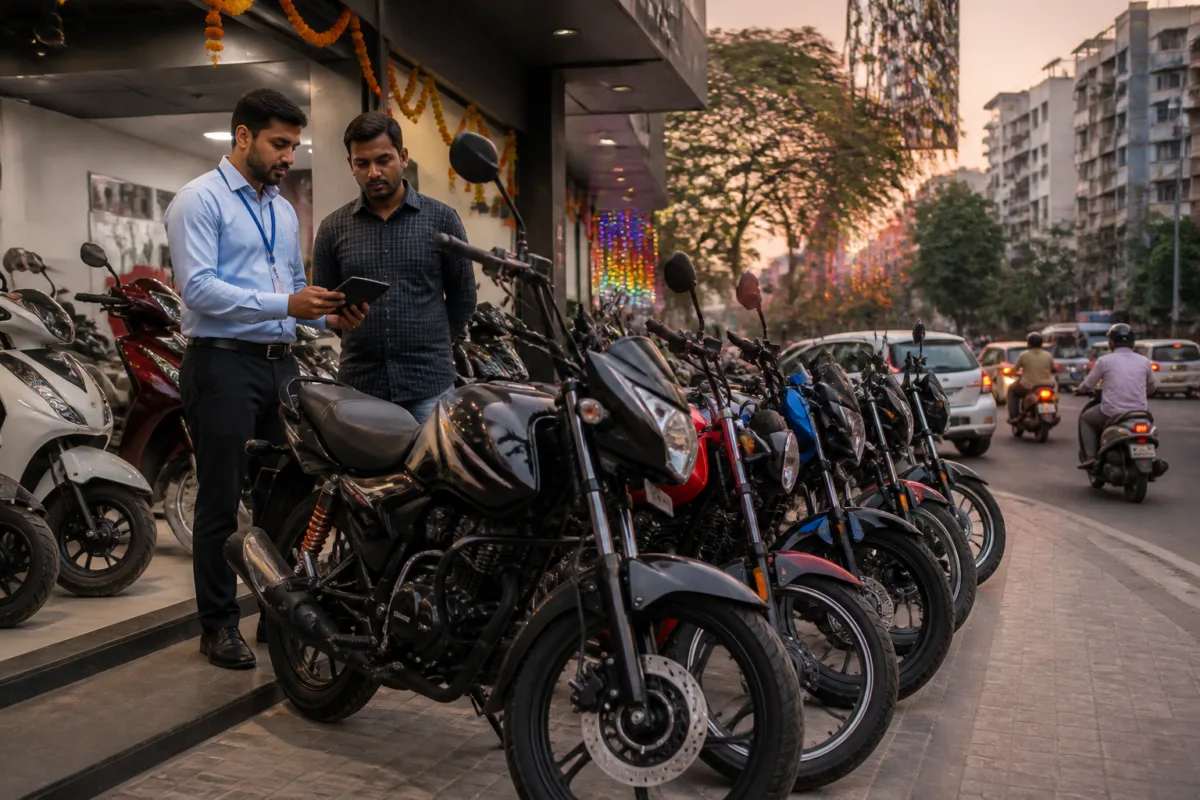
Motorcycle discounts of up to ₹11,000 are being used by India’s leading manufacturers to defend festive demand, but the offers also expose a deeper shift in the economics of everyday urban mobility. After a reduction in goods and services tax briefly lowered the cost of motorcycles, repeated price increases linked to steel, copper and other inputs have partly eroded that benefit. The result is a market where the headline showroom price matters less than the combination of cash incentives, financing terms, monthly instalments and service support.
The contest is most visible in India’s 125–250cc motorcycle segment. TVS Motor is advertising savings of up to ₹11,000 on its Raider, while Hero MotoCorp is offering a cash bonus of up to ₹10,000 on the Xtreme 160R. Bajaj Auto’s benefits range from ₹6,000 to ₹8,900 across several Pulsar models. These are not permanent price reductions. They are time-bound packages designed to make higher-priced motorcycles appear more accessible during the festive buying period.
That distinction matters because the market is no longer operating in a simple cycle of manufacturers raising prices and buyers responding to the final sticker value. Promotional offers now combine cash discounts, processing-fee waivers, free servicing, financing rates and other conditional benefits. For a household assessing a two-wheeler purchase, affordability is therefore increasingly determined at the point of financing rather than only at the showroom.
The TVS Raider illustrates how quickly the underlying price can move. The top-end motorcycle was launched a year earlier at ₹95,600 and now lists at ₹1,03,170, an increase of nearly 8 per cent. The company’s advertised savings could offset more than a year’s price increase for eligible buyers, but the qualification conditions vary by location and financing profile. TVS Credit is separately promoting interest rates starting at 5.99 per cent on eligible models.
Bajaj’s festive structure provides another view of the strategy. Benefits are listed at ₹6,000 for the Pulsar 125, ₹6,200 for the NS125 and ₹7,200 for the Pulsar 150. They rise to ₹7,500 on the N160 and NS160, ₹7,900 on the N250, ₹8,000 on the NS200 and ₹8,900 on the RS200. The packages combine different forms of relief rather than applying one uniform reduction to every buyer.
Hero MotoCorp’s offer follows a similar pattern. The Xtreme 160R carries a listed cash bonus of up to ₹10,000, while the smaller Xtreme 125R has a bonus of up to ₹3,000. Roadside assistance is available on eligible online bookings. Such terms make the purchase proposition more attractive without necessarily changing the manufacturers’ underlying price architecture across their portfolios.
The immediate commercial pressure comes from input costs. Bajaj Auto indicated earlier this year that steel costs had increased by about 15 per cent and copper costs by about 20 per cent. Its April price revisions recovered only around 40 per cent of the additional burden. TVS Motor said its pricing had offset roughly a third of commodity inflation. It raised prices across much of its portfolio in August and revised Raider prices again in October by up to ₹2,600. Hero also implemented increases averaging around ₹2,000 per vehicle.
This sequence reveals the tension at the centre of the market. Manufacturers need to recover higher production costs, but they also need to preserve demand in a price-sensitive segment. Permanent price reductions would directly affect revenue per vehicle and could make it harder to recover input-cost pressure. Temporary incentives offer more flexibility: they can be increased during a competitive or seasonal period and withdrawn after the campaign ends.
For buyers, however, the distinction between a discount and a reversal of a price increase can be difficult to assess. A customer may see a large festive benefit while still paying more than the buyer of the same model did before successive revisions. The advertised saving can therefore improve immediate affordability without restoring the earlier market price. Several current offers expire on October 31, while the underlying price increases remain in place.
The policy backdrop adds another layer. In September 2025, the goods and services tax on motorcycles up to 350cc was reduced from 28 per cent to 18 per cent. The change initially lowered prices by thousands of rupees and created a favourable demand signal for manufacturers and dealers. Subsequent manufacturer-led increases have partly eroded that benefit. The consumer-facing effect is a market in which tax relief and corporate pricing decisions are moving in opposite directions.
The data supplied by the Federation of Automobile Dealers’ Associations shows why manufacturers are trying to sustain momentum. Two-wheeler retail sales rose 33.1 per cent to 17.90 lakh units in September 2026. The increase indicates strong recent retail activity, but it does not establish how much of that growth is permanent, how much reflects the tax change, or how much has been supported by festive promotions. The performance after incentives expire will be important in determining the durability of the current expansion.
The shift is not limited to discounts. Manufacturers are also trying to persuade buyers to move from basic commuter motorcycles to better-equipped models with higher prices. Hero’s top-spec Xtreme 125R offers dual-channel ABS. Selected TVS Raider variants feature connected displays and upgraded braking equipment, while Honda’s SP125 offers RoadSync smartphone connectivity. These features are being used to justify a move towards premium commuters and to improve revenue per vehicle.
That product strategy changes the meaning of affordability. A motorcycle with stronger braking equipment, connectivity or other additional features may offer more capability, but it also raises the initial purchase cost. Buyers must balance the value of those features against down payments, monthly instalments, fuel expenses, servicing and the risk that promotional financing will not be available to every applicant. The final decision is consequently shaped by the total cost of ownership and access to credit, not only by the model’s advertised equipment.
The urban significance is clear even though the offers are presented as a retail and industry story. Motorcycles remain an important mobility option for households that need flexible travel and cannot rely on a single public transport route or schedule. When prices rise, the effect is felt through the cost of accessing work, education, services and household activities. When finance packages reduce the initial burden, they may support purchases, but they can also shift more of the affordability question into future instalments and maintenance costs.
The current market therefore reflects three competing forces: policy-led price relief, manufacturer-led cost recovery and consumer demand for more capable motorcycles. Festive incentives temporarily bring these forces into alignment. Manufacturers can promote demand, dealers can use the season to increase retail activity, and buyers can access benefits that reduce the immediate purchase burden. Yet the offers do not remove the structural pressure created by input costs or guarantee that prices will remain affordable once the campaigns close.
What the evidence confirms is that India’s motorcycle market is using promotional finance and feature upgrades to protect demand while recovering a portion of higher production costs. What remains uncertain is whether buyers will continue moving towards premium commuter motorcycles after the incentives expire. The October 31 deadlines and subsequent retail data will show whether current demand reflects lasting product appeal or temporary affordability created by festive campaigns.

