


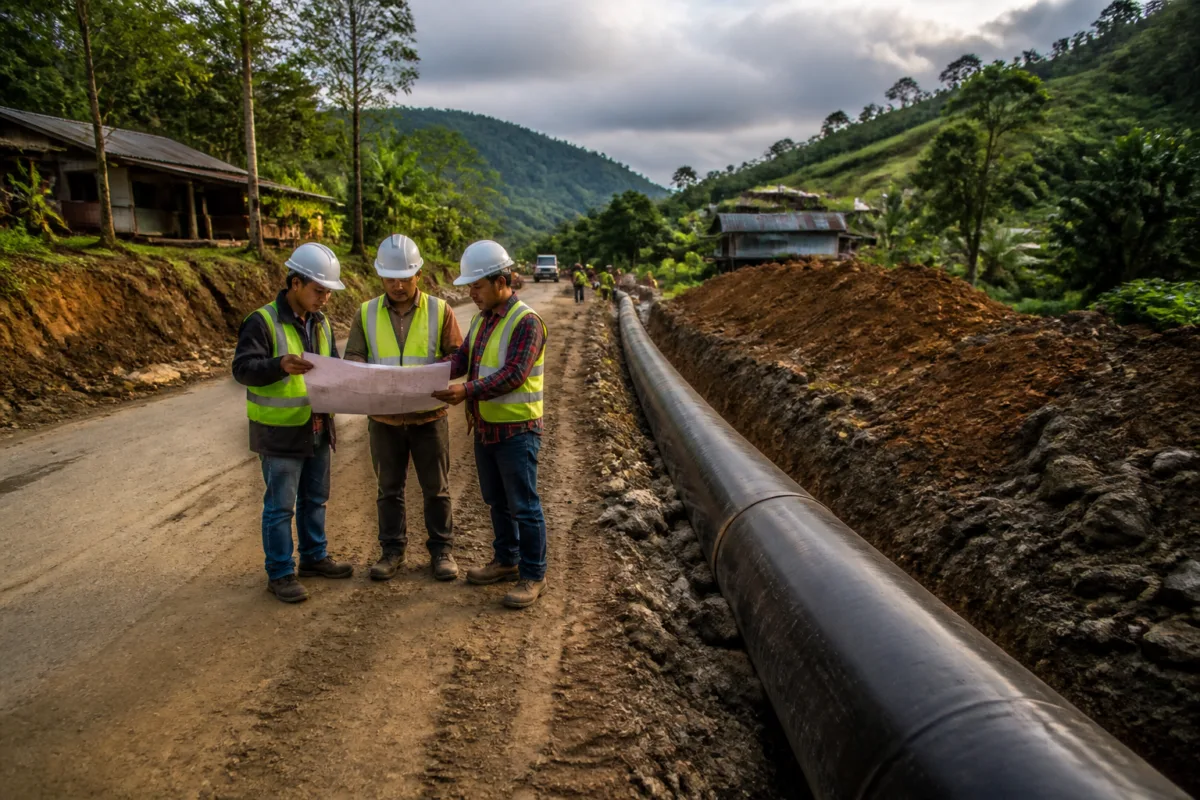
Mizoram’s plan to introduce piped cooking gas in Mamit and Aizawl is more than a household-fuel announcement: it is a test of whether a difficult, inter-state infrastructure project can turn a remote state’s energy supply from a periodic logistics problem into a networked utility. The state government expects the service to reach Mamit town by March-April 2027 and Sihhmui in Aizawl district by March-April 2028.
Food, civil supplies and consumer affairs minister B Lalchhanzova announced the implementation plan after inspecting work on the 119.45-km Panisagar-Aizawl gas pipeline at Tuidam village in Mamit district, near the Tripura border. The pipeline is being built by Indradhanush Gas Grid Ltd (IGGL) under the Northeast Gas Grid project.
The immediate policy objective is to extend piped natural gas to households. The larger infrastructure question is whether Mizoram can secure a more reliable connection to regional energy systems while coordinating land, road and construction work across districts and states. The source material records both the promise of network connectivity and the practical constraints that could determine whether the promise becomes a functioning urban service.
The pipeline will connect the network of Tripura Natural Gas Company Ltd with Aizawl. Of its total length, 15.105 km will pass through six villages in Tripura and 104.345 km through 20 villages in Mizoram. It will use a 12-inch-diameter pipe with a wall thickness of 7.14 mm, supported by six sectionalising valve stations, one dispatch terminal and one receiving terminal.
These technical details matter because the project is not simply a local distribution line inside a city. It is a regional transmission connection that must cross administrative boundaries before reaching Mizoram’s urban centres. The line’s operating infrastructure, including valve stations and terminals, will determine how gas is dispatched, received and managed along the route. The project therefore links household energy access to the reliability of a wider inter-state system.
The pipeline is part of the Northeast Gas Grid project, which aims to build 1,656 km of gas pipelines across several northeastern states at an estimated investment of around Rs 9,265 crore. Mizoram’s connection is consequently one component of a wider effort to create a gas network in a region where terrain, distance and fragmented infrastructure can make energy distribution more complex.
The state minister said global conflicts had disrupted fuel supplies and caused LPG shortages in Mizoram during certain periods. That statement places the pipeline within a broader supply-security concern. LPG reaches households through a cylinder-based distribution chain, while a piped gas network depends on a permanent connection between the consumer and the transmission or distribution system. The two systems have different operating requirements and different points of vulnerability.
A pipeline cannot eliminate every supply risk. Its performance depends on the completion of the route, the availability of gas at the network connection, pressure management, maintenance and the creation of last-mile distribution infrastructure. The supplied information does not establish the proposed household connection model, tariff structure, number of initial consumers or the distribution network required beyond the transmission pipeline. Those details will be important in determining how quickly the infrastructure becomes accessible to residents.
The project also shows why urban utility expansion is often an exercise in coordination rather than construction alone. During the inspection in Mamit, officials identified a 1.5-km stretch where the pipeline route requires widening at several points. IGGL and the Public Works Department discussed the issue on site to ensure that the adjustments do not disrupt existing road repair plans.
This is a familiar infrastructure interface: one agency is laying a buried utility while another is repairing or improving the road above it. If the works are not sequenced properly, newly repaired roads may need to be opened again, raising costs and disrupting access. If the pipeline is delayed to protect road works, the network’s completion schedule may come under pressure. The decision to coordinate the two operations reflects the administrative work required to integrate utilities with public infrastructure.
The minister has urged IGGL to expedite construction and assured residents of the state government’s support. He also stressed coordination between government departments, district administrations and the local public. That emphasis is significant because the route crosses 20 villages in Mizoram, making local administration and public cooperation part of project delivery rather than peripheral concerns.
The planned commissioning dates also reveal a phased approach. Mamit town is expected to receive service in March-April 2027, while Sihhmui in Aizawl is expected to be reached in March-April 2028. The sequencing indicates that the physical completion of the transmission route and the extension of usable service to specific settlements are separate milestones. A pipeline may be laid before connections, terminals, distribution systems and operational arrangements are ready for consumers.
The proposed network could also support a transition beyond cooking fuel. Lalchhanzova said that once Mizoram is connected to the gas grid, the state will be able to use compressed natural gas for vehicles. The supplied report does not specify the number of potential CNG vehicles, fuelling stations or a rollout timetable. However, the possibility expands the project’s significance from a domestic-energy intervention to a potential transport-fuel infrastructure platform.
That potential would depend on infrastructure that is not described in the announcement, including compression facilities, dispensing stations, vehicle conversion or procurement, and a regulatory and commercial framework for supply. The immediate project, as currently presented, remains focused on connecting Mizoram to the gas grid and bringing piped cooking gas first to Mamit and Aizawl. CNG is a stated future use, not an established operational outcome.
The project’s urban relevance lies in the way energy systems shape settlement life. Cooking fuel is a basic household service, but its reliability depends on regional supply chains, storage, roads, administrative coordination and the purchasing system faced by residents. A piped network changes the physical relationship between homes and fuel supply, but it also creates a new utility dependency. Service continuity, billing, maintenance and consumer protection will become important operational questions once household connections begin.
The available information confirms the route, technical specifications, implementing agency, broader project investment and expected service milestones. It does not establish how many households will initially be connected, what consumers will pay, whether all sections of Mamit and Aizawl will be covered, or how supply will be managed during construction and commissioning. These gaps do not undermine the announcement, but they mark the next layer of public accountability for the project.
Mizoram’s piped gas plan therefore represents both an infrastructure opportunity and an implementation test. The 119.45-km pipeline can connect the state to a wider regional energy grid, reduce reliance on a disrupted LPG supply chain and create the basis for future CNG use. Yet the outcome will depend on the less visible parts of delivery: route coordination, road interfaces, village-level administration, terminals, distribution systems and the terms on which households receive service.
The next milestones are the expected arrival of service in Mamit town by March-April 2027 and at Sihhmui in Aizawl district by March-April 2028. Progress on the 1.5-km route section requiring widening, coordination between IGGL and the PWD, and the completion of the pipeline’s terminals and valve stations will indicate whether the regional connection is moving towards an operational urban utility.

