


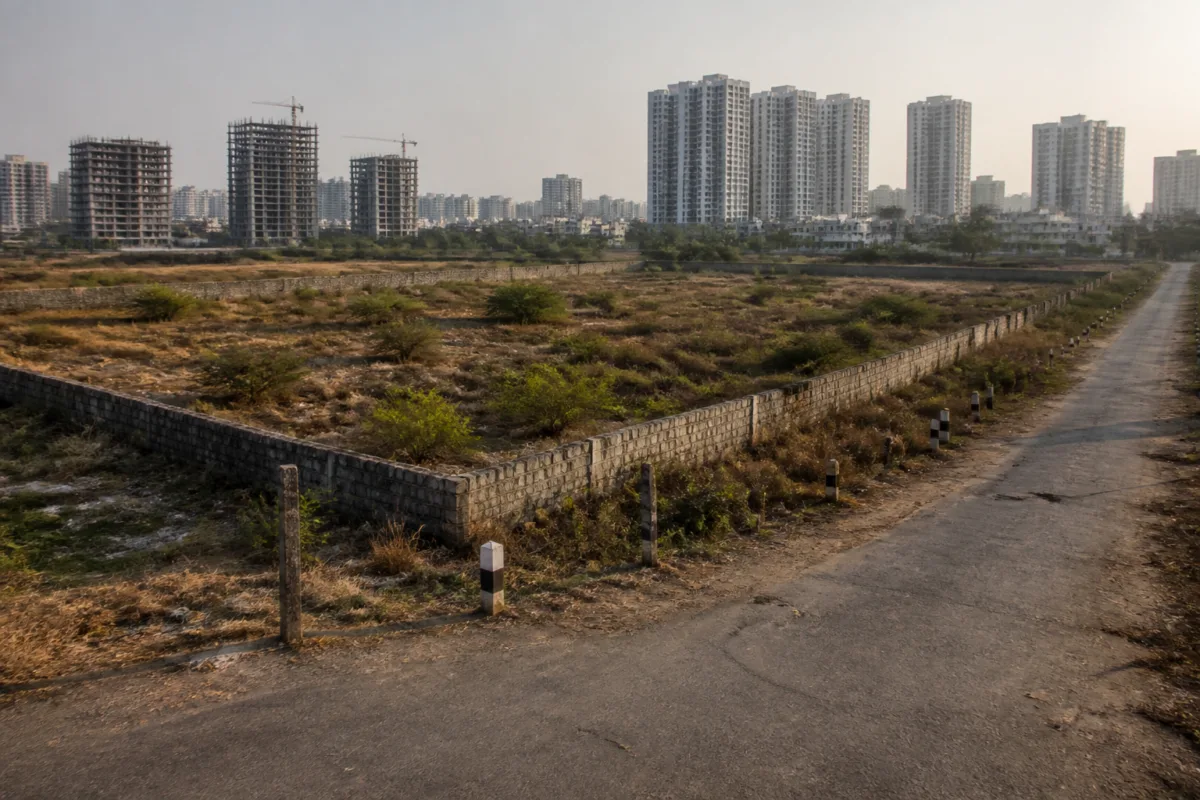
The Miyapur land dispute has moved beyond a contest over ownership. The Supreme Court’s declaration of the disputed 550 acres as government property has opened a larger question for Hyderabad: how should a valuable public asset be protected, managed and used after years of litigation? That question has become sharper after BRS Assembly deputy floor leader T. Harish Rao accused Chief Minister A. Revanth Reddy of misrepresenting the previous government’s role in the case and criticised the reported proposal to sell the land.
According to Deccan Chronicle, Harish Rao rejected the Chief Minister’s claim that the earlier BRS government had colluded with private entities to grab the land. He also disputed the suggestion that the Supreme Court outcome resulted primarily from the efforts of the Congress government. Harish Rao said records of the proceedings would show that the BRS government, led at the time by K. Chandrashekar Rao, had fought an eight-year legal battle from 2015 to 2023 to establish the land’s government ownership.
The report attributes to Harish Rao the claim that the then Telangana government appointed senior advocate C.S. Vaidyanathan on April 7, 2015, to represent the state in the Supreme Court. He further said documentary evidence supporting government ownership was placed before the court during the BRS tenure. These are statements made by Harish Rao and are not independently examined in the material supplied for this article. The full Supreme Court judgment and the underlying land records would be required to establish the precise legal history and the respective contributions of each government.
That distinction matters because the political dispute is also an argument about institutional continuity. Land litigation often extends across changes in government, while the legal responsibilities of the state continue regardless of which party is in office. A case that began during one administration may be defended, amended or concluded during another. Public ownership, in that sense, is not normally a political asset belonging to the government of the day; it is an administrative responsibility carried by the state.
Harish Rao referred to the Supreme Court’s reliance, in the Miyapur dispute, on legal principles discussed in its June 15, 2023 judgment in Trinity Infraventures Ltd v. M.S. Murthy. The supplied report does not reproduce the court’s reasoning or specify how those principles were applied to the Miyapur parcels. It therefore establishes that the earlier judgment was cited, but not the complete legal route by which the court reached its conclusion. That missing detail is central to understanding the scope of the verdict, the status of competing claims and any restrictions on future transactions involving the land.
The political disagreement has intensified over what should happen next. Harish Rao criticised Revanth Reddy for proposing to sell the Miyapur land within 24 hours of the Supreme Court verdict. He questioned whether the state should dispose of such a large public asset so quickly. The report also quotes him as alleging that the land could be sold to benamis of the Chief Minister. That allegation is not established in the supplied material and is presented here only as a political claim made by Harish Rao.
The reported valuation adds to the significance of the dispute. Harish Rao said Revanth Reddy had valued the 550 acres at more than Rs 60,000 crore. The figure is attributed to the political exchange and is not supported in the supplied article by a valuation report, government order, tender document or market assessment. It should therefore not be treated as an independently verified measure of the land’s value. Even so, the scale of the stated valuation indicates why decisions concerning the property have implications well beyond the immediate legal controversy.
For Hyderabad, the central governance issue is not simply whether public land can be sold. It is whether the state can demonstrate a transparent chain from judicial recognition of ownership to valuation, land-use decision, public consultation where required, disposal method and use of proceeds. The supplied report does not identify a sale notification, auction notice, development plan, cabinet decision or formal implementation schedule. Nor does it establish whether the proposed disposal refers to the entire 550 acres, specific parcels or a future development arrangement.
Those unanswered questions are important because large urban land parcels perform several possible public functions. They may be retained as land reserves, used for public infrastructure, planned for housing or other civic purposes, or monetised to raise funds. The correct legal and administrative route depends on the land’s classification, applicable planning controls, encumbrances, court directions and the government’s stated policy. None of those details is provided in the source report, so the consequences of any proposed sale cannot yet be assessed from the available evidence.
The Miyapur dispute also highlights the difference between winning a title case and completing public-asset management. A court verdict may settle a legal question, but it does not by itself determine the best urban use of the land. After ownership is established, the administration still has to maintain records, secure the site, update land registers, identify planning constraints and decide whether the property should be retained or transferred. If disposal is proposed, the state would ordinarily need to disclose the legal authority, valuation basis, bidding or allotment process and intended use of the proceeds. The supplied article does not say whether these steps have begun.
This is where the competing political narratives meet a measurable administrative test. Harish Rao’s account presents the Miyapur verdict as the result of a long state defence conducted during the previous government’s tenure. Revanth Reddy’s reported position credits the Congress government’s efforts and accuses the earlier administration of collusion with private interests. The source material contains no detailed response from the Chief Minister, no text of the Supreme Court order and no documentary timeline against which either account can be fully tested.
The available chronology is nevertheless significant. Harish Rao places the legal battle between 2015 and 2023 and identifies the appointment of the senior advocate in April 2015. He also refers to the Supreme Court’s June 2023 decision in another case as part of the legal framework relied upon in the Miyapur judgment. The current report then focuses on the political dispute following the verdict and the alleged proposal to sell the land. That sequence shows how long-running land litigation can become politically contested even after the court has determined the ownership issue.
The urban planning implications remain unresolved. A 550-acre parcel is large enough for any decision to affect surrounding development patterns, access, infrastructure demand and the future distribution of public land in Hyderabad. However, the source does not provide a master-plan designation, existing land use, location-specific infrastructure assessment or details of adjoining neighbourhoods. It would be inaccurate to claim that the land is suitable for a particular project or that a sale would produce a specific planning outcome without those documents.
The immediate public-interest requirement is therefore disclosure. Citizens need to know what the Supreme Court held, which parcels are covered, what records establish government ownership, whether any claims remain pending and what action the state has formally authorised. They also need clarity on the proposed sale: its scope, valuation, process, eligibility conditions and safeguards against preferential transfer. Political statements can identify the dispute, but these questions can be answered only through court records and official land and transaction documents.
The Miyapur case confirms the importance of treating public land as a governance system rather than a one-time revenue opportunity. The supplied report establishes a Supreme Court verdict recognising government ownership and records a sharp political dispute over the history of the litigation and the proposed next step. It does not establish the full contents of the judgment, the legal basis for a sale or the authenticity of the allegations exchanged by the parties. The developments that deserve monitoring are the publication of the court’s operative directions, any official sale or land-use notification, the valuation documents and the government’s explanation of how the 550 acres will serve Hyderabad’s public interest.

