


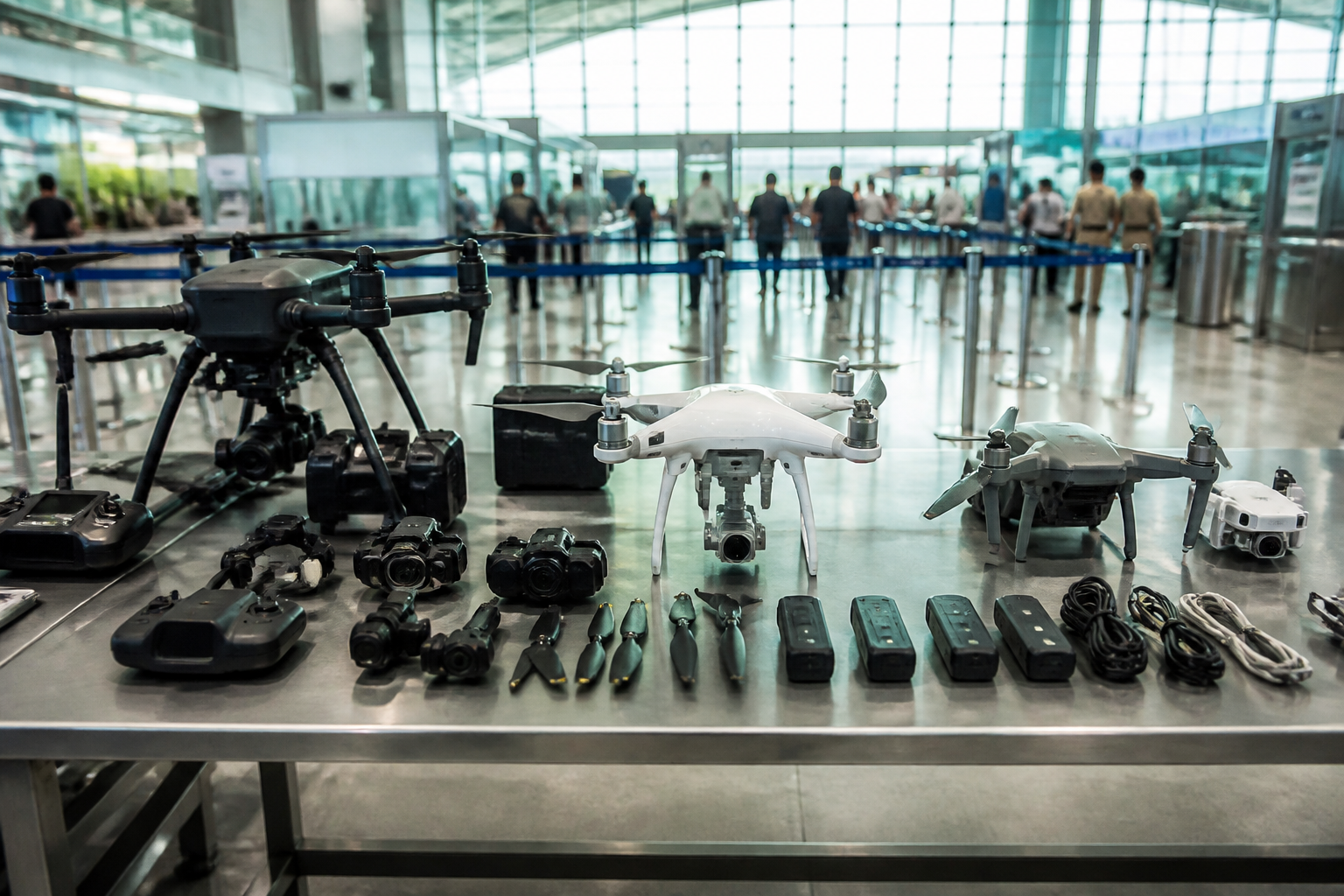
The seizure of 10 military and defence-category drones at Delhi’s Indira Gandhi International Airport is not only a customs enforcement story. It also shows how airports have become critical points in the governance of increasingly capable unmanned aircraft, where aviation security, import policy, national security and commercial technology overlap.
According to the Customs account reported by Jagran, three Indian passengers arriving through Vietnam from Hong Kong were stopped at Terminal 3 on September 25 after officers acted on intelligence. The passengers had travelled on Vietnam Airlines flights VN-593 and VN-981 and were intercepted while crossing the green channel. A detailed search of their baggage led to the recovery of 10 Autel Robotics MDX-1 drones, along with controllers, camera-equipped gimbals, cables, propellers, joysticks and other equipment.
The report places the assessed value of the seized goods at Rs 1,03,55,900, based on an evaluation by a chartered engineer. An iPhone 18 Pro Max was also found with the passengers. Customs seized the goods under Section 110(1) of the Customs Act, 1962, while questioning and investigation continued into their source and the purpose for which they were being brought into India.
The significance of the case lies in the technical description of the equipment. Customs said the drones were professional-grade systems with thermal imaging and laser range-finding capabilities. Those features can support functions beyond ordinary photography, including heat detection, longer-range observation and measurement of the distance to a target. The report therefore says the equipment was assessed, on the basis of its technical characteristics, as military and defence-category unmanned aerial vehicles.
That description also demands precision. A drone’s legal classification is not determined by the presence of a single sensor alone. It depends on the equipment’s broader technical specifications and the assessment of the relevant authority. This distinction matters because the consumer and professional drone markets increasingly contain systems that can be used for surveying, inspection, mapping, photography and other civilian tasks, while also possessing capabilities that may be relevant to security operations.
The case therefore illustrates the difference between a drone’s physical appearance and its regulatory identity. A small aircraft packed in passenger luggage may look like commercial equipment, but its classification can depend on its range, payload, navigation systems, imaging equipment, control architecture and intended use. In this instance, Customs relied on the assessment of a technical expert rather than treating the seized products as ordinary camera drones.
The import-policy question is central. The report cites the Directorate General of Foreign Trade’s policy as restricting the import of completely built units, semi-knocked-down units and completely knocked-down units of drones. It also notes that exceptions can apply for defence and security purposes and in certain government or research-related cases, subject to prescribed conditions and permissions.
This framework places the airport at the intersection of several institutional responsibilities. Customs controls goods entering the country and can seize items when it suspects a violation of the law. DGFT determines the import-policy framework. Technical assessment establishes the nature and capabilities of the equipment. Where defence or security exceptions are relevant, the importer must meet the conditions attached to those exceptions. The case shows that enforcement is not simply about detecting a prohibited object; it involves determining what the object is, how it entered the country and whether the importer had the necessary authorisation.
The route described in the report also highlights the complexity of contemporary cross-border logistics. The passengers were travelling from Hong Kong through Vietnam before arriving in Delhi. The available account does not establish why that route was used, whether the drones were purchased directly by the passengers or on behalf of another entity, or whether any documentation or permission was presented. Those questions remain part of the investigation and should not be treated as settled facts.
What is established is that the passengers were stopped at the green channel after intelligence-led surveillance. The green channel is designed for travellers who do not have dutiable or restricted goods to declare. In this case, the interception demonstrates the role of targeted intelligence and baggage examination in identifying consignments that might not be detected through routine passenger processing alone.
The seizure also illustrates the limits of looking at airports only as passenger infrastructure. An international airport is simultaneously a transport hub, a customs boundary, a logistics node and a security environment. Goods moving through passenger baggage can include high-value electronics, specialised machinery and dual-use technologies. The airport’s operational challenge is to process large volumes of travellers without weakening controls over equipment whose risks cannot be judged by appearance or price alone.
The reported valuation adds another layer. At more than Rs 1 crore, the consignment was not a minor personal purchase. However, the valuation by itself does not establish the intended use of the drones, the identity of any prospective recipient or whether the passengers acted independently. The report says the source of the drones and the purpose of bringing them into India were still under investigation. Those unresolved facts are essential to understanding whether the case represents an attempted policy violation, a commercial import routed through passengers or a wider chain of procurement.
The presence of thermal imaging and laser range-finding equipment is why the case has wider relevance than a routine undeclared-electronics seizure. These capabilities can have legitimate civilian applications, including professional surveying and inspection, but they may also raise security concerns depending on the system’s specifications and operating context. Regulation therefore has to distinguish between technology that is broadly available for civilian work and equipment whose configuration, performance or intended deployment requires additional scrutiny.
The report does not provide the complete technical specifications of the MDX-1 systems, their operating range, payload capacity, software configuration or country of manufacture. It also does not state whether the passengers produced any import documents, licences or authorisations. Without those details, it is not possible to independently assess the precise regulatory basis for the classification or the eventual legal outcome. The Customs seizure and arrests indicate enforcement action, not a final adjudication of guilt.
That distinction is important for public reporting. The three passengers have been arrested and questioned, but the supplied account does not say that a court has determined their culpability. Similarly, the seizure establishes that the equipment was taken into custody under the cited legal provision; it does not by itself establish the final status of the goods or the conclusion of the investigation.
The case nonetheless reveals a structural challenge for urban and national infrastructure. Cities depend on airports to support trade, travel and technology flows, but those same flows can carry equipment that sits between civilian commerce and security-sensitive use. The more capable drones become, the more difficult it becomes to regulate them through broad labels such as consumer, professional or military without examining their detailed technical and operational characteristics.
For airport governance, this means enforcement increasingly depends on coordination among intelligence units, Customs officials, technical evaluators and import-policy authorities. A physical checkpoint can identify a consignment, but classification and legal action require expertise beyond conventional baggage screening. The Delhi seizure shows how those layers can converge in a single passenger movement through Terminal 3.
The facts currently available confirm the seizure of 10 drones, the arrest of three Indian passengers, the technical features cited by Customs, the assessed value of the goods and the use of Section 110(1) of the Customs Act. They do not yet establish the full supply chain, the intended end user, the exact permissions sought or the final legal findings. The next significant developments will therefore be the outcome of the questioning, the investigation into the drones’ source and purpose, and any formal determination of the applicable import violations.
