


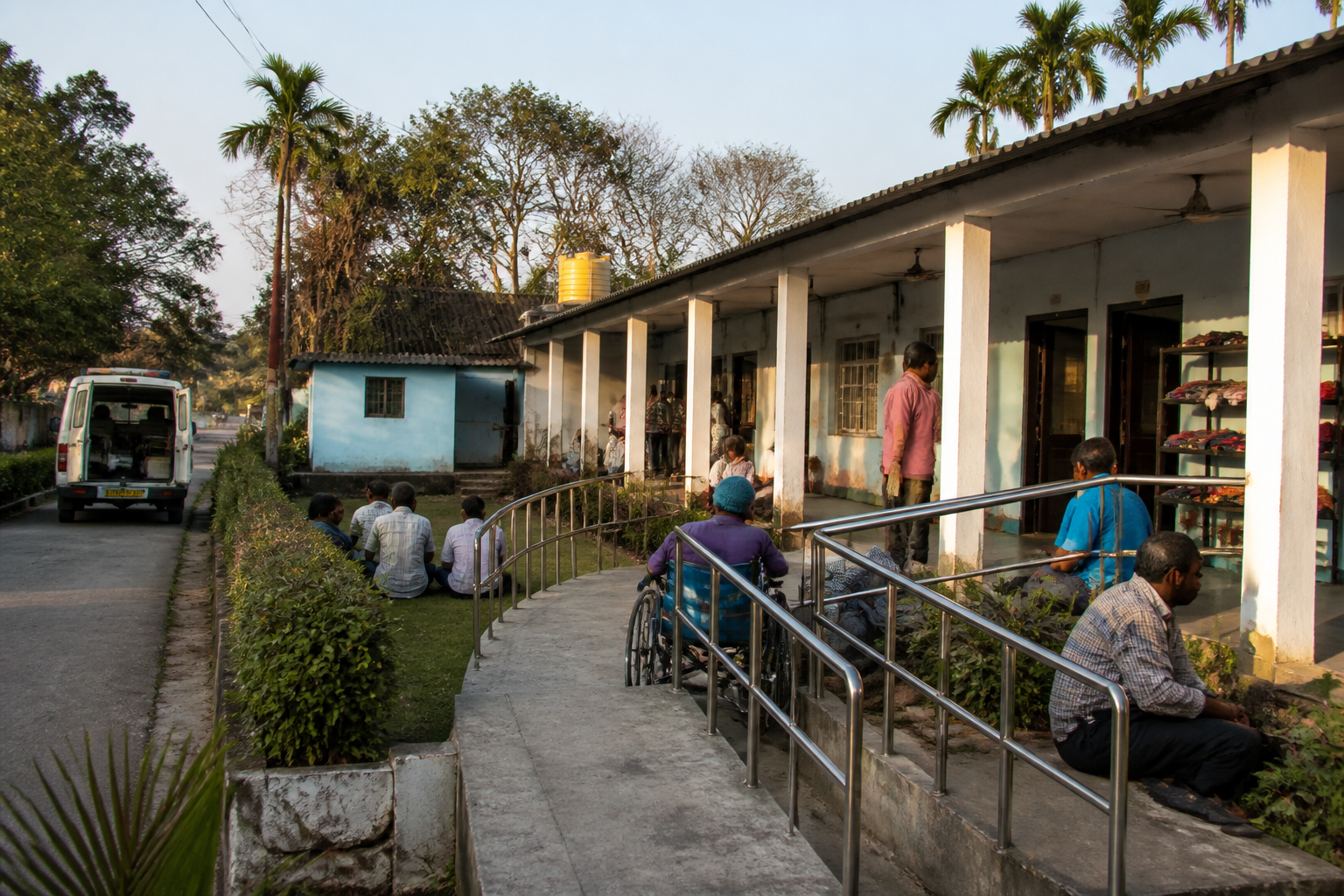
Heaven Shelter in Alipurduar is home to 87 homeless people, but its survival depends largely on the personal finances and persistence of 54-year-old Saju Talukdar. His account reveals a difficult urban question in north Bengal: what happens to people who are stranded at railway stations, bus stops, passenger sheds and other public spaces when a formal shelter system does not reach them?
Talukdar told The Telegraph that he spends around ₹3 lakh every month to run the facility without institutional help. The amount is a substantial burden for an individual, yet he said he could not abandon the people living there. The shelter’s existence is therefore tied not to a clearly identified public programme or institutional budget, but to one person’s ability to keep meeting recurring costs.
That dependence makes Heaven Shelter more than a story of individual charity. It is also a small, visible example of how homelessness is managed when public systems, community support and private initiative overlap without a clearly described operating framework. The available account does not establish the total number of homeless people in Alipurduar or north Bengal, nor does it provide details of the shelter’s registration, funding structure, capacity beyond its current residents or access to formal social services. But it does show the consequences of an informal response filling a public need.
From clothing collection to residential shelter
Talukdar’s work began with collecting used clothes from households across north Bengal and distributing them among people living around closed and sick tea gardens. The initiative emerged from his own experience of hardship. He recalled leaving school because his family could not afford a uniform and later working with his father, a tailor, in a household of nine, including seven children.
He eventually learnt to drive and bought a second-hand car for commercial work. The idea of collecting clothes came after he saw unclothed children playing on the road. That first intervention addressed an immediate need, but his work expanded when he began encountering people who had nowhere to live and could not care for themselves.
In 2017, he met Budu Oraon in Nagrakata. Oraon was incapacitated from the waist down and living in a passenger shed. Talukdar brought him home. Other distressed and homeless people later joined him after being found around railway stations and bus stops. The arrangement soon exceeded the space available in Talukdar’s house.
The sequence is important because it shows how homelessness becomes visible to citizens through transport spaces and roadside locations. People who are not accommodated in a formal shelter can remain dispersed across the everyday infrastructure of a town: a passenger shed, a station approach, a bus stop or a road edge. These locations may provide temporary cover, but they do not offer the care, accessibility or security required by people who are elderly, disabled, unwell or separated from their families.
A housing scheme created space, but not a system
Talukdar said he was able to obtain a house under a government housing scheme after seven or eight people were staying with him. The house relieved an immediate space constraint, but the account does not indicate that it was designed or funded as a shelter for multiple homeless residents. The distinction matters. A housing allocation to an individual can help create a safe place, but it does not by itself establish a publicly supported residential-care facility.
The shelter later received land support from four local residents. The Alipurduar district administration took the initiative to build a road and arrange drinking water and electricity at the site. Another well-wisher offered an ambulance. These interventions helped make the facility physically accessible and operational, but they also appear to have come from separate acts of support rather than from a single, clearly described institutional framework.
The resulting arrangement is a mixed model. Land came from local well-wishers. Basic access and utilities were arranged with district administration involvement. An ambulance was offered by another supporter. The recurring expenditure, however, remains Talukdar’s responsibility according to his account. The shelter’s capital requirements and monthly operating costs are therefore treated differently, with the most persistent financial burden resting on a private individual.
The source material does not state how residents are admitted, whether they pay anything, how food and medical care are organised, or whether the shelter receives regular government grants. It also does not identify the government department responsible for monitoring or supporting the facility. Those missing details are not minor administrative points. They determine whether a shelter can provide continuity of care and what happens if its principal funder becomes unable to continue.
The institutional gap behind the personal story
Talukdar has also helped reunite missing people with their families. That role places the shelter at the intersection of housing, welfare, health, mobility and local administration. A person found at a railway station may need more than a bed. They may require identification, medical attention, disability support, family tracing or assistance in returning home.
Heaven Shelter’s experience suggests that these needs can arrive together at a facility that was not necessarily created as a government service centre. The shelter may become the first point of contact for people whose problems cross departmental boundaries. Yet the supplied report does not establish whether there is a formal referral mechanism connecting it to police, hospitals, social welfare offices, municipal bodies or other public agencies.
This is the central governance issue raised by the facility. A shelter can be physically present while the wider support network remains unclear. Roads, water and power make a site usable, but they do not by themselves ensure rehabilitation, health services, legal identity documents or family reunification. The account shows some state participation in enabling the facility, but not the full administrative architecture around its residents.
The geography of the story also matters. Talukdar began by working around closed and sick tea gardens, and later found people at railway stations and bus stops. These are settings where economic distress, labour insecurity, mobility and the loss of family support can become visible. The source does not establish the causes of homelessness for the 87 residents, so it would be inaccurate to assign a single explanation. It does, however, show that people without stable shelter are moving through or living beside the region’s economic and transport infrastructure.
What the monthly cost reveals
Talukdar’s estimate of ₹3 lakh a month translates to roughly ₹3.6 million a year if maintained for twelve months. On a simple average, the reported monthly spending equals about ₹3,448 per resident, although the source does not specify what the amount covers. It may include food, utilities, healthcare, transport, staffing, repairs or other expenses, but the available account does not provide a breakdown.
Even without assuming the composition of the expenditure, the figure demonstrates the scale of the challenge faced by a facility housing 87 people. A shelter is not a one-time construction project. It requires recurring spending after land, buildings, water connections, electricity and road access have been secured. The story’s most significant number is therefore not only the number of residents but also the continuing monthly obligation attached to keeping them housed.
That obligation is vulnerable when it depends on one person. Talukdar’s statement that the burden is huge makes the arrangement’s fragility explicit, even though the report does not describe any immediate closure threat. The shelter may continue because of his commitment, local goodwill and administrative assistance. But the same model may be difficult to reproduce elsewhere unless responsibility for operating costs is made clearer.
The larger urban question
Homelessness is often encountered as a street-level issue, but the response requires coordination across the built environment and public administration. People sleep in or near transport facilities because those spaces are accessible and visible. A shelter needs a site, road access, water and electricity. Residents may also need health, disability, identity and family-reunification support. The Heaven Shelter account brings these layers together in one location.
The story does not prove that formal systems are absent across the region, nor does it establish that the shelter is the only such facility. It does show that one privately run shelter is supporting 87 people and spending around ₹3 lakh a month while operating without the institutional assistance described by its founder. That fact is enough to raise questions about how similar residents are identified, where they are referred and who pays for their continuing care.
The immediate public recognition Talukdar received at the School Awards for Excellence event acknowledged his work. The longer-term issue is administrative: whether support for people without homes should depend on exceptional individuals, or whether local institutions can provide a reliable framework that complements community initiative.
For now, Heaven Shelter remains an example of a private response supported by local residents and selected interventions from the Alipurduar district administration. Its future, and the welfare of the 87 people living there, will depend on whether that informal network can sustain the recurring requirements of shelter, utilities, care and family-reunification work.
