


The MHI leadership reshuffle comes at a sensitive point for India’s automotive policy. The Ministry of Heavy Industries is administering ₹37,838 crore across the PM E-DRIVE programme and the Auto Production Linked Incentive scheme, while manufacturers are facing tighter scrutiny of localisation claims, subsidy eligibility and technical compliance. The immediate question is not simply who occupies which post, but whether the ministry can preserve institutional continuity while enforcing increasingly complex rules.
Secretary Kamran Rizvi is due to retire at the end of October, according to The Hindu BusinessLine. Additional Secretary Dr Hanif Qureshi’s upgraded central posting expires on January 7, 2027, and he is expected to oversee the ministry’s day-to-day affairs after Rizvi’s retirement until a successor is appointed. The report says it remains unclear whether his arrangement will be extended or whether he will move to another central appointment.
The uncertainty matters because Qureshi has overseen automotive policy administration through the transition from FAME-II to PM E-DRIVE. That period has required the ministry to manage a shift in the design of electric-vehicle support while responding to manufacturers’ concerns over subsidy disputes, localisation requirements and changing regulations. Uday Narang, Chairman and Founder of Omega Seiki Mobility, said Qureshi had balanced government objectives with the operational challenges faced by the automobile industry.
The reshuffle also extends to the automotive desk. Ankit Chauhan, a 2013-batch AGMUT-cadre IPS officer and former Delhi Police Deputy Commissioner (Special Branch), has joined as Deputy Secretary (Auto). According to officials cited in the report, his responsibilities include coordinating a ₹780-crore upgrade of automotive testing infrastructure across the Automotive Research Association of India, the International Centre for Automotive Technology, NATRAX and the Global Automotive Research Centre.
That appointment places an officer with an enforcement background in a role involving testing-agency coordination, domestic value-addition verification and technical certification. These functions are central to the credibility of incentive programmes. Automotive support is not only a question of allocating public funds; it also depends on whether the state can establish that companies meet the technical and domestic-production conditions attached to those funds.
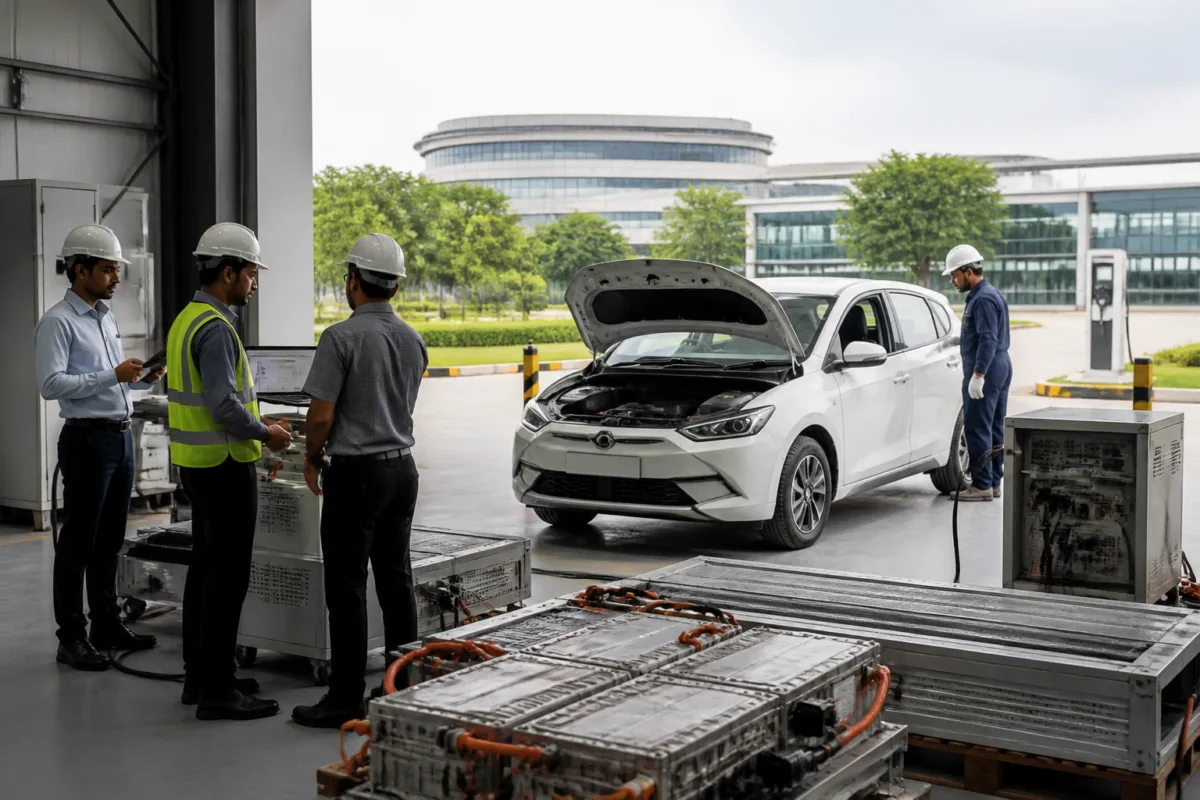
The ₹780-crore testing infrastructure allocation under PM E-DRIVE is intended to strengthen facilities for EV battery safety, alternative fuels, vehicle certification and technical verification. In practical terms, this infrastructure sits between policy design and market implementation. A programme can announce financial support, but manufacturers and consumers encounter its rules through certification systems, testing timelines, eligibility assessments and the decisions of coordinating agencies.
The scale of the two principal programmes explains why administrative continuity has become an institutional issue. PM E-DRIVE carries an approved outlay of ₹11,900 crore, while the Auto PLI scheme has an approved outlay of ₹25,938 crore. Together, they represent nearly ₹38,000 crore in public support for automotive manufacturing and electric mobility. Auto PLI, in particular, involves domestic value-addition verification, making technical and administrative capacity important to both industry access and public accountability.
The ministry’s challenge is therefore dual. It must offer sufficient predictability for companies making investment and product-development decisions, while ensuring that subsidies are not released without compliance with prescribed conditions. A senior official working closely with MHI said incoming officers would need to understand industry concerns while advancing localisation, decarbonisation and indigenous technological capability. The official also pointed to geopolitical tensions, global uncertainty and supply-chain disruptions as reasons these priorities have gained importance.
This balance is difficult because the regulatory workload is expanding beyond a single EV incentive programme. Randheer Singh, Founder and CEO of ForeSee Advisors and former Director of Electric Mobility at NITI Aayog, said manufacturers and dealers were preparing for tighter Corporate Average Fuel Economy standards, evolving tractor emission norms, the possibility of BS7 regulations, E20 fuel compatibility and proposals involving compressed biogas blending with CNG. He said each measure could affect product development, vehicle costs, affordability and consumer demand.
The list also shows why MHI cannot administer the transition in isolation. Fuel compatibility, emissions, vehicle certification, battery safety and domestic manufacturing standards involve different policy and regulatory interfaces. The supplied report says these requirements span several ministries and regulatory authorities. Coordination is consequently not an administrative detail; it determines whether rules arrive in a predictable sequence and whether companies receive consistent interpretations from the agencies responsible for implementation.
For consumers, the institutional changes may eventually be felt through the availability, price and compliance status of vehicles, although the report does not establish a direct consumer-price impact from the reshuffle itself. Testing capacity can influence the time required to certify new technologies, while localisation and eligibility rules can affect which products qualify for government support. The immediate public-interest concern is that the incentives should be administered transparently and that technical requirements should be applied consistently across manufacturers.
For manufacturers, the policy environment is becoming more demanding. Companies must respond not only to demand for electric vehicles but also to a wider set of standards covering fuel efficiency, emissions, alternative fuels, battery safety and domestic value addition. A change in senior personnel does not alter those rules, but it can affect how quickly outstanding decisions are processed, how agencies coordinate and how institutional knowledge is retained during a transition.
The succession question is particularly relevant because no decision on Qureshi’s continuation at MHI or his subsequent appointment has been established. The report says he has also been empanelled for Additional Director General of Police or equivalent positions at the Centre. This leaves the ministry’s near-term administrative arrangement open, even as the programmes under its oversight continue to operate.
The wider policy landscape is defined by a shift from broad support for automotive and electric mobility to closer verification of outcomes and eligibility. The government’s stated objectives include localisation, decarbonisation and the development of indigenous technological capabilities. Achieving those objectives requires more than an announced outlay. It requires testing institutions that can validate new technologies, administrative systems that can assess claims and officials who can coordinate across agencies without weakening compliance.
The numbers underline the consequence of this transition. PM E-DRIVE and Auto PLI together account for ₹37,838 crore in approved outlays, while ₹780 crore is earmarked for testing infrastructure under PM E-DRIVE. These sums represent different layers of the same system: production incentives support industrial capacity, EV support accelerates a technology shift, and testing infrastructure provides part of the technical basis for deciding whether products and companies meet the rules.
The evidence supplied does not establish whether the reshuffle will delay approvals, alter subsidy decisions or change the design of either programme. It does establish that the ministry is entering a period in which continuity, verification and coordination will be tested simultaneously. The appointment of a new Deputy Secretary (Auto), the impending retirement of the secretary and the uncertain status of the additional secretary create a leadership transition while the regulatory agenda is becoming more complex.
India’s automotive and EV push therefore depends on an administrative capability that is less visible than vehicle launches or investment announcements. The effectiveness of the programmes will be judged not only by their headline outlays, but by whether manufacturers can understand the rules, testing agencies can certify products in a timely manner and the government can verify domestic value addition without compromising accountability. The next established milestone is the end-October retirement of Kamran Rizvi; the ministry’s subsequent leadership arrangement will determine how it manages that continuity challenge.

