


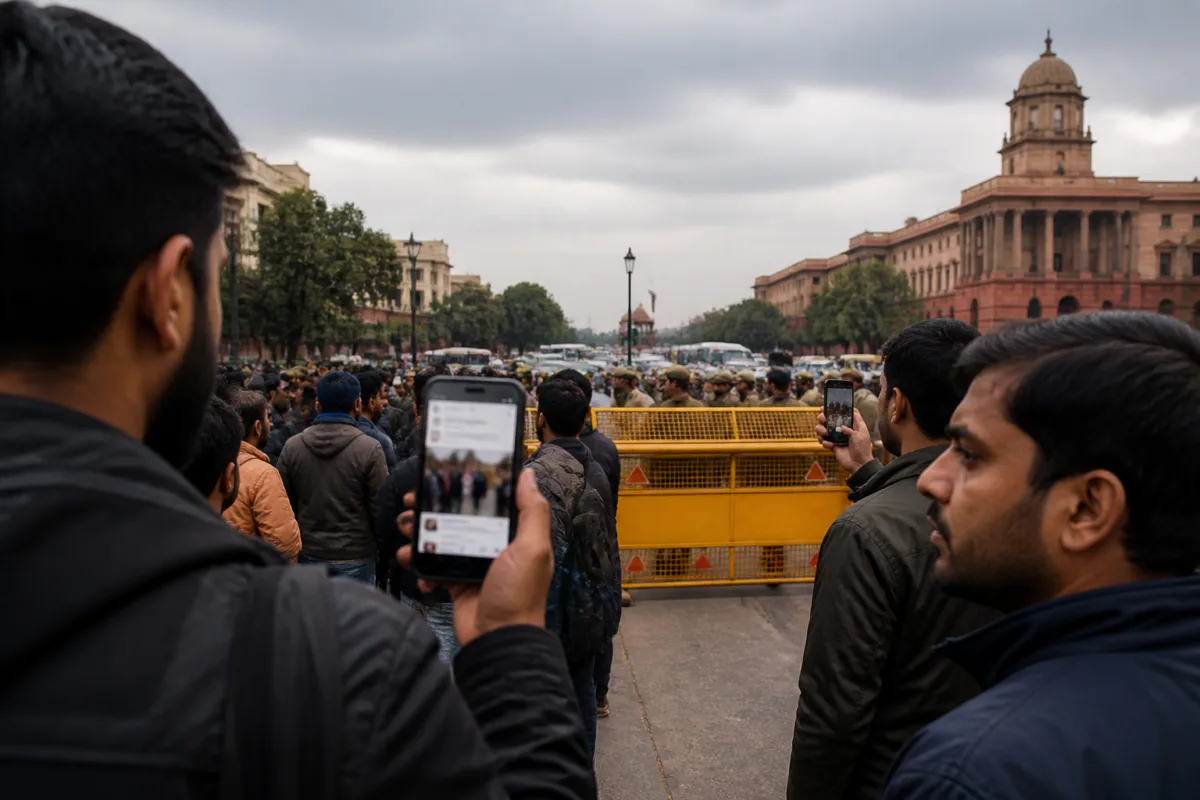
The government’s advisory to Meta over the recommendation of misleading, manipulated or out-of-context content is more than a platform-compliance request. It is a test of how public authorities want information to circulate during protests, emergencies and law-and-order situations—and how much responsibility should be placed on private algorithms for the behaviour of an increasingly digital public sphere.
The Ministry of Electronics and Information Technology, in an advisory dated October 10, asked Meta to review the systems that rank and recommend content on Facebook and Instagram. Among its requests was that recommendation systems should not create “disproportionate exposure” to a single or limited set of narratives, and should instead attempt to provide diversity of relevant and credible information.
The advisory did not identify a specific incident that led to its issuance. However, it came amid protests in Delhi led by the Cockroach Janta Party and opposition parties demanding the resignation of Chief Election Commissioner Gyanesh Kumar over the Special Intensive Revision of electoral rolls. The timing places the directive within a familiar administrative problem: when public events move rapidly from streets to screens, authorities must respond not only to what happened on the ground but also to how platforms package and amplify competing accounts of what happened.
That distinction matters. The government is not merely asking Meta to remove unlawful material. It is also asking the company to examine the distributional effects of its systems—what users see repeatedly, which versions of an event gain reach, and whether old or selectively edited visuals are being presented as current. This shifts the regulatory focus from individual posts to the architecture of visibility itself.
The advisory’s six tasks, as described in the report, include identifying and addressing content covered by the Information Technology Rules, reviewing recommendation and ranking systems, providing context for visual material from ongoing public events, strengthening rapid review and escalation mechanisms, cooperating with law-enforcement agencies, and paying particular attention to misleading claims about emergency measures, restrictions, police action and official responses.
For cities, the significance lies in the type of events singled out. Protests, police action, restrictions and emergencies are urban events before they become digital narratives. They unfold in dense public spaces, affect transport and access, involve multiple authorities and can create immediate uncertainty for residents. A video from a road blockade, a photograph from a previous demonstration or a selectively edited clip of police action can alter how people decide whether to travel, gather, avoid an area or respond to official instructions.
The advisory therefore connects two systems that are usually discussed separately: physical urban administration and digital platform governance. Municipal agencies, police departments and other public authorities manage streets, public order and emergency communication. Meta controls privately operated systems that determine how information about those events is recommended to users. When the two systems interact, the platform’s ranking choices can influence the public response to an event even though the platform does not organise the street, issue the restriction or control the police operation.
The central institutional question is whether a platform should be treated only as a passive intermediary or also as an active distributor of information. MeitY’s reference to the Information Technology Act, 2000, and the due-diligence obligations under the IT Rules, 2021, supports the government’s position that intermediaries must take responsibility for content likely to cause public disorder or incite a cognisable offence relating to public order.
But the advisory also expands the practical meaning of that responsibility. It asks Meta to review content that may be misleading or out of context even when the problem is not necessarily that a post is unlawful. It asks for adequate context where the authenticity, date, location or circumstances of photographs, videos and graphics may not be clear. It further asks the company to address content that gains significant reach through recommendation systems and could create widespread confusion, apprehension, violence or disturbance of public order.
This is an important distinction in platform governance. A post can be inaccurate without meeting the threshold for removal. A genuine image can still mislead if its date or location is omitted. A real video can be repurposed to support a false account of a current event. The advisory’s response is not limited to deleting such material; it also targets the repeated recommendation and disproportionate amplification that can make a limited narrative appear dominant.
The report says ministry sources had received reports that Meta platforms were not promoting all narratives equally, with algorithms appearing to favour one kind of content over others. That claim is attributed to ministry sources and is not accompanied in the supplied material by a public technical audit, platform data or a specific case study. The distinction is important because allegations about algorithmic preference require evidence about ranking systems, exposure patterns and the content available to users.
The advisory itself appears to recognise that the problem is not only content moderation capacity. It asks for rapid identification, review and escalation of content that is gaining significant reach through recommendations. This focuses attention on speed. During a fast-moving public event, a correction issued after a misleading video has already been repeatedly recommended may not have the same effect as context supplied when users first encounter it.
That creates a difficult administrative balance. Authorities need reliable channels to warn residents about genuine restrictions, emergencies and public-safety risks. At the same time, broad interventions into information flows can affect lawful expression and legitimate public discourse. MeitY’s advisory says its purpose is to facilitate responsible dissemination and recommendation of information while respecting both. The report also quotes a digital-rights advocate describing the directive as a “continuing censorship directive”, showing that the policy has already raised concerns about the boundary between safety regulation and control over public narratives.
The tension is sharper during protests and contested political events. Governments may possess official information about restrictions, police action or emergencies, but official accounts are not automatically the only relevant accounts of what is happening. A requirement to provide diversity of credible information could improve context if applied transparently. If applied as a demand to privilege government-approved narratives, it could narrow public debate. The supplied advisory does not establish how Meta should measure “diversity”, “credibility” or “disproportionate exposure”, leaving those terms institutionally important but operationally unresolved.
This lack of detail is significant because recommendation systems are not simple publication lists. They select, rank and repeat material based on signals that are not fully visible to users. A directive aimed at those systems must eventually answer practical questions: what counts as disproportionate exposure; how should a platform identify a limited narrative; who determines whether context is adequate; how quickly must a review take place; and what records should be available for oversight?
The advisory also asks Meta to cooperate with law-enforcement and other authorised government agencies by furnishing information or assistance in accordance with applicable law and within the timelines prescribed under the IT Rules, 2021. That request places platform systems within an established administrative chain. It also raises the importance of clear authorisation, documented requests and legally defined timelines, although the supplied report does not provide further detail on the monitoring or disclosure framework that would apply.
For urban governance, the immediate lesson is that communication infrastructure has become part of public-order infrastructure. Roads, stations and public squares remain the physical locations where disruption is experienced, but the interpretation of events increasingly occurs through privately managed digital feeds. Authorities therefore face a dual task: managing the physical consequences of a protest or emergency and communicating enough verified information to prevent confusion without suppressing legitimate disagreement.
Meta’s response is not included in the supplied report, so the company’s interpretation of the advisory, any implementation timetable and any technical changes remain unclear. The report also does not establish whether the ministry has published evidence supporting its concern that particular narratives were being favoured. Those gaps prevent a definitive assessment of the advisory’s effectiveness or proportionality.
What the episode does confirm is a shift in the focus of India’s platform-regulation debate. The government is addressing not only whether content violates a rule, but also how recommendation systems affect the scale, speed and apparent prominence of information during public events. That is a broader intervention in the relationship between digital companies and public administration.
The developments that deserve monitoring are therefore procedural as much as political: whether Meta publicly responds, how the requested review of ranking systems is conducted, whether the ministry provides measurable standards for context and amplification, and how cooperation with government agencies is documented. Until those details emerge, the advisory remains a significant statement of regulatory intent—and an unresolved test of how India will govern the digital layer of urban public life.

