


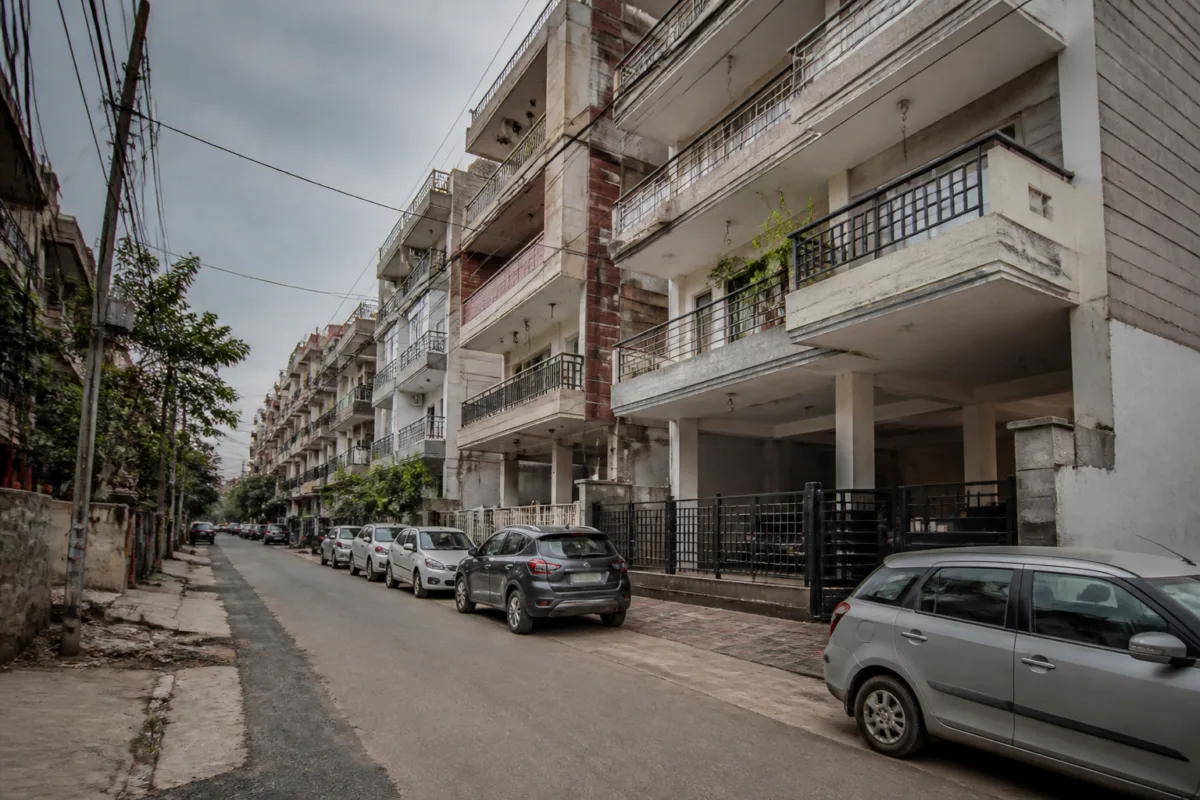
Gurugram’s stilt-plus-four construction dispute is no longer only a question of how many residential plots received permission. The Haryana government’s affidavit before the Punjab and Haryana High Court shows that 32,024 permissions had been granted in the city up to April 2, 2026, while residents’ objections focus on the consequences of those approvals: parking shortages, drainage stress, possible misuse of buildings and the capacity of neighbourhood infrastructure to absorb additional density.
The numbers also complicate the claim that approvals were rushed after Haryana revived the S+4 policy in July 2024. The Department of Town and Country Planning (DTCP) said 62.3% of building plans in private licensed colonies had been approved before July 1, 2024. The affidavit was filed in opposition to a plea seeking an immediate halt to ongoing construction and the issuance of occupation certificates.
That distinction matters because the S+4 policy has operated through several layers of rules, agencies and enforcement mechanisms. It allows four floors above a stilt parking area in a residential building. The policy expanded the development potential of individual plots, but also created a test for whether roads, parking, water, sewerage, electricity and drainage systems could keep pace with the additional built-up area.
The controversy is therefore about more than the legality of individual permissions. It concerns whether a planning system that approves additional floors can reliably verify how those buildings are used, whether the mandated parking remains available, and whether civic agencies have the information and authority needed to manage the cumulative impact on entire neighbourhoods.
The approval figures show the scale of the issue. Of the 32,024 permissions in Gurugram, 18,719 building plans were approved in private licensed colonies by the DTCP, while 13,305 were approved by the Haryana Shehri Vikas Pradhikaran (HSVP) in its sectors. Across Haryana, 35,021 permissions had been granted by April 2, with Gurugram accounting for more than 91% of the total. Panchkula accounted for 2,997 approvals, including 103 in DTCP colonies and 2,894 in HSVP sectors.
Within the Gurugram-Manesar Urban Complex, the DTCP said 15,447 building plans in private licensed colonies had been approved. Of these, 9,625, or 62.3%, were sanctioned before July 1, 2024. The department said these approvals were governed by instructions issued on March 7 and September 2, 2019. The March instructions allowed the fourth floor to function as an independent unit, while the September instructions provided for purchasable development rights.
The remaining 5,822 plans, or 37.7%, were approved between July 2, 2024, when the policy was revived with restrictions, and April 2, 2026, when the High Court stayed the notification. The figures do not by themselves establish whether the resulting construction complied with approved plans. They do, however, show that the city’s S+4 expansion cannot be attributed solely to the 2024 revival.
The court proceedings also bring out the difference between permission and compliance. The DTCP rejected the claim that around 30,000 permissions had been granted under the July 2, 2024 order, calling it “factually incorrect” and “wholly erroneous”. It argued that alleged unauthorised construction in individual cases could not justify a blanket ban on every permission and construction activity under the policy.
At the same time, residents’ concerns relate precisely to what happens after permission is granted. Residents’ Welfare Association representatives have flagged alleged use of buildings as paying guest facilities on narrow 10-metre roads, four-floor construction on 100-square-yard plots and the conversion of stilt areas into commercial spaces rather than parking. These allegations point to a regulatory problem that is different from the approval of a building plan: the system must also monitor actual use, construction quality and the retention of common or mandated facilities.
The treatment of stilt parking illustrates the gap. The DTCP said approvals or occupation certificates could be withdrawn if the stilt area was enclosed, either fully or partially, under Clause 8 of the July 2, 2024 instructions. It also said action was being taken against violations on a case-by-case basis under Section 10 of the Haryana Development and Regulation of Urban Areas Act, 1975.
However, the department opposed physical verification of every property, describing such a blanket exercise as being based on “erroneous assumptions”. It also said it had no records of pending occupation-certificate applications for residential plots submitted to architects under the self-certification system. Under a standard operating procedure issued on November 16, 2022, private architects were designated as the competent authority to inspect properties and issue occupation certificates. The DTCP said it received records only after an occupation certificate had been granted.
This arrangement places the effectiveness of enforcement at the intersection of private certification and public oversight. The department’s position is that violations can be addressed when occupation certificates are examined and through action in individual cases. The information in the affidavit also indicates that the DTCP does not receive the relevant records before certification is completed. That creates a monitoring sequence in which the authority responsible for broader planning oversight may not have immediate visibility of every property’s compliance status.
The infrastructure question is equally significant. The DTCP said HSVP had prepared a standard operating procedure for sector-wise capacity audits covering water supply, sewerage, electricity and roads. Areas with inadequate services would be prioritised, and separate accounts funded through S+4 charges would be maintained for the purpose.
The affidavit does not provide the results of those audits or identify how many sectors currently lack adequate capacity. It establishes that a capacity-audit mechanism has been framed, but the supplied material does not show whether the audits have been completed, what deficiencies they found or how quickly remedial work will be carried out. That distinction is important in a city where the planning decision is made at the plot level but the impact is felt across roads, drains, networks and neighbourhood parking systems.
Gurugram’s S+4 dispute also demonstrates how multiple approval regimes can make accountability difficult to follow. Private licensed colonies fall under the DTCP’s approval framework, while HSVP sectors have a separate approving authority. The total figures combine both categories, but the institutional responsibilities remain divided. Enforcement, occupation certification, infrastructure audits and court compliance may involve different actors and different records.
The policy history adds another layer. Haryana froze approvals under the S+4 policy in February 2023 and appointed an expert committee headed by retired bureaucrat P Raghavendra Rao. The government revived the policy with restrictions on July 2, 2024, based on the committee’s findings. The High Court stayed that notification on April 2, 2026, and the current proceedings concern a plea challenging the policy and seeking restraint on construction and occupation certificates.
The court has not, according to the DTCP’s affidavit as reported, declared every permission issued under the S+4 regime illegal or incapable of regulation. The department specifically argued that the April 2 stay could not be interpreted as a finding that all such permissions were non-compliant. The legal dispute therefore remains distinct from the administrative question of whether particular buildings have breached approved plans or whether neighbourhood infrastructure is adequate.
For residents, those distinctions are experienced less clearly. A building may have an approved plan, but its occupants and neighbours still depend on available parking, functioning drainage, reliable utilities and roads that can handle the resulting activity. A stilt area may be legally required to remain open, but its conversion into another use can reduce the practical capacity of a plot and shift pressure onto public streets. A building may also receive permission within a broader planning framework that does not automatically demonstrate that the surrounding network has spare capacity.
The evidence supplied in the affidavit confirms the scale of approvals and the government’s defence of the policy. It does not establish the total number of violations, the condition of individual properties, the findings of the proposed capacity audits or the number of occupation certificates affected by non-compliance. Those are the data points that would determine whether the system is effectively regulating S+4 construction or mainly processing permissions and responding to violations after they emerge.
The larger urban question is whether Gurugram can manage increased residential intensity through plot-level approvals without equivalent, publicly visible monitoring of area-level infrastructure. The court proceedings have brought the approval count into focus, but the eventual test will lie in how the authorities verify construction, protect stilt parking, publish infrastructure-capacity findings and assign responsibility between the DTCP, HSVP, architects and property owners.
For now, the record supports two conclusions. First, most of the private-colony approvals cited by the DTCP predate the July 2024 policy revival, weakening the claim that the entire approval surge followed that decision. Second, the existence of permissions does not resolve whether buildings comply in practice or whether neighbourhood services can support them. The next significant developments will be the High Court’s consideration of the challenge, the implementation of the stated capacity audits and the treatment of occupation certificates where stilt areas or other approved conditions have been violated.

