


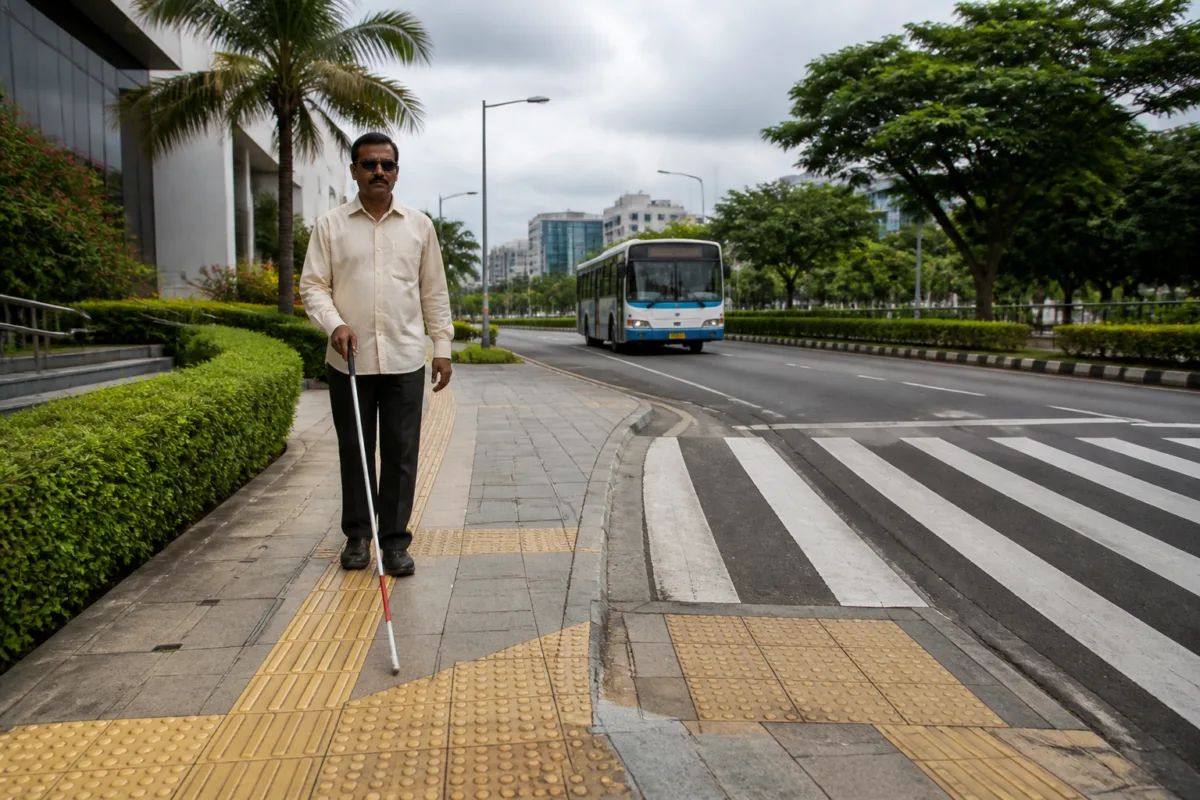
Justice Devan Ramachandran’s warning that visually impaired people need accessible streets rather than sympathy puts Kerala’s urban design problem in stark terms: a city cannot claim to be inclusive if its footpaths, pedestrian crossings and tactile pathways are routinely blocked or unusable. Speaking at White Cane Day celebrations at Infopark, Kakkanad, the Kerala High Court judge connected the everyday difficulty faced by visually impaired pedestrians to a wider failure of public-space governance.
The issue is not limited to whether a person can technically enter a street or reach a building. It is whether the street has been designed and managed to support independent movement. A footpath occupied by vehicles, a pedestrian crossing that does not function safely, or a tactile pathway obstructed by other uses can turn a formally available route into an inaccessible one. For a visually impaired pedestrian, the difference is fundamental: the built environment either provides reliable cues and protection or transfers the burden of navigation to the individual.
Justice Ramachandran’s remarks at the event, organised by the Rotary Club of Cochin Global, focused on that transfer of responsibility. “Those who claim to have sight are blind. They don’t see the footpaths, pedestrian paths or pedestrian crossings,” he said, referring to the continued misuse of pedestrian facilities despite interventions by the High Court to restore them. His criticism identifies a governance gap that is familiar across Indian cities: infrastructure may be provided, but its protection, enforcement and continuity are often treated as secondary concerns.
The judge’s statement that “a city where you can’t walk is not a city at all” also shifts the discussion from disability welfare to the basic functioning of urban space. Walkability is frequently discussed as an amenity, but for people with visual impairment it is a condition of independence. The usability of the street determines whether they can travel to work, access public services, attend educational institutions or participate in community life without relying on another person.
That distinction matters because public responses to disability can focus on assistance while overlooking the systems that create dependence. Justice Ramachandran said visually impaired people do not need sympathy but a society that respects their independence and stops creating obstacles. He also said, “We make them dependent and then take credit for making them independent. It is us who have to change.” The observation places responsibility on motorists, public authorities, institutions and the wider community rather than on people navigating streets that were not adequately designed or maintained for them.
His own experience during the event gave the argument a direct experiential dimension. The judge recalled taking part in a blindfolded white cane walk before the function and described the three or four minutes as among the most difficult moments of his life. He suggested that motorists, particularly bus drivers, should undergo similar exercises to understand the challenges faced by visually impaired pedestrians.
The exercise cannot substitute for systematic design or enforcement, but it illustrates the gap between how streets are perceived by drivers and how they are experienced by pedestrians without sight. A driver may see a footpath as available space for temporary parking or a pedestrian route as an inconvenience. A visually impaired person depends on the route remaining predictable, unobstructed and connected. When those conditions fail, the problem is not simply poor etiquette; it is a breakdown in the street’s public function.
The report does not provide a citywide audit of blocked footpaths, the number of accessible crossings in Kochi or the frequency of enforcement action. It therefore cannot establish the scale of the problem through comparable measurements. But the judge’s remarks, together with the reference to continuing vehicle occupation despite High Court interventions, show that the issue is not being presented as an isolated incident. It is a recurring conflict between pedestrian rights and competing uses of public space.
That conflict also reveals why accessibility cannot be secured through isolated additions such as tactile paving. Tactile pathways are useful only when they form part of a continuous, legible route. If vehicles occupy the walkway, if construction or street activity interrupts the path, or if a crossing does not provide a safe connection, the individual element loses much of its value. The urban system has to work as a chain rather than as a collection of disconnected features.
The institutional challenge is therefore broader than the installation of infrastructure. The High Court interventions mentioned by Justice Ramachandran point to the role of enforcement and administrative follow-through. Restoring pedestrian facilities requires authorities to identify obstructions, assign responsibility, act against violations and ensure that cleared routes remain usable. The source report does not identify the agencies responsible for particular stretches or describe the status of those interventions, but it makes clear that judicial attention alone has not removed the underlying problem.
The setting of the event is significant in another way. Infopark, Kakkanad, is associated in the report with workplaces, technology activity and training programmes for visually impaired people. A person may receive mobility or digital-skills training, secure employment and still face barriers on the way to work if the surrounding public realm is inaccessible. Employment inclusion and street accessibility are therefore connected. The ability to participate in the economy depends not only on training and employer support but also on the physical route between home, transport and workplace.
Project Surya, highlighted during the celebrations, offers an example of the support structure being built outside direct municipal infrastructure. According to founding trustee Rotarian Noby E A, the initiative has reached more than 2,000 visually impaired individuals through 20 foundation course batches, 45 online batches and awareness workshops. Nearly 80 per cent of its alumni are employed in government offices, private companies, IT parks and non-governmental organisations, he said.
The programme began in 2008 with seven students at Infopark’s Vismaya Building, was renamed Project Surya in 2015 and expanded to 15 students per batch in 2017, according to the organisers’ statement. It provides computer, assistive technology, mobility, communication and life-skills training. Deserving candidates also receive boarding, travel assistance and learning materials. These details show how much institutional effort may be required to support independence when the surrounding city does not reliably provide it.
The initiative’s planned expansion is focused on digital skills, newer assistive technologies, employer partnerships and outreach to rural and semi-urban areas. That expansion can widen access to training, but the street-level problem identified by the judge remains a public-authority responsibility. Non-governmental programmes can build capability and confidence; they cannot by themselves prevent vehicles from occupying footpaths or guarantee that pedestrian crossings remain usable.
This creates a clear policy distinction. Accessibility programmes address the capabilities and opportunities of individuals. Inclusive street design addresses the conditions under which those capabilities can be used. A city needs both. Training without accessible routes leaves people dependent during daily travel. Accessible routes without education, employment or assistive support may also fail to produce meaningful independence.
The event therefore brings together two sides of the urban inclusion question. Project Surya demonstrates how training and assistive technology can help visually impaired people access education and employment. Justice Ramachandran’s intervention demonstrates why those gains can be undermined by ordinary decisions made on streets: parking on walkways, disregarding pedestrian crossings and failing to protect tactile routes.
The larger question for Kerala’s cities is whether accessibility is being treated as a design standard, a legal obligation and an operational duty, or only as a theme for occasional campaigns. The supplied report confirms the judge’s concern and records the work of a community initiative, but it does not establish whether local authorities have created measurable accessibility targets, published audits or maintained a continuous monitoring system. Those are the gaps that future reporting would need to examine.
What the evidence does establish is that independence cannot be delivered through sympathy alone. It depends on streets that remain clear, crossings that function and public spaces that are designed for more than the majority user. Kerala’s conversation on accessibility will ultimately be tested not at a commemorative event, but on the footpaths, pedestrian routes and crossings that visually impaired residents must use every day.

