


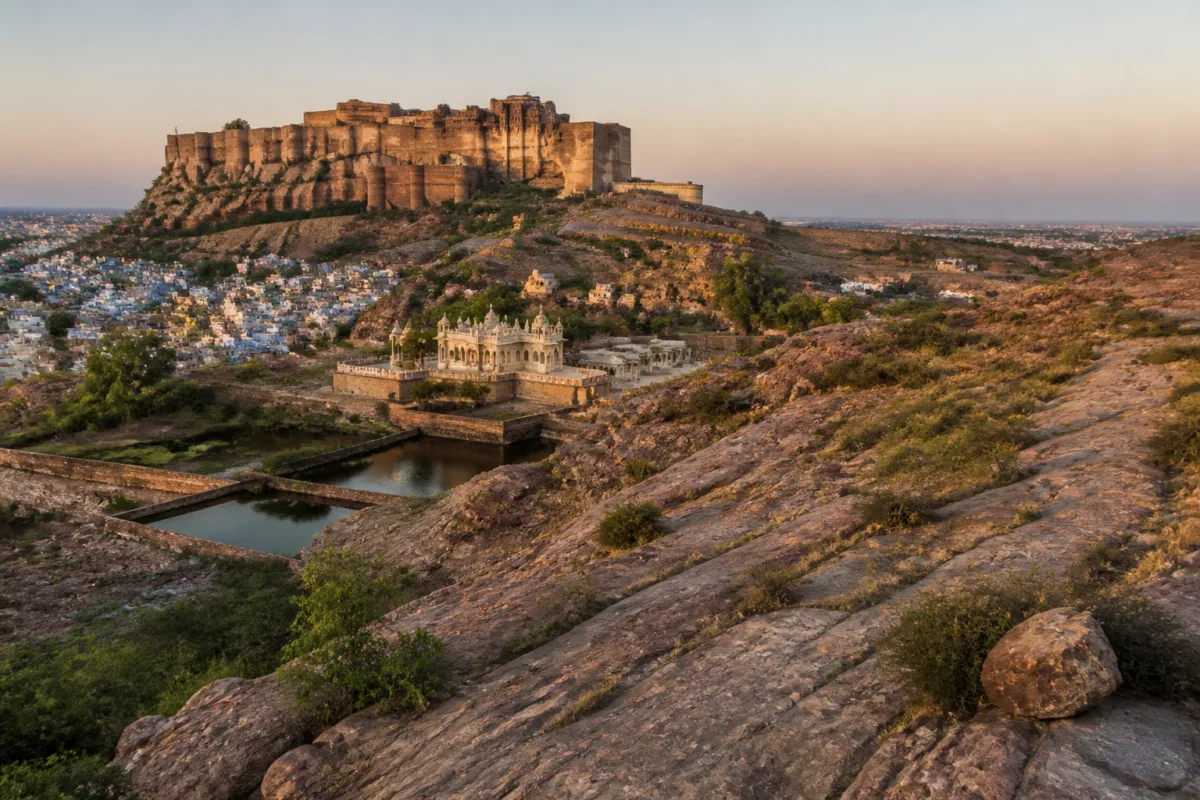
The proposal to make Mehrangarh Fort and its surrounding landscape India’s first UNESCO Global Geopark is not only a bid for an international designation. It is also an attempt to present Jodhpur as a place where geology, water systems, architecture, settlement and cultural life developed together. That connection is central to the campaign now seeking support from the Union government.
Gaj Singh II, the former ruler of Marwar, wrote to Prime Minister Narendra Modi on November 7, asking him to intervene and support the proposal. In the letter, Singh urged the Centre to seriously consider the bid and help secure approvals through the concerned ministries. He cited what he described as Mehrangarh and the adjoining areas’ exceptional cultural, geological and ecological significance.
The proposal comes at a time when India has no UNESCO Global Geoparks. Organisers of the Mehrangarh initiative said the international network includes 241 geoparks across 51 countries. Recognition would therefore give the Jodhpur landscape a designation that is currently absent from India, while placing the city within a global framework for linking geological heritage with conservation, research, education and tourism.
The significance of the proposal lies in what it seeks to place under one conservation narrative. Mehrangarh is widely identified with its fort and architectural heritage, but the initiative argues that the fort cannot be understood separately from the physical landscape around it. Shiv Singh Rathore, convener of the Mehrangarh Geoheritage and Geopark Initiative, said the site offered an opportunity to study the relationship between Jodhpur’s geological formations, rocks, water systems, geomorphological features and human civilisation.
That framing shifts the focus from a monument alone to a larger urban and environmental system. According to Rathore, local geological conditions influenced the fort’s architecture, traditional water management systems, settlements, culture and lifestyle. The claim does not present these elements as separate attractions. Instead, it connects the material conditions of the region to the ways people built, stored water, organised settlements and developed cultural practices.
This is an important distinction for a city whose heritage is often experienced through individual landmarks. A fort, a traditional water source, a rock formation and a settlement may be administered, interpreted or visited as separate sites. The geopark proposal attempts to bring them together as parts of one landscape. Its stated purpose is to combine geological and cultural dimensions through conservation, scientific research, education and sustainable tourism.
The initiative has already begun public-facing activity to explain that relationship. Organisers conducted a heritage walk last month through Mehrangarh Fort and six nearby locations. Experts used the walk to explain connections between local rock formations, geomorphology, traditional water sources and the fort’s architectural heritage. The event indicates that the campaign is treating interpretation and public education as part of the proposed geopark model, rather than limiting the effort to an administrative application.
The institutional question is now significant. Singh’s letter does not announce that the geopark has been approved, nor does it establish that the proposal has received recognition from UNESCO. It asks the Prime Minister to support the bid and facilitate approvals through the relevant ministries. The immediate status, therefore, is that of a proposal seeking government backing. Organisers have said the campaign will continue, but the supplied account does not specify a final approval process, a timeline for submission or the government’s response.
That distinction matters because an international heritage designation depends on more than the visibility of a monument. The case being advanced by the initiative rests on the combined value of geology, ecology, cultural heritage, water systems and human settlement. It would require these elements to be documented and presented as a coherent landscape. The source material confirms that the campaign is making that argument, but it does not establish which parts of the proposal have been formally assessed or accepted by authorities.
The proposed geopark also raises a question about how tourism is managed around heritage landscapes. Organisers describe sustainable tourism as one of the expected benefits of recognition, alongside conservation, research and education. In this formulation, tourism is not presented only as a measure of visitor growth. It is linked to the interpretation of geological and cultural assets and to the possibility of creating a model for geoconservation and geotourism in Rajasthan.
The available evidence does not provide visitor numbers, tourism revenue, carrying-capacity assessments or a management plan. It therefore cannot establish how the designation would affect footfall, local businesses, access arrangements or conservation costs. What it does show is that the campaign is presenting tourism as one part of a wider framework rather than as the sole justification for the proposal.
The Jodhpur case also illustrates how urban heritage can extend beyond built structures. Traditional water systems, rock formations and geomorphological features are being included in the same conversation as the fort and surrounding settlements. This approach treats the city’s physical landscape as an active influence on its history and built form. It also makes conservation more complex, because protecting a monument alone may not preserve the environmental and geological relationships that helped shape it.
For local residents and visitors, that could eventually change how the area is explained and experienced, if the proposal advances. A heritage walk that connects rocks, water sources, architecture and settlement offers a different account of the city from one centred only on royal history or visual spectacle. However, the supplied material does not establish whether new visitor infrastructure, regulations or administrative arrangements are planned.
The proposal’s broader importance lies in the absence of a UNESCO Global Geopark in India and in the effort to create a national example around an already prominent heritage site. Organisers say recognition would give Jodhpur an international geoheritage identity and Rajasthan a distinct global profile. Those are stated objectives of the campaign, not outcomes that have yet been secured.
At present, the evidence confirms three developments: Gaj Singh II has asked the Prime Minister for intervention and support; organisers are linking Mehrangarh’s fort, geology, water systems, ecology and settlements through a geopark initiative; and public activities, including a heritage walk covering the fort and six nearby locations, have been held to explain that connection. The next material developments will be the government’s response, the status of approvals and whether the proposal proceeds through the relevant formal process. Until then, the UNESCO Global Geopark bid remains a campaign seeking institutional backing, but one that has placed Jodhpur’s wider landscape—not only its fort—at the centre of India’s geoheritage conversation.

