


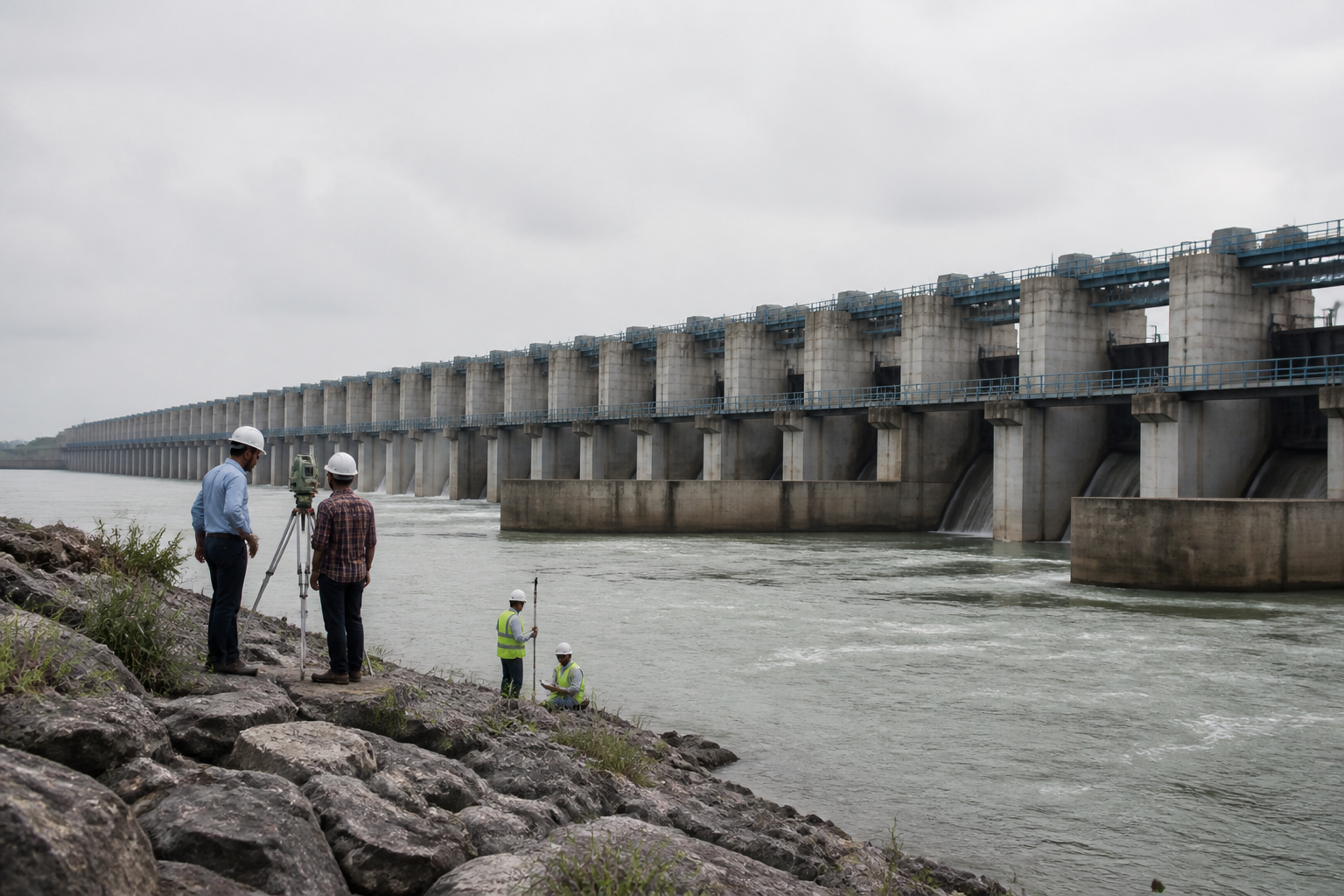
Telangana is considering an end-to-end diaphragm wall for the Medigadda barrage and stronger downstream stilling basins for all three barrages of the Kaleshwaram project, as the state moves towards a comprehensive rehabilitation programme. Irrigation minister Uttam Kumar Reddy said the final designs are expected within two to three weeks, with work planned to begin in November or December and finish by June 2027, before the next monsoon.
The proposed diaphragm wall would run across the entire width of the Medigadda barrage and is intended to provide comprehensive protection to its foundation. The state is also examining the strengthening and extension of downstream stilling basins at Medigadda, Annaram and Sundilla.
Stilling basins are designed to reduce the velocity of water released downstream and dissipate its energy. According to the minister, strengthening and extending these structures would be necessary at all three barrages to improve their ability to control the force of floodwaters.
The proposals are based on a preliminary assessment of extensive technical tests conducted at the three barrages. Uttam said soil, concrete and foundation investigations recommended by the National Dam Safety Authority were nearing completion. IIT Bombay and international engineering consultancy AFRY India have been engaged to examine the test findings and prepare repair and rehabilitation designs.
The final interventions for each barrage have not yet been confirmed. The design agencies are reviewing the investigation results to determine the precise structural measures required at Medigadda, Annaram and Sundilla. The minister said the final design report was expected in two or three weeks.
The state government intends to begin rehabilitation work in November or, at the latest, December, and complete it by June 2027. The proposed schedule is aimed at completing the works before the next monsoon, although the final scope will depend on the designs prepared after the technical assessments.
Uttam described the rehabilitation of the damaged barrages as technically more complex than constructing a new structure. Despite that complexity, he said the government had decided to proceed with repair, rehabilitation and rebuilding in the larger interests of Telangana.
The government sought assistance from national and international institutions after taking office to establish the causes of the structural failures and identify technically sound rehabilitation measures. The NDSA inspected the barrages and prescribed a series of investigations, whose findings are now being considered by the design agencies.
The state’s stated objective is to restore all three barrages to full functionality through a comprehensive engineering solution. The next formal milestone is the submission of the final rehabilitation design report, after which the government is expected to proceed with the planned works.
