


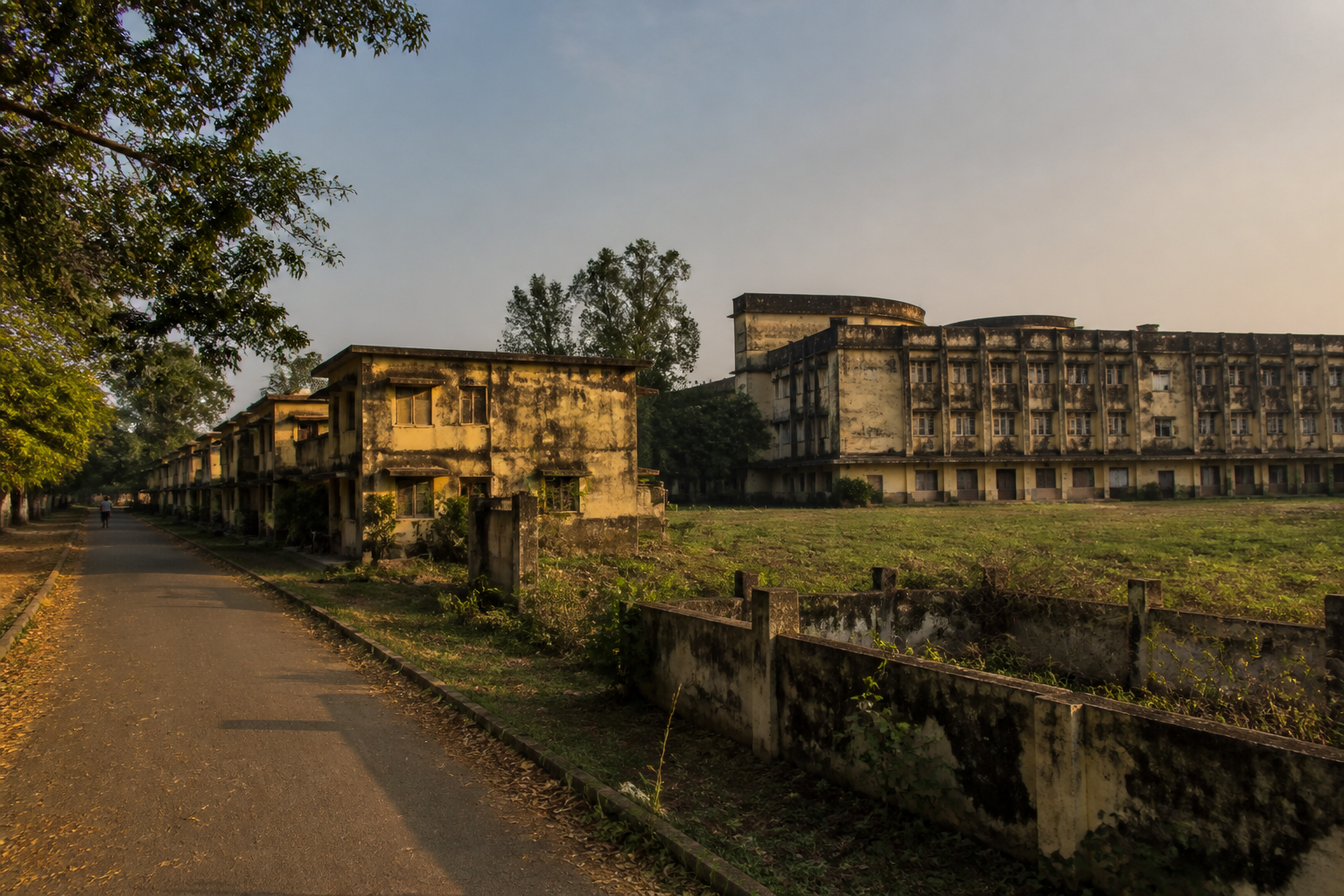
The decline of Mining & Allied Machinery Corporation (MAMC) has left more than a shut factory behind. In Viswakarma Nagar, a residential neighbourhood built around the Durgapur engineering undertaking, the collapse of industrial employment has also weakened the social and physical infrastructure that once gave the colony its purpose.
The Statesman reported that the neighbourhood wore a deserted look on the day of Viswakarma Puja, a festival historically associated with engineering and industrial work. Residents told the newspaper that the colony once organised at least 12 local pujas, apart from a major celebration inside the factory. This year, according to retrenched workers’ representatives quoted in the report, there was no visible celebration.
That detail is more than a cultural observation. It captures the way an industrial closure can empty public life from a planned settlement. Viswakarma Nagar was not simply a collection of homes near a factory. It was a company township with housing, schools, healthcare, an auditorium and football grounds. When the industrial institution weakened, the neighbourhood’s shared civic life weakened with it.
The colony is spread across Wards 23 and 24 of the Durgapur Municipal Corporation and contains 4,326 company quarters, according to the report. It also includes two schools, a hospital, an auditorium and football grounds. The report says these facilities have become overgrown with algae, indicating that the problem extends beyond vacant or ageing housing. The physical assets of the township remain, but their maintenance and institutional purpose appear to have deteriorated.
This is the central urban question raised by MAMC’s decline: who is responsible for a company town after the company stops functioning? Industrial housing and civic facilities are usually created as part of an integrated employment system. The employer builds or manages the homes, supports social infrastructure and supplies the economic activity that sustains local shops, transport and services. Once the employer disappears, ownership, maintenance and service responsibility can become divided between public agencies, former workers and new institutional owners.
MAMC was built in 1965 by a Russian government firm to manufacture equipment for the coal-mining industry. Its location in Durgapur reflected the city’s wider role as an industrial centre in Bengal. The undertaking was part of a public-sector model in which heavy engineering capacity, industrial employment and planned urban development were closely connected.
The company became financially sick and was referred to the Board for Industrial and Financial Reconstruction in 1992 under the Sick Industrial Companies Act, 1985. The report says the Centre declined to approve a revival package of Rs 142 crore. MAMC subsequently shut down in January 2001.
The sequence is important because it shows that the present condition of Viswakarma Nagar is not the result of a single recent decision. The neighbourhood has been living with the consequences of closure for more than two decades. Each stage of the institutional process — sickness, failed revival, closure, transfer and a later proposed restructuring — has added another layer of uncertainty for residents.
In 2003, the Calcutta High Court handed over the colony to the Asansol Durgapur Development Authority. That transfer placed the residential settlement within a development authority’s jurisdiction, but it did not automatically restore the economic role that had sustained it. A development authority may control land or housing assets, while municipal bodies remain responsible for civic services and other agencies retain responsibility for former employees or industrial property. The supplied report does not establish how these responsibilities are currently divided, but the condition of the facilities points to the practical difficulty of managing a township after industrial ownership changes.
A second possible revival emerged in 2010. A consortium comprising Bharat Earth Movers Limited, Coal India Limited and Damodar Valley Corporation won the auction of MAMC with a Rs 100 crore bid and declared that it would revamp the undertaking. Former workers’ representatives now say that this promise has not translated into renewed industrial activity. Asim Chatterjee, president of a retrenched workers’ welfare forum, told The Statesman that residents had lost the courage to organise local pujas. Binoy Chakraborty, secretary of the former labour union’s Centre of Indian Trade Unions unit, said BEML had backed away from the revival plan.
Those statements are the workers’ representatives’ assessment of the situation, as reported by The Statesman. The supplied report does not include a fresh official statement from BEML, Coal India, Damodar Valley Corporation, the Asansol Durgapur Development Authority or the Durgapur Municipal Corporation explaining the current status of the assets or the revival proposal. That absence matters because the future of the colony depends not only on the historical failure of MAMC but also on present responsibility for land, buildings, services and redevelopment.
The numbers convey the scale of the urban footprint. A settlement of 4,326 company quarters is large enough to function as a distinct neighbourhood rather than an isolated industrial housing cluster. The presence of two schools, a hospital, an auditorium and sports grounds suggests a complete social infrastructure designed for a stable workforce and its families. If these facilities are no longer maintained, the loss is not limited to the former employees who occupy or once occupied the quarters. It affects the possibility of retaining a functioning neighbourhood in an established part of Durgapur.
At the same time, the report does not provide occupancy figures, the current number of residents, the ownership status of individual quarters, maintenance budgets, utility conditions or the extent of structural damage. It also does not establish whether the schools and hospital are formally closed, underused or operating in a reduced manner. These missing details limit what can be concluded about the precise condition of the colony, but they do not erase the broader pattern documented by residents and the visible deterioration described in the report.
The MAMC case also exposes the limits of measuring industrial revival only through a factory’s reopening. A functioning industrial undertaking supports more than production. It anchors housing demand, local retail, education, healthcare, recreation and transport. When the undertaking fails, these connected systems can contract at different speeds. Employment may disappear first, followed by maintenance, population stability and the use of community facilities. A township can therefore remain physically present while becoming socially and economically hollow.
This is particularly relevant to older industrial cities such as Durgapur, where planned neighbourhoods were built around steel, coal, heavy engineering and related public-sector activities. Such cities carry a legacy of large institutional land parcels and purpose-built housing. Their future cannot be addressed only by attracting a new company to an old factory site. It also requires decisions on what happens to existing housing, public facilities and land-use patterns when the original industrial model no longer works.
The governance structure described in the report is layered. MAMC was the original industrial institution. The Centre was involved in the earlier revival decision. The Calcutta High Court transferred the colony to the Asansol Durgapur Development Authority in 2003. The Durgapur Municipal Corporation covers the wards in which the colony is located. The 2010 consortium included BEML, Coal India and Damodar Valley Corporation. Each institution is connected to the site’s history, but the supplied material does not identify a single current agency responsible for a comprehensive neighbourhood plan.
That institutional fragmentation can create a familiar urban problem: assets remain visible, but accountability becomes difficult to see. A school may be physically present without a clear operating authority. A hospital building may survive without the institution that staffed it. Company quarters may continue to house former workers while questions over tenure, repairs and redevelopment remain unresolved. Public authorities may inherit a settlement without inheriting the financial resources or administrative framework needed to restore it.
The report places this unresolved industrial legacy beside a newer proposal for Durgapur. In July, according to The Statesman, the city was proposed as a potential technological hub, with a microchip manufacturing facility, IT parks, artificial intelligence units and hyperscale data centres intended to attract fresh investment. The proposal was described by Bengal Finance Minister Swapan Dasgupta as a roadmap for transforming the steel-and-coal city into the state’s first Silicon Valley.
The contrast is striking but should not be treated as proof that the newer plans will succeed or fail. The supplied material does not provide funding details, timelines, land arrangements or implementation guarantees for the proposed technology hub. What it does show is that Durgapur is being asked to carry two urban stories at once: the promise of a new economy and the unresolved physical legacy of an old one.
That tension is central to any transition strategy. New investment announcements can generate a future-facing narrative, but established neighbourhoods also require attention. The condition of Viswakarma Nagar raises questions about whether industrial transition includes only new sectors and new capital, or whether it also accounts for workers’ housing, inherited public facilities and the social geography created by earlier investments.
MAMC’s story therefore belongs to the built environment as much as to industrial policy. Its factory may have closed in 2001, but the consequences remain embedded in homes, roads, institutions and public spaces. The 2010 revival promise, as described by former workers, added another period of expectation before the apparent retreat now reported. Every delayed decision increases the difficulty of deciding whether the township should be repaired, repurposed, redeveloped or transferred into a different administrative and economic model.
The available evidence confirms a long-running urban decline anchored in the failure of a major public-sector undertaking. It also confirms that Viswakarma Nagar retains a substantial physical footprint and a history of integrated industrial planning. What remains unclear is the current legal, financial and operational responsibility for the 4,326 quarters and associated facilities, as well as the status of the proposed revival and the newer technology-led plans for Durgapur. Those are the facts that future official decisions and public scrutiny will need to establish.

