


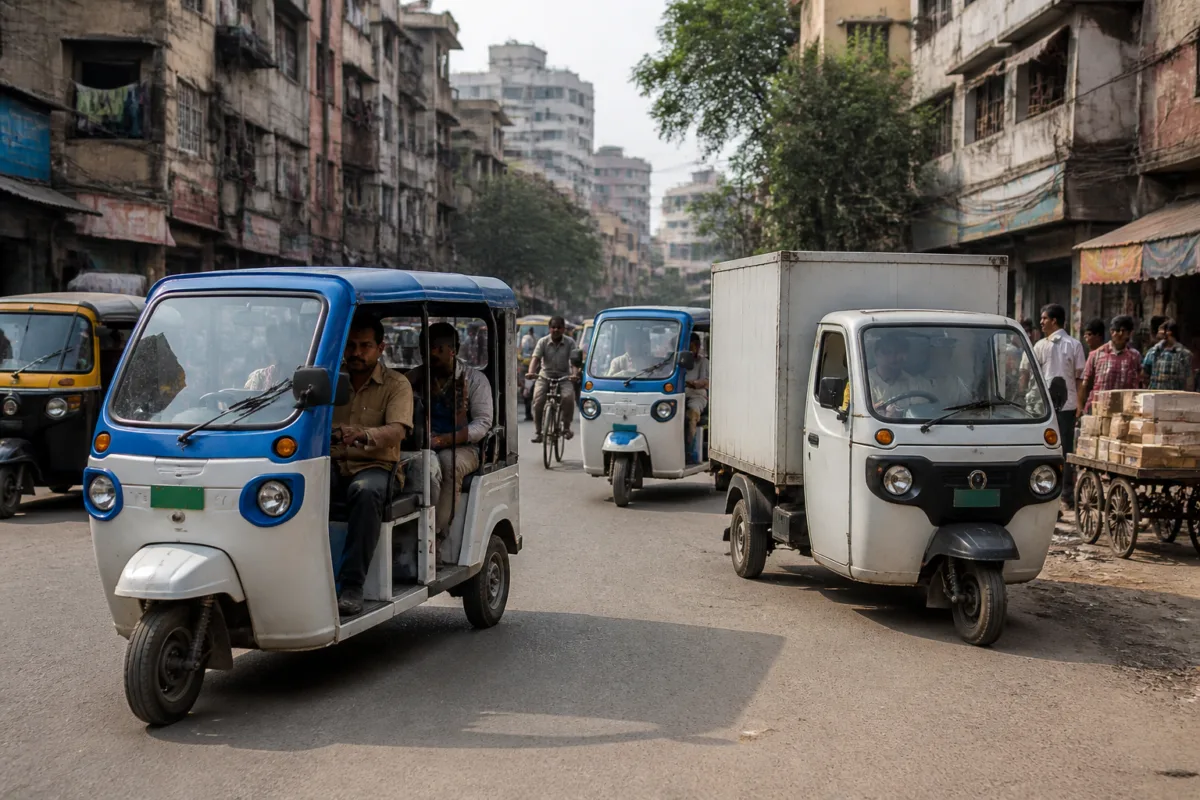
Mahindra Last Mile Mobility Ltd is considering a public listing in about 18 months to fund new electric three- and four-wheeler products and expand manufacturing capacity, a move that could shape the company’s role in passenger and cargo transport within Indian cities.
The proposed timeline is broad and no listing date has been finalised, company chairman Rajesh Jejurikar said in an interview with Press Trust of India. He said the company did not want management attention to be diverted by the work involved in an initial public offering.
Jejurikar said proceeds would be used mainly to support growth in new segments, develop products and increase capacity, rather than only to provide an opportunity for existing investors to unlock value. Mahindra would continue to participate in the company’s growth and did not intend to significantly reduce its stake, he said.
Mahindra Last Mile Mobility, which the company chairman said has a valuation of around $1 billion, currently has two investors, with a third expected to join shortly. The company is also examining potential overseas markets, although Jejurikar said international expansion would require assessments of product suitability, business potential and electric-vehicle penetration in each market.
The company’s immediate product focus is expected to remain urban last-mile transportation. Jejurikar said it was evaluating electric three- and four-wheelers for both passenger and cargo applications, without disclosing specific upcoming models. Passenger electric three-wheelers have so far driven demand, while the company expects cargo vehicles to gain momentum.
That shift would place cargo mobility alongside passenger transport as a potential area of expansion for electric vehicles operating within cities. However, the company has not provided details on target cities, production volumes, launch dates or the capacity increase it is considering.
Jejurikar said vehicle-price incentives under the FAME and PM E-DRIVE schemes were no longer available for the category, leaving the production-linked incentive scheme as the only remaining support mentioned by the company. He said higher volumes could help reduce material costs, while customers’ recognition of the operating economics of electric vehicles could create some scope for pricing.
The company’s approach therefore depends on both manufacturing scale and customer adoption. Jejurikar said cost optimisation would come partly from higher volumes and partly from customers seeing sufficient economic value in electric vehicles. The interview did not provide a forecast for sales, fleet deployment or the effect of the proposed expansion on urban emissions or congestion.
Mahindra Last Mile Mobility has also received enquiries from potential overseas partners after its recognition by the Earthshot Prize. The company has not yet undertaken detailed work on its global strategy, Jejurikar said, and any international expansion would require distribution, spare-parts and service networks.
The £1 million received as part of the Earthshot Prize will not be used for business expansion. Instead, the company plans to use the amount to support women who want to become drivers and promote women’s empowerment, according to Jejurikar.
For Indian cities, the immediate significance of the proposal lies in the possible expansion of electric vehicles serving short-distance passenger and cargo trips. The extent of that impact will depend on the products eventually launched, their affordability, charging and service support, and whether the proposed listing and capacity expansion proceed on the broad timeline described by the company.

