


Maharashtra’s recorded noise pollution offences have risen from 247 in 2024 to 689 by September 2026, but the figures reveal more than an increase in complaints or festival-related violations. They show a regulatory system attempting to measure and record a problem that residents have long experienced, while still struggling to demonstrate consistent enforcement across streets, public events, silence zones and permitted loudspeaker installations.
The figures were placed before the National Green Tribunal in an affidavit filed by the office of Maharashtra’s director general of police. The affidavit said offences rose to 328 in 2025 and 689 in the first nine months of 2026. On the available figures, the number recorded in 2026 had already exceeded the total for the previous two years combined, although the periods are not directly comparable because the 2026 figure covers only up to September.
The immediate case concerns noise pollution, including loudspeakers used during festivals and other public events. But the material submitted to the tribunal indicates that the enforcement problem is not limited to unauthorised installations. The DGP’s office acknowledged that loudspeakers operating with valid permissions could also breach prescribed noise limits. That distinction is important because a permission to install or use a loudspeaker does not remove the obligation to comply with the applicable sound-level restrictions.
The police affidavit stated that action should be taken under the Maharashtra Police Act against loudspeakers that violate regulations, whether they are installed illegally or have permission. This shifts the enforcement question from simply identifying unauthorised equipment to checking actual sound levels and responding when limits are exceeded.
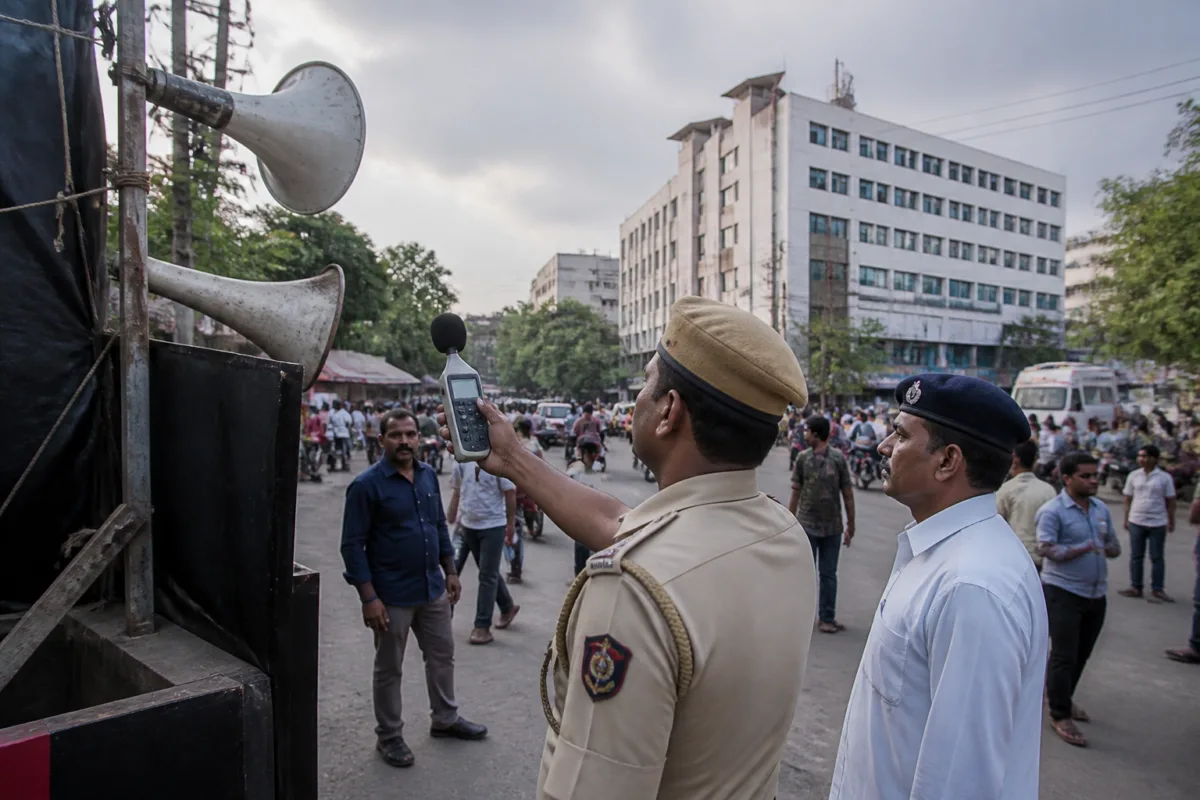
That is a more demanding administrative task. It requires local police stations to measure noise, record the location and circumstances of an offence, identify the responsible person or organisation, and report the action taken. The DGP’s office said police stations had been directed to measure noise levels in their jurisdictions and submit monthly reports on violations to the special inspector general of police for law and order and the regional officers of the Maharashtra Pollution Control Board.
The reporting mechanism follows a circular issued in July 2025. Its stated purpose was to establish procedures for handling complaints and taking action against violators. The significance of the circular is therefore not only that it creates an instruction for field-level enforcement, but also that it places local measurements within a monthly reporting chain involving the police and the pollution control board.
However, the case also highlights the difference between issuing instructions and producing usable public evidence of enforcement. The police have now disclosed offence figures, but the material before the tribunal does not establish how many complaints were received, how many measurements were conducted, what sound levels were recorded, how many prosecutions or penalties followed, or whether repeat violations were identified. The number of offences is an important starting point, but by itself it cannot show whether the regulatory system is becoming more effective.
That limitation matters because a rise in recorded offences can have more than one explanation. It may reflect worsening compliance, stronger police registration, improved monitoring, or a combination of these factors. The supplied material does not establish which explanation accounts for the increase. What it does establish is that violations are being recorded at a significantly higher level and that the police department has recognised the need to act against permitted as well as unauthorised loudspeakers.
The institutional division of responsibility adds another layer. The Central Pollution Control Board told the tribunal that enforcement of noise pollution norms rests with the police, the Maharashtra Pollution Control Board and other state agencies concerned. This means the system is not operated by a single authority. Police agencies are responsible for action in the field, while the pollution control machinery is involved in environmental regulation and monitoring. The effectiveness of the framework consequently depends on information moving between institutions.
The CPCB’s submission also pointed to a data problem. It said it had sought enforcement-related information for the preceding three years from pollution control boards across the country, but the MPCB had not provided the required information by the time the CPCB filed its affidavit. The gap does not prove that enforcement did not occur. It does show that data collection and reporting remain incomplete even while the tribunal is examining the wider issue.
For citizens, this administrative gap is experienced at street level. Complaints about loudspeakers are often made in specific places and at specific times, including near hospitals and other declared silence zones. Yet without sound-level measurements, a complaint may not become a documented violation. Without a documented violation, it becomes difficult to establish whether action was taken, whether the source repeated the offence, or whether a local area remained exposed to recurring noise.
Pune-based audiologist and noise pollution activist Kalyani Mandke told the newspaper that her original petition before the NGT was limited to noise pollution during festivals in Pune, but that the tribunal widened the matter after taking suo motu cognisance of the issue last year. She said the problem had become a year-round concern rather than one restricted to festivals and urged authorities to begin implementing norms in declared silence zones, including areas around hospitals.
Her account identifies a structural weakness in the way noise is often governed: enforcement can become concentrated around visible annual events, while routine violations between festivals receive less attention. The police affidavit’s reference to monthly reporting is therefore significant because it suggests an attempt to create a regular administrative process rather than rely only on seasonal drives or responses to exceptional complaints.
The affidavit also referred to instructions issued to police commissioners and superintendents of police to implement the Bombay high court’s directions on firecrackers across Maharashtra. In its September 22 order, the high court directed a complete ban on bursting firecrackers during festivities on streets and roads and asked authorities to take measures to prevent air and noise pollution. The police response places firecracker-related noise within the same broader enforcement landscape as loudspeakers, although the two sources of pollution involve different activities and legal controls.
The connection is operational rather than identical. Both require authorities to act at the location where a violation occurs, often during crowded public events and within limited time windows. Both also require clear instructions to local officials and a record of implementation. The court’s direction and the DGP’s circular therefore increase the number of responsibilities placed on field agencies, making coordination and evidence collection central to the outcome.
The case raises a wider question about what constitutes enforcement in urban environmental regulation. A rule is visible to residents only when it produces a predictable response: a complaint is received, a measurement is conducted, a violation is assessed against a standard, and an action is recorded. If any link is missing, the formal existence of the rule may not translate into a reduction in exposure for people living, working or seeking treatment in affected areas.
The available evidence does not establish whether noise levels have increased across Maharashtra, whether offences are concentrated in particular cities, or whether the 689 cases represent complaints, registered offences, prosecutions or another police classification. Those distinctions will matter when the tribunal examines the data. The figures should therefore be read as an indicator of recorded enforcement activity, not as a complete measure of the population’s exposure to noise.
What is clear is that Maharashtra’s institutions are being pressed to address three connected problems: compliance by both unauthorised and permitted loudspeaker users, regular enforcement beyond festival periods, and reliable sharing of data between police and pollution-control agencies. The tribunal proceedings have brought these issues into one forum, while the police affidavit has made the scale of recorded offences more visible.
The next test will be whether the new reporting and measurement instructions produce detailed, consistent and accessible evidence of action. The NGT matter has been adjourned to January, according to Mandke. Until then, the central question is not simply why the number of recorded cases has risen, but whether the administrative system can show what happened after each violation was identified and whether residents in silence zones and other affected areas received effective protection.

