


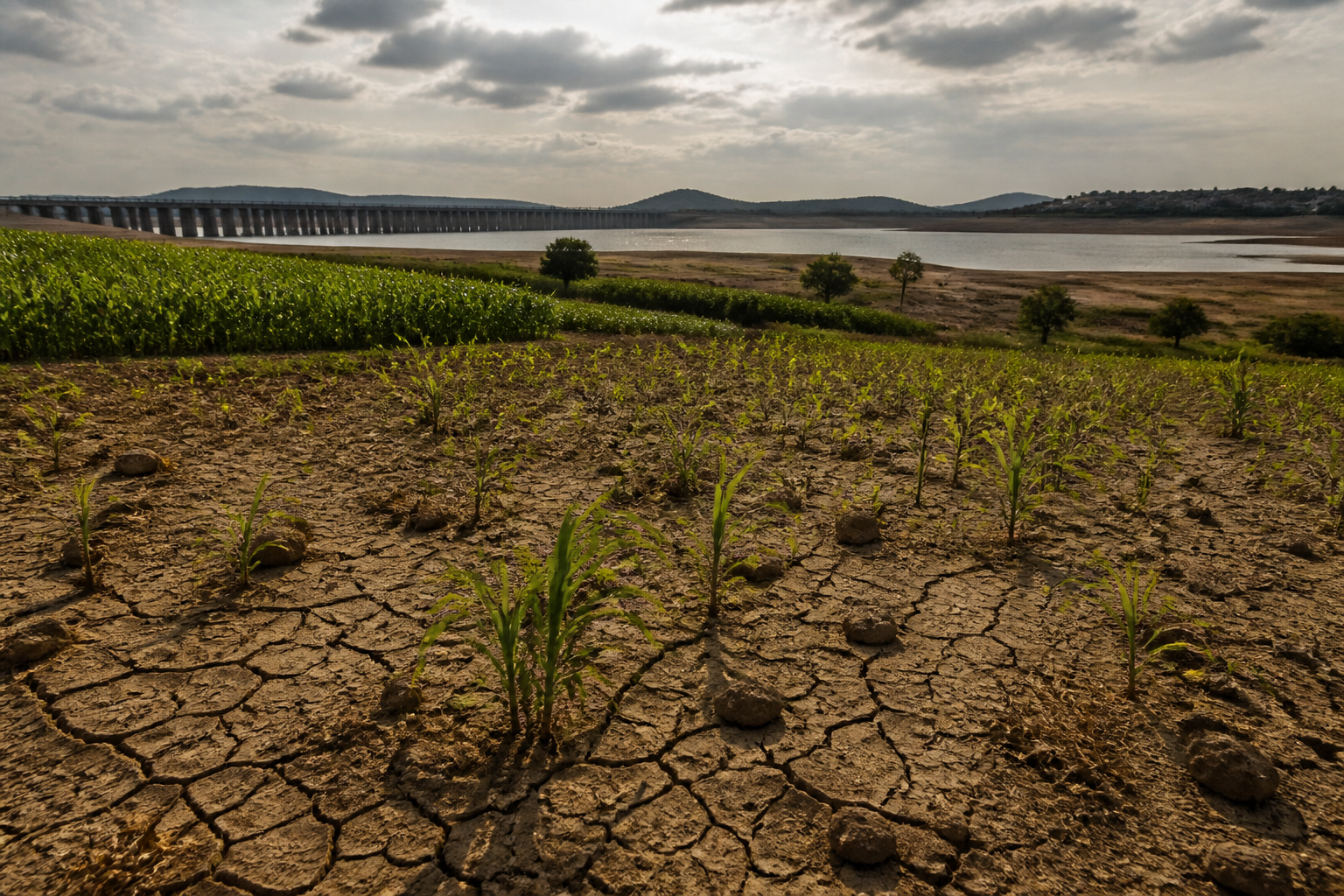
Maharashtra’s drought is emerging not from one failed week but from 17 weeks of uneven rainfall, according to an analysis of India Meteorological Department data cited by the Times of India. By September 25, the state had received 798.2 mm of rain against a normal 970.9 mm, an overall deficit of 18%. The more important finding, however, is how that deficit accumulated: Marathwada experienced deficient to large-deficient rainfall in 12 of the 17 tracked weeks, while Vidarbha saw the same pattern in 11 weeks.
That distinction matters because a seasonal rainfall total can conceal the way water actually arrives. A state may record intense rain during a few episodes and still experience prolonged stress if the intervening gaps are long. The IMD data cited in the report shows precisely that uneven pattern in Maharashtra. It also shows that the state’s drought story is geographically concentrated rather than uniform, with Marathwada and Vidarbha carrying most of the shortfall while Pune and Nashik recorded rainfall surpluses.
Satyaban Bishoyi Ratna, head of climate application and user interface at IMD Pune, described the pattern as different from a typical bad monsoon year. Marathwada remained continuously deficient to large-deficient from the middle of August, Ratna said, while Vidarbha followed almost the same trajectory apart from one week of excess rain in September. The observation shifts attention from the headline deficit to the sequence of rainfall weeks that produced it.
For cities and towns, this is an important distinction in how drought risk is understood. Water systems do not respond only to the final seasonal total. They are affected by the timing, location and intensity of rainfall, as well as by whether water can be stored and used when it is needed. The supplied report does not provide urban reservoir, drinking-water supply or municipal demand data, so it cannot establish the direct effect on specific cities. It does establish that a statewide average conceals sharply different regional conditions.
The regional contrast is pronounced. In Marathwada, the rainfall deficit ranged from 33% in Nanded to 45% in Dharashiv. In Vidarbha, it ranged from 39% in Amravati to 28% in Chandrapur. These are not minor variations around a common state-level trend. They show that districts within the same broad region have faced different levels of rainfall stress, creating different pressures on farming, local water availability and administrative response.
The comparison with other parts of Maharashtra makes the unevenness even clearer. Pune recorded an 18% rainfall surplus and Nashik a 37% surplus for the June 1 to September 25 period. The coexistence of surplus rainfall in some areas and severe deficits in others complicates the idea of a single Maharashtra monsoon. It also makes state-level averages less useful for understanding where the greatest pressure is located.
This unevenness is especially significant because the report notes that several dams in the affected region have reached full storage capacity. At first glance, full reservoirs might appear inconsistent with a drought narrative. In reality, the two conditions can exist together, although the supplied material does not provide enough information to determine the storage levels, catchment conditions or operational rules behind individual dams.
The apparent contradiction points to a central water-management question: how much protection does stored water provide when rainfall is badly distributed across time and space? A dam reaching full storage capacity records the presence of water at a particular point. It does not, by itself, demonstrate that rainfall has been reliable across the season, that farms have received water when required, or that every affected settlement has equal access to supplies. The report explicitly connects the uneven rainfall to agricultural disruption and farmer vulnerability despite the full storage levels in several dams.
That finding exposes the limits of using infrastructure capacity as a complete measure of resilience. Storage can cushion a rainfall deficit, but the evidence presented here suggests that storage does not erase the consequences of prolonged gaps between rainy days. The practical outcome depends on when water enters the system, where it is stored, how it is distributed and which users depend on it. The article does not supply enough evidence to assess those distribution systems, but it shows why reservoir status must be read alongside rainfall timing and district-level conditions.
The agricultural impact is the clearest consequence established in the source. The report says that the uneven distribution of rainfall affected agricultural activities and left farmers vulnerable. It does not quantify crop losses, changes in sowing, irrigation withdrawals or farm incomes. Those gaps are important because they limit how far the current data can be used to measure economic damage. What the evidence does show is a sustained rainfall problem during the monsoon period rather than a brief interruption that can be understood in isolation.
The 17-week sequence also changes the administrative meaning of the drought. A short dry spell may be treated as a temporary operational problem. Repeated deficient weeks across much of the season create a cumulative condition that requires authorities to track rainfall at a finer geographic and temporal scale. The IMD figures cited in the report already provide that level of differentiation: they distinguish between regions, districts and individual weeks rather than relying only on a single state total.
For Maharashtra’s urban and regional planning systems, that distinction has two implications supported by the available evidence. First, drought assessment needs to recognise local variation. A statewide deficit of 18% does not describe the conditions in Dharashiv, Amravati, Pune or Nashik equally. Second, rainfall totals need to be considered with the pattern of gaps and excess spells. The IMD official’s account indicates that one week of excess rain in Vidarbha did not reverse the broader trajectory of deficient rainfall.
The source also places Maharashtra among the worst-affected states in terms of rainfall deficiency so far. The report does not provide a comparative table or the figures for other states, so the extent of Maharashtra’s ranking cannot be independently assessed from the supplied material. Nevertheless, the statement reinforces that the state’s experience is part of a wider rainfall-deficiency picture, while the district data shows that the immediate consequences remain highly localised.
The most important conclusion is therefore not simply that Maharashtra received less rain than normal. It is that the state received rainfall in a pattern that created prolonged stress in Marathwada and Vidarbha, even as other regions recorded surpluses and some dams reached full storage. That combination challenges simple definitions of drought based only on seasonal totals or reservoir levels.
The evidence currently confirms the scale and unevenness of the rainfall deficit, but it does not establish the full downstream impact on drinking water, urban supply, crop production or reservoir operations. Those are the next questions that public agencies and readers will need answered. For now, the IMD figures show a monsoon that has failed unevenly and cumulatively—and that is the defining feature of Maharashtra’s drought story.
