


Lady Shri Ram College for Women has resumed offline classes after briefly shifting to online teaching following the alleged gang-rape of a 17-year-old girl at Aastha Kunj Park in South Delhi. The incident has transformed a routine student route into a test of how educational institutions, civic agencies and the police respond when public-space safety fails around a major urban campus.
According to a report by Millennium Post – Delhi, the alleged assault took place around dusk on September 21, 2026, inside the park, located about two kilometres from LSR and near a frequently used route to the Kalkaji Temple area and the nearby metro station. The report says the girl was visiting the park with a friend on her 17th birthday when three men allegedly attacked her at gunpoint.
The college’s decision to resume physical classes on September 24 came a day after teaching was moved online. Principal Kanika K Ahuja said student welfare remained the priority and that faculty mentors and counsellors were available. The decision restored classroom operations, but it did not resolve the question that has unsettled students: whether the routes and public spaces surrounding the campus can be considered safe for daily travel.
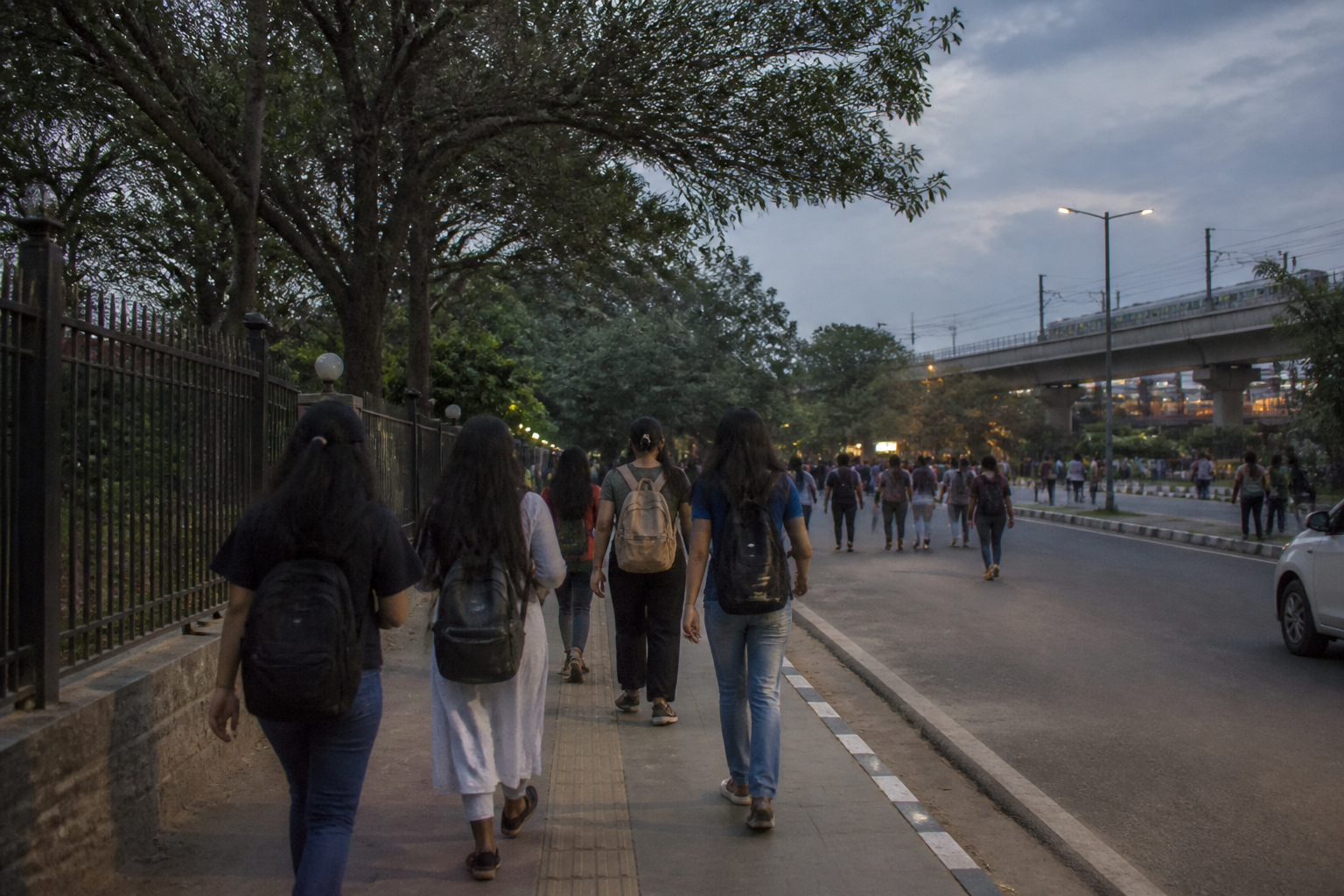
That distinction matters in a city where the boundary between a secure institution and an insecure journey is often thin. A college can control its gates, classrooms and internal procedures. It has limited control, however, over parks, footpaths, lighting, road edges, transit approaches and police visibility beyond its perimeter. Students experience the entire journey as one system, not as separate administrative jurisdictions.
The response around LSR reflects that gap. Hundreds of students joined a solidarity march outside the college, while student protesters raised concerns about broken streetlights, public gun violence and the absence of adequate accountability. Saavy, a Ram Lal Anand College student and member of the All India Students’ Association, told Millennium Post – Delhi that students were demanding accountability and greater freedom to protest against safety failures and restrictions imposed on women.
Another LSR student, identified as Sania in the report, described the social pressures surrounding participation in the protest. She said many women were covering their faces because they feared their parents would see them at the demonstration and call them back home. Her account shifts the safety discussion beyond policing alone. For women students, access to public space is shaped not only by the risk of violence but also by family controls, moral policing and the fear of consequences for speaking publicly.
The issue therefore has two connected layers. The first is physical safety: lighting, surveillance, policing, emergency response and the condition of routes linking campuses to public transport. The second is civic safety: whether students can raise concerns, participate in demonstrations and demand institutional action without being pushed out of public life. The source material does not establish the responsibility of any single agency for the alleged assault, but the protests show that students understand the problem as a system-wide failure rather than an isolated incident.
The geography described in the report is significant. Aastha Kunj Park is close enough to LSR to form part of the everyday landscape of students, even though it is outside the college campus. The route between an institution and a metro station is not merely a transport connection. It is an extension of the campus experience, particularly for students who depend on public transport and walk through the surrounding neighbourhood every day.
This is where institutional accountability becomes difficult. A college administration can provide counselling and communicate with students, but lighting, park management, policing and route security may fall under different public authorities. When responsibilities are distributed across agencies, a student’s experience of danger can become administratively fragmented. Each institution may address only the portion within its formal jurisdiction, while the unsafe journey remains unresolved.
The political response has also widened beyond LSR. The Akhil Bharatiya Vidyarthi Parishad held a protest outside the University of Delhi Vice-Chancellor’s office, linking the incident to wider concerns about threats faced by students across the university. ABVP and student leaders called for comprehensive security audits, regular police patrolling and an overhaul of transit-route security.
These demands point towards a more operational understanding of campus safety. A security audit would need to examine the complete route students use, including lighting, visibility, access points, crowd movement, blind spots and the distance between help points. Regular patrolling would raise questions about frequency, coverage and coordination. Transit-route security would require authorities to look beyond college gates and examine how students move between campuses, metro stations, bus stops, parks and surrounding roads.
The available report does not provide details of any completed security audit, a new patrolling schedule, arrests, a formal police response or a timetable for institutional changes. Those gaps are important. The public discussion has moved quickly from the alleged assault to demands for systemic reform, but the evidence supplied does not establish which measures have been accepted, funded or assigned to particular authorities.
The resumption of classes consequently carries an ambiguous meaning. Administratively, it signals that the college has restored its normal teaching schedule after a brief interruption. Socially, it does not represent a return to normal conditions for students who use the affected routes. The report describes a campus marked by grief, protest and determination, suggesting that attendance inside classrooms and safety outside them cannot be treated as separate concerns.
The episode also shows why urban safety cannot be measured only by the security arrangements inside institutions. Students interact with a wider public realm: parks, roads, footpaths, religious sites, transport corridors and poorly lit edges. If any link in that chain is unsafe, the institution’s internal protections cannot fully compensate. For women students in particular, the cost of an unsafe route may include altered travel patterns, restricted movement, dependence on escorts and pressure to avoid protests or public spaces.
What the evidence confirms at this stage is limited but consequential. LSR has resumed offline classes; the reported assault took place near a route used by students; students have protested; the college has pointed to counselling and faculty support; and student organisations are demanding audits, patrolling and route-level security. What remains unclear is how authorities will translate those demands into defined responsibilities, measurable interventions and publicly communicated timelines.
The next phase will determine whether the incident produces a documented review of the surrounding urban environment or fades into a temporary cycle of protest and reassurance. For LSR students, the central question is not simply whether classes are taking place again. It is whether the city beyond the college gate is being treated as part of the campus’s safety responsibility by the authorities that control it.
