


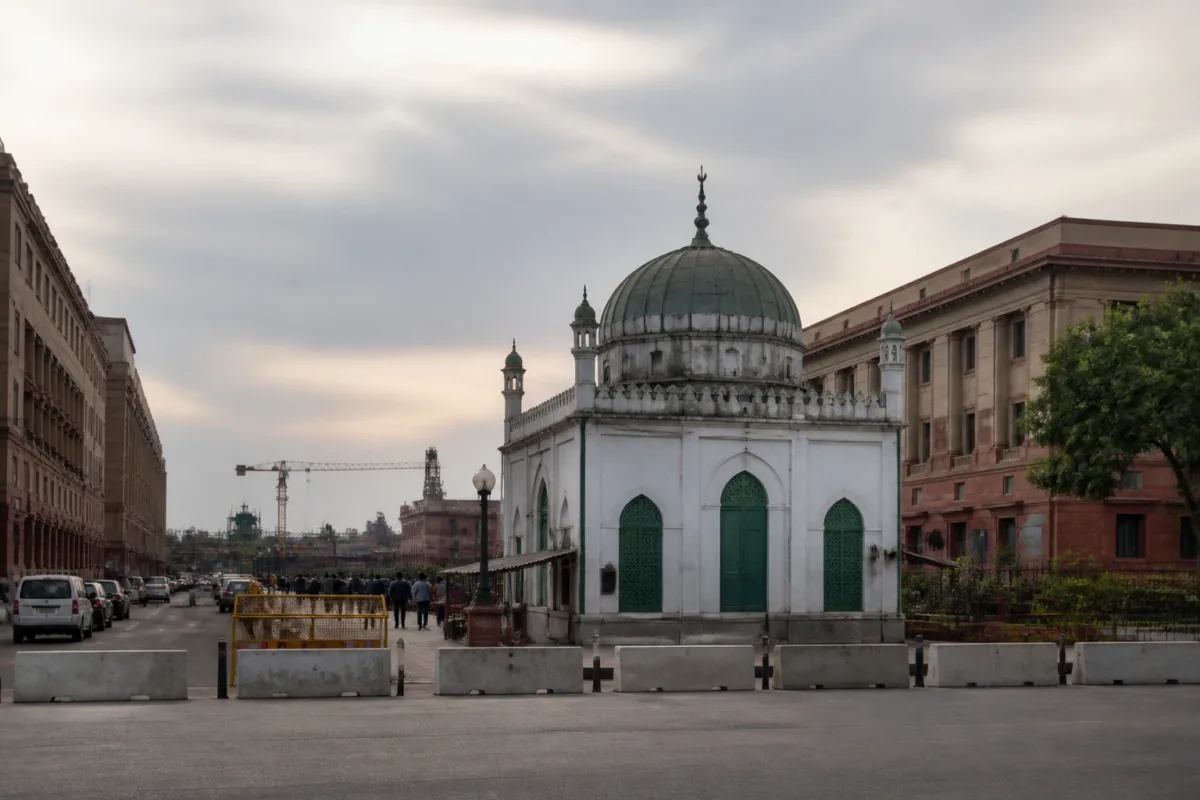
The Union government has told the Delhi High Court that the century-old Qadeemi Masjid at Krishi Bhawan in New Delhi must be removed to enable construction of Common Central Secretariat Buildings 4 and 5, drawing criticism from AIMIM president Asaduddin Owaisi.
The government argued before the court that a permanent religious structure within a government office complex is impermissible and incompatible with the secular character of government property. It said the mosque stands on the site identified for a major Central Vista redevelopment project and must be removed for construction to proceed.
According to the government’s submission, the Central Vista Redevelopment Master Plan provides for the redevelopment and reconstruction of Common Central Secretariat Buildings 4 and 5 at Plot No. 120. The plot covers the footprint of the existing Shastri Bhawan and Krishi Bhawan, two government-office complexes used for central administration.
The Union government described the construction of the two buildings as a public project of paramount national importance. It said the project is intended to modernise infrastructure considered essential to the functioning of the national government. The Qadeemi Masjid, which stands within the project site, was identified as an obstruction to executing the planned buildings.
Owaisi criticised the Centre’s position in a post on X. He referred to the mosque’s reported presence before 1912 and questioned the government’s argument on secularism by citing the Bhoomi Pooja held for the Central Vista project.
“Apparently, secularism is not offended by the use of one faith’s rituals for a public project, but is allergic to a masjid that has stood there even before 1912, long before Krishi Bhawan was even built,” Owaisi said.
The dispute places a religious structure within a wider question about how large public redevelopment projects treat existing sites, structures and uses on government land. The government’s position links the mosque’s removal to the approved footprint and construction requirements of the Common Central Secretariat buildings, while Owaisi’s response challenges the consistency of the secularism argument used in court.
The supplied court submission does not establish the mosque’s ownership, legal status, relocation arrangements or the timeline for its removal. It also does not specify the next hearing date or whether the Delhi High Court has issued an order on the government’s submission. The immediate legal and administrative status of the structure will therefore depend on further court proceedings and official directions.

