


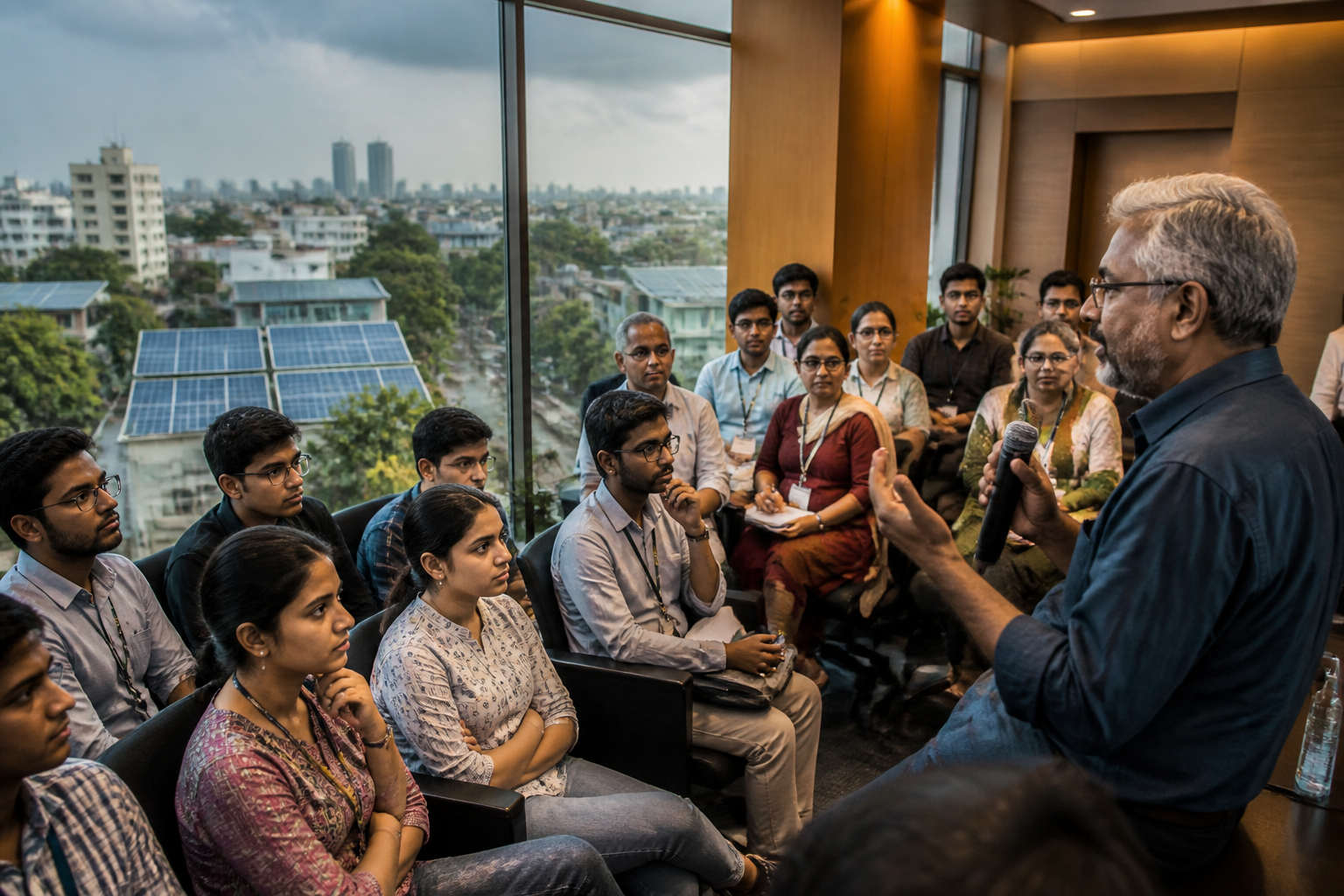
Kolkata’s climate resilience will depend not only on large infrastructure projects but also on reducing everyday energy waste and expanding solar power, NASA Jet Propulsion Laboratory scientist Goutam Chattopadhyay told students and teachers at a session hosted by the Bengal Chamber of Commerce and Industry.
Chattopadhyay, a senior scientist at NASA’s Jet Propulsion Laboratory and visiting professor at the California Institute of Technology, urged students to adopt simple energy-saving habits. “Charity begins at home. When you leave a room, turn off the light. Don’t unnecessarily connect your phone to the plug,” he said.
His remarks followed a question from a student about the immediate steps cities such as Calcutta and Mumbai could take in response to rising sea levels. The student referred to a United Nations report published earlier in September that warned millions of people were at “immediate risk” of losing their homes because of rising seas and permanent inundation.
The report, as described during the session, identified Calcutta and Mumbai as facing immediate and severe risks from accelerating sea-level rise and displacement. The supplied account does not provide the report’s title, projections or recommendations, but the discussion placed household energy use within a wider concern about the vulnerability of coastal cities.
Chattopadhyay also called for greater adoption of solar energy in India. “India has abundant solar energy. But there are not enough solar panels. Germany doesn’t get to see that much sun. But the country has miles and miles of solar panels,” he said.
The comments point to two separate but connected parts of the urban climate challenge: reducing energy consumption and increasing access to lower-carbon electricity. The session did not announce a new government programme, funding commitment or city-level implementation plan. Its focus was on individual behaviour and the wider need to expand solar generation.
Gautam Ray, former president of the Bengal Chamber of Commerce and Industry, moderated the event. Alongside climate concerns, students questioned Chattopadhyay about his work at NASA’s Jet Propulsion Laboratory and the search for life beyond Earth.
Chattopadhyay said he had worked with NASA for 26 years and described daily interaction with post-doctoral researchers from different parts of the world as an important part of his work. “Innovation does not happen in the back room. Go and talk to people. Talk to real people. Trying to solve something, maybe you will end up solving something else,” he said.
The scientist also told students that life beyond Earth was possible, while noting that planetary bodies with similar conditions were light-years away. Humanity’s fastest active spacecraft, he said, would take tens of thousands of years to reach them.
The climate discussion ended with a practical message directed at students: reduce unnecessary electricity use, consider the role of solar power and connect personal habits with the larger risks facing cities exposed to rising seas.
