


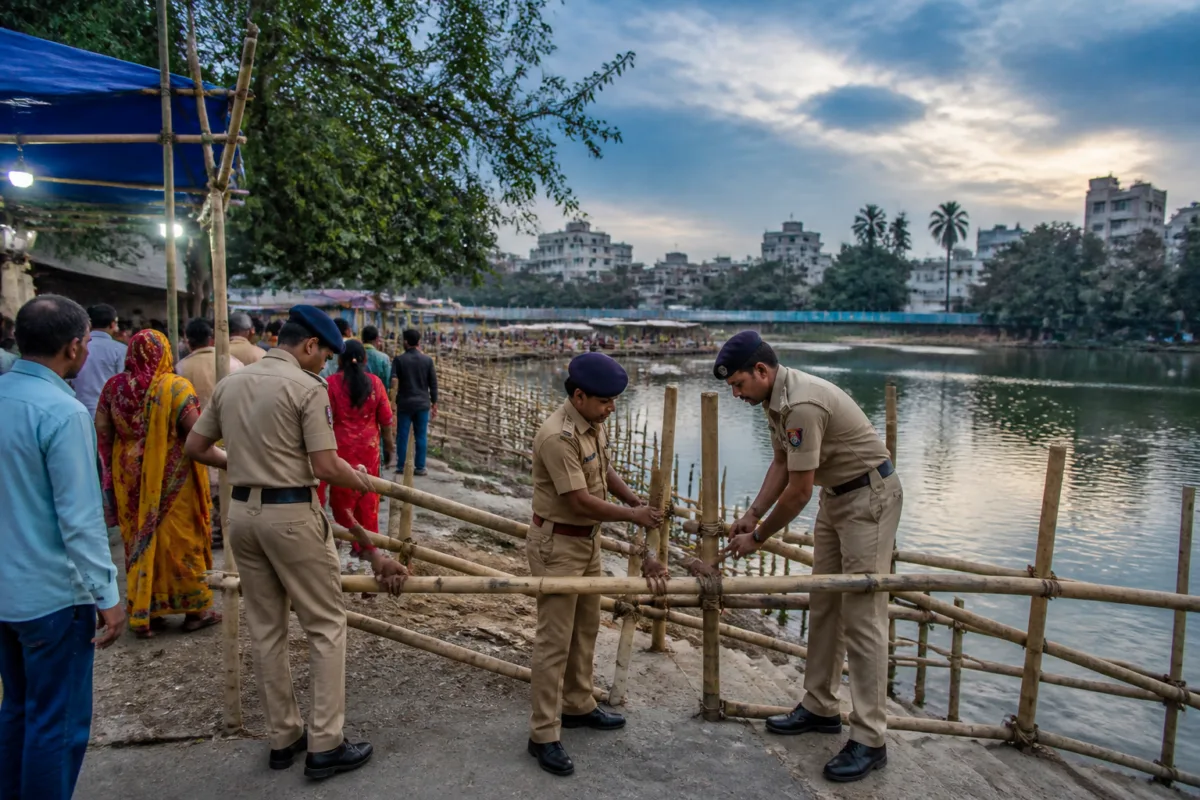
Kolkata Police will deploy 3,700 personnel across 133 ghats and water bodies for Chhath Puja, while intensifying raids on illegal firecracker markets and monitoring DJ music after noise violations and attacks on police during Diwali.
The deployment will cover permanent ghats, natural water bodies and temporary or artificial waterfronts where devotees are expected to gather on Monday evening and Tuesday morning. At least 35 senior officers, including deputy commissioners and assistant commissioners, will lead the operation, according to the police arrangements reported by the Times of India.
Fourteen police station areas have been identified for additional surveillance, particularly around local water bodies that have recorded repeated violations during Chhath in previous years. The areas include Mukundapur, Survey Park, Kasba, Dhakuria, Paddapukur, Beleghata, Tangra, Cossipore, Sarsuna and Parnasree. Police said major ghats along the Hooghly generally see fewer serious infringements, while smaller local water bodies with limited police presence have been more vulnerable to illegal firecracker use.
Another 300-odd personnel will guard Subhas Sarobar and Rabindra Sarobar from 10am on Sunday in shifts. The deployment will include traffic police, who will redirect devotees towards temporary and permanent water bodies. Rabindra Sarobar’s gates will again be barricaded, with tin structures placed between bamboo barricades at selected points to prevent people from entering through gaps.
The arrangements follow a noisy Diwali during which police faced attacks at three locations and recorded concerns over banned firecrackers and excessive sound. Police personnel told the Times of India that the possibility of similar violations during Chhath could not be completely ruled out in some pockets with a history of non-compliance. At the same time, officers said measures to control DJ music had worked in recent years and could be repeated through Chhath and the upcoming Jagatdhatri Puja.
Police have been instructed to conduct frequent raids at firecracker trading centres, including Old China Bazar and Chandi Chowk in central Kolkata, as well as selected locations in southern parts of the city. The aim is to prevent the sale of illegal firecrackers before the festival. Police sources said around 250 kg of illegal firecrackers had been seized in Kolkata over the past three years, while daily seizures also indicated that illegal stock remained available in the city.
Public announcements and awareness drives are planned in business districts and neighbourhoods with large numbers of Chhath devotees, including Posta, Burrabazar and several areas in north and south Kolkata. The police have also mapped locations that reported the highest number of noise complaints during Diwali and points where illegal crackers were burst during Chhath in earlier years.
The city’s preparations are also shaped by last year’s complaints, including an account from a Tangra professor who emailed senior officers about disturbances lasting more than 24 hours. Police said the deployment would be slightly lower than last year because devotees were familiar with the arrangements and because the plan had been extended across more parts of the city after discussions with local communities. A separate police presence will continue in selected areas to manage law and order and prepare for Jagatdhatri Puja on October 30.

