


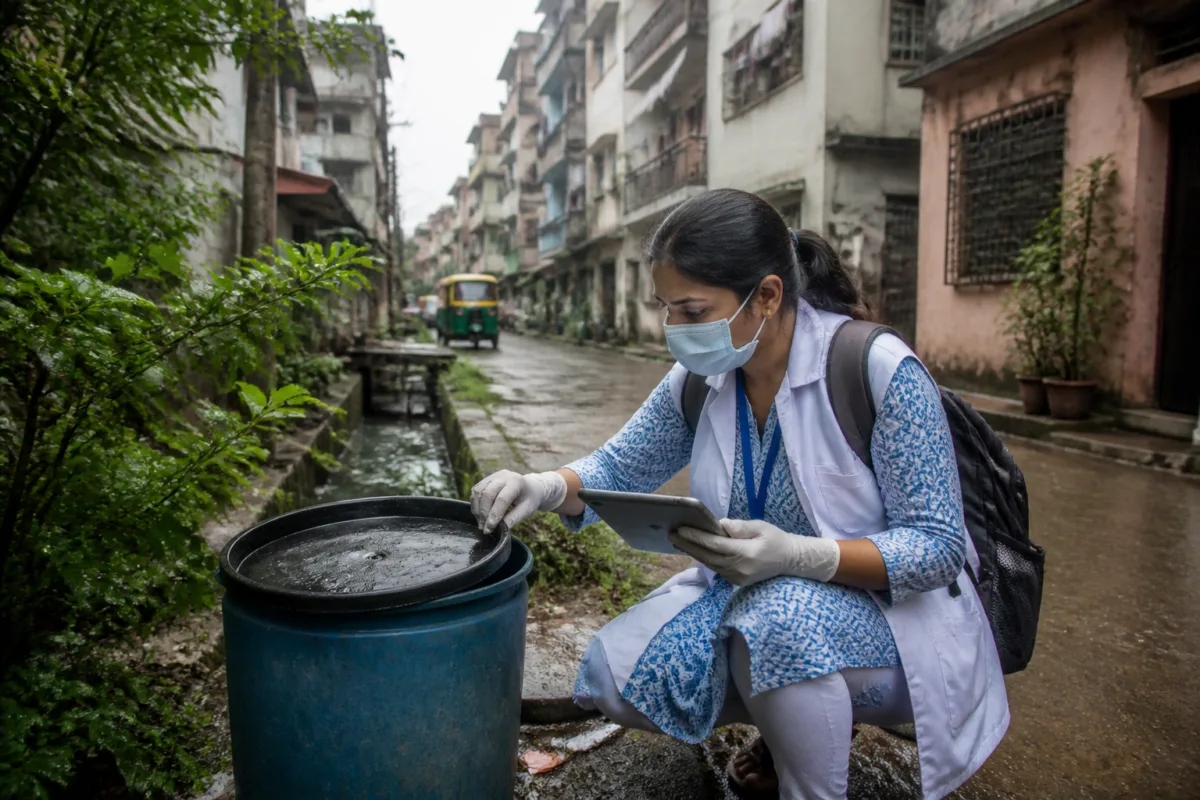
West Bengal’s dengue control measures have received appreciation from the Union health ministry after the state reported 14,634 cases around the 44th week of this year, compared with 17,032 around the same period last year. The figures indicate a decline, but the more important development is the administrative machinery cited alongside them: a reporting portal, training for healthcare workers and regular monitoring. Together, these measures show how dengue control is not only a matter of treating patients, but also of building a system that can detect, report and respond to outbreaks across an urbanising state.
The appreciation came at a November 6 review meeting of high-burden states convened by the National Centre for Vector Borne Diseases Control. The meeting placed West Bengal’s response within a wider public-health framework rather than treating the state’s dengue numbers as an isolated achievement. The report does not provide a state-wise comparison of performance or identify the specific indicators used by the Centre to assess the measures. It does, however, identify three institutional features that were recognised: digital reporting, healthcare-worker training and a regular monitoring and observation system.
That combination matters because dengue is experienced locally but managed through multiple administrative layers. A patient may first appear in a neighbourhood clinic, private facility or hospital, while the public-health response depends on information moving to health authorities and on frontline workers being able to act on it. A reporting portal is therefore more than a technology intervention. Its value depends on whether cases are entered consistently, whether information is timely and whether officials can use the data to identify concentrations of illness and organise a response.
The supplied report does not explain the portal’s coverage, the number of facilities connected to it, the frequency of reporting or the methods used to validate entries. Those gaps prevent a firm assessment of how much the portal contributed to the fall in reported cases. The available evidence supports a narrower conclusion: the Centre specifically recognised the portal as part of West Bengal’s dengue-control approach, and the state reported fewer cases than in the comparable period last year.
The reported numbers are significant but require careful reading. West Bengal recorded 14,634 dengue cases around the 44th week this year, compared with 17,032 around the 44th week last year. That is a reported reduction of 2,398 cases, or roughly 14 per cent. The comparison provides a clear year-on-year signal, but it does not by itself establish why the decline occurred. The article does not provide information on testing volumes, reporting coverage, deaths, hospitalisation, geographic distribution, weather conditions, mosquito-control operations or changes in case definitions.
This distinction is important for urban public-health reporting. A fall in reported cases can reflect a real reduction in transmission, but reported totals are also shaped by access to testing, healthcare-seeking behaviour, reporting discipline and the ability of institutions to capture cases across public and private facilities. Since the report does not provide those supporting indicators, the number should be treated as an important administrative measure rather than a complete account of dengue conditions across the state.
The workforce component of the state’s response addresses another part of the system. Training programmes for healthcare workers were among the initiatives appreciated by the Union health ministry. Training can improve the ability of frontline staff to recognise suspected cases, record information and follow established procedures. Yet the report does not specify the number of workers trained, the cadre of workers involved, the training content or whether programmes were concentrated in districts with higher case burdens.
That missing detail also illustrates the difference between announcing a public-health intervention and demonstrating its operational reach. A training programme becomes meaningful at city and neighbourhood level when workers are available, equipped and connected to a functioning reporting and response chain. The supplied material confirms that training took place and was recognised by the Centre, but it does not establish how the programme changed diagnosis, reporting or mosquito-control activity.
Regular monitoring and observation were the third major element cited in the report. Monitoring gives authorities a way to track the disease over time and identify whether the situation is improving or worsening. In a state containing large urban centres as well as smaller towns and rural areas, the quality of monitoring can influence how quickly resources are directed towards affected locations. However, the report does not describe the frequency of reviews, the indicators monitored or the institutional responsibility for follow-up action.
This is where the dengue issue connects to the wider governance of cities. Disease control relies on more than the health department. It can involve municipal sanitation, drainage maintenance, waste management, public communication, hospitals, laboratories and local administrative units. None of those wider operational details are provided in the report, so it would be inappropriate to attribute the reported decline to any one agency or intervention. The evidence instead points to the importance of coordination without documenting its full structure.
The Centre’s review of high-burden states also shows how national and state institutions interact in public-health administration. The state undertook the measures, while the National Centre for Vector Borne Diseases Control and the Union health ministry reviewed and appreciated them. Such a framework creates a channel for comparing state responses and identifying practices that may be useful elsewhere. At the same time, the article does not say whether the Centre issued a formal ranking, written assessment or operational direction after the meeting.
The available data remains limited to two reported totals around the same period in consecutive years. There is no multi-year trend, district-level breakdown or information on the share of cases reported by different types of health facilities. There is also no information on fatalities or severe cases. As a result, the figures are useful for understanding the immediate comparison presented by the state, but insufficient for judging the full health burden or the distribution of risk within West Bengal.
The difference between 17,032 and 14,634 cases nevertheless gives the public a measurable basis for understanding the state’s current claim. The reduction is not presented in the supplied material as proof that dengue has been eliminated or that transmission has ended. It is a comparison for a particular period, supported by the state’s reporting system and discussed at a national review meeting. That distinction should remain central to how the result is communicated.
For residents, the practical meaning of the administrative response depends on whether systems work below the level of state announcements. A reporting portal must capture cases from the places where residents seek care. Training must reach the workers who interact with patients. Monitoring must lead to timely action rather than only produce a record of what has already happened. The report establishes that these elements exist as stated initiatives, but it does not provide enough evidence to assess their performance in individual neighbourhoods or cities.
The statement from state health minister Sharadwat Mukherjee that the Centre’s appreciation would encourage and motivate health workers places emphasis on the workforce behind the response. That acknowledgement is relevant because public-health systems are sustained by routine activities rather than by a single review meeting. Still, the source does not include a detailed account of the next operational steps, additional funding, targets or timelines for the state’s dengue programme.
What the evidence confirms is therefore specific. West Bengal reported 14,634 dengue cases around the 44th week of the year, lower than the 17,032 cases reported around the corresponding period last year. The Centre appreciated the state’s dengue reporting portal, healthcare-worker training and regular monitoring at a review meeting of high-burden states. What remains unestablished is the relative contribution of each measure, the distribution of cases and the effect on severe illness or mortality.
The larger urban question is whether disease-control systems can convert information into coordinated local action. West Bengal’s experience, as described in the report, places surveillance and institutional capacity at the centre of that question. Further assessment would require district-level figures, reporting coverage, testing data, mortality information and details of the response triggered by monitoring. Until those details are available, the reported decline is a positive signal, while the strength of the system behind it remains the more important issue to examine.

