


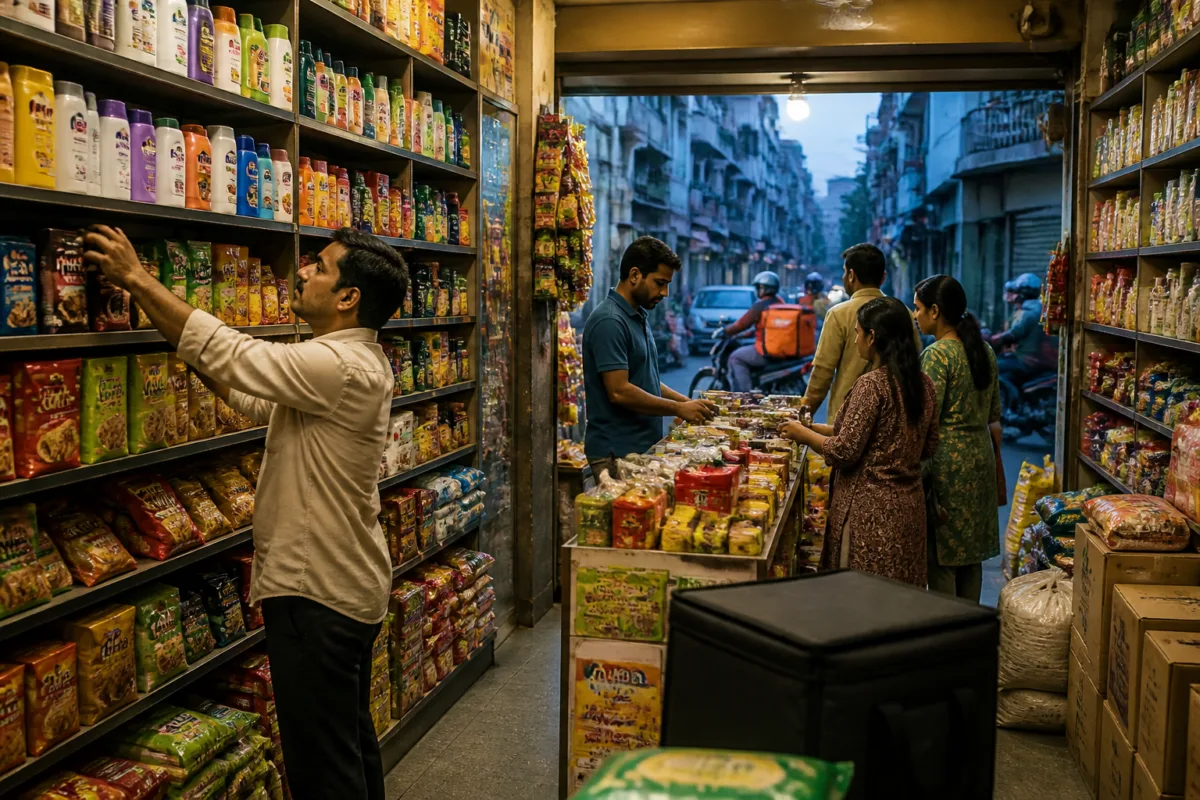
India’s kirana market is becoming less exclusive for legacy FMCG companies. New-generation consumer brands increased their share of kirana outlets to 21.7% in the first half of FY27, up from 14.8% a year earlier, according to exclusive data from retail intelligence platform Bizom reported by Economic Times. The corresponding share of established FMCG companies fell from 85.2% to 78.3%.
The figures point to more than a change in brand preference. They indicate that the distribution system supporting India’s neighbourhood retail economy is being opened up by digital-first brands that once struggled to move beyond online marketplaces, social media and quick-commerce platforms. For decades, access to millions of kirana stores was the central advantage of companies such as Hindustan Unilever, ITC, Marico and Emami. That advantage was built through distributors, warehouses, sales representatives, retailer relationships, credit arrangements and frequent replenishment.
The new data suggests that this infrastructure is no longer an impregnable barrier. It does not establish that new-generation brands have displaced legacy companies at scale. It does show that online consumer demand, quick-commerce visibility and more specialised products are helping smaller companies enter physical retail faster than was previously possible.
The changing geography of retail distribution
Kirana stores remain central to how consumer goods reach Indian households. Unlike modern retail chains, these stores are distributed through residential neighbourhoods, smaller towns and urban peripheries. Their value lies not only in the number of outlets but also in their proximity to consumers and their ability to sell products in locations where organised retail may have limited reach.
For a brand, entering this system requires a different operating model from selling through a website. Products have to be supplied regularly, retailers have to be persuaded to allocate shelf space, inventory must be financed and sales teams must maintain relationships across a fragmented network. A product that attracts online attention but moves slowly in a neighbourhood shop can quickly lose its place.
Bizom’s data indicates that new-generation brands increased their presence in the kirana network while established companies experienced a 1.9% decline in urban kirana outlets. At the same time, established FMCG companies increased their rural store count by 2.3%. This contrast suggests that the disruption is not uniform. New-age brands are making their strongest advances where digital discovery, premium consumption and rapid delivery platforms can support physical retail demand.
The September quarter also saw digital-first brands expand their kirana footprint by 200 basis points, according to the report. Bizom tracks 10 million kirana outlets, giving the trend significance beyond a handful of prominent startup brands. However, the data excludes several digital-first companies that have already been acquired by FMCG groups and integrated into their businesses. Their inclusion could make the overall presence of new-generation brands larger, but the supplied material does not provide a revised figure.
Digital demand is becoming a route into physical stores
The earlier weakness of digital-first brands was not necessarily product discovery. Many could build awareness through social media, influencers, online marketplaces and direct-to-consumer websites. The difficult step was converting that awareness into consistent sales across a large physical network.
Quick commerce has changed that sequence. A new brand can become available across several cities faster through dark stores and delivery platforms than through conventional distribution. If consumers repeatedly search for or request the product, a kirana retailer has a commercial reason to consider stocking it. Digital channels therefore function not only as sales platforms but also as demand-generation systems that can help brands negotiate entry into general trade.
The product categories involved also matter. The report cites Plum Goodness chief executive Shankar Prasad as saying that consumers are increasingly seeking science-oriented, performance-led and clinically positioned products. Such products are often sold on specialised formulations, health benefits or differentiated ingredients rather than on the lowest price.
This positioning can make shelf space more attractive to retailers. A premium product may offer higher realisations than a mass-market item, provided it sells with sufficient regularity. The new brands’ challenge is to convert consumer curiosity into repeat purchases across markets, not merely to secure an initial listing.
Why legacy distribution still matters
The scale of established distribution networks remains substantial. Hindustan Unilever, cited in the report, has more than 3,500 distributors across over 2,000 towns and reaches nine million retail outlets, including three million directly. The company had also been changing its distribution model to reduce delivery time to kiranas from three days to less than 24 hours, with distributors handling orders and payments while HUL managed warehousing and logistics.
That investment illustrates why physical distribution has been such a durable competitive advantage. It is not simply a database of retailers. It is an operating system involving inventory, transportation, sales personnel, warehousing, payments and replenishment. Smaller companies may enter selected outlets, but replicating this network nationally requires capital and administrative capacity.
The same advantage explains the acquisition of digital-first brands by established FMCG companies. Over the past five years, HUL, ITC, Marico and Emami have acquired or taken controlling stakes in at least a dozen such brands, according to the report. The examples cited include HUL’s acquisition of Minimalist, Marico’s acquisition of Plix and ITC’s acquisition of Yoga Bar.
These deals combine two forms of market strength. Newer businesses bring differentiated products, consumer following and faster innovation. Their larger owners provide warehouses, distribution, marketing and retailer access. Wellbeing Nutrition founder Avnish Chhabria told ET that before HUL’s investment, his company had access to four or five warehouses, compared with 150 to 200 after the investment. Crisil Ratings found that around two-thirds of FMCG acquisitions during the preceding five fiscal years were in the D2C segment.
The acquisition model therefore acted as a bridge between digital demand and physical scale. The latest Bizom numbers suggest that some brands may now be crossing that bridge independently, at least in selected parts of the market.
The difficult economics of the last mile
The growth in kirana presence should not be mistaken for a completed transformation. Worldpanel by Numerator’s Brand Footprint India 2026 report found that 56% of low-penetration brands increased consumer reach in 2025, compared with 83% of highly penetrated brands. The numbers underline the difference between gaining initial visibility and building durable household penetration.
For smaller companies, general-trade expansion brings several costs. They need to finance inventory, appoint distributors, maintain sales teams and ensure frequent replenishment. Higher retailer margins may help secure an initial listing, but they cannot guarantee shelf space if the product does not move. A kirana owner has limited space and must continuously weigh the revenue generated by each item.
The economics become more complicated when brands use several channels at once. Logistics expenses and platform commissions can reduce margins, while quick-commerce operations may require frequent replenishment of multiple dark stores. A product that appears successful in online demand data may still face difficulties when it has to achieve repeat sales through thousands of independent retailers.
Legacy companies are also adapting. Their long-standing relationships with kirana owners cannot easily be replicated, and their financial scale allows them to invest in supply systems, digital ordering and retailer engagement. Tarun Arora, chief executive of Zydus Wellness, told ET that sustaining distribution and building sales over time is considerably harder for newer businesses. His assessment captures the central tension in the market: entry is becoming easier, but endurance remains expensive.
What the shift means for urban retail systems
The kirana market is part of India’s urban infrastructure, even though it is often discussed only as a consumer-goods channel. Neighbourhood stores connect households to everyday products, provide local employment and operate within dense residential areas where access, delivery time and retailer relationships matter. Changes in the brands occupying their shelves can therefore reflect wider changes in how urban consumption is organised.
The current shift also shows how digital and physical retail are becoming interdependent rather than separate systems. Social media can create awareness, quick commerce can test demand across locations and kirana stores can provide durable local availability. Established companies still control much of the infrastructure required for scale, but newer brands are finding ways to reach that infrastructure with evidence of consumer demand already in hand.
The evidence confirms a meaningful movement in India’s retail distribution network: new-generation brands increased their kirana share from 14.8% to 21.7% in a year, while established companies retained a large but reduced majority. What remains uncertain is whether this expansion will translate into sustained repeat purchases, profitable distribution and nationwide penetration. The next measure of the trend will not simply be how many outlets stock these brands, but how consistently those outlets replenish them.

