


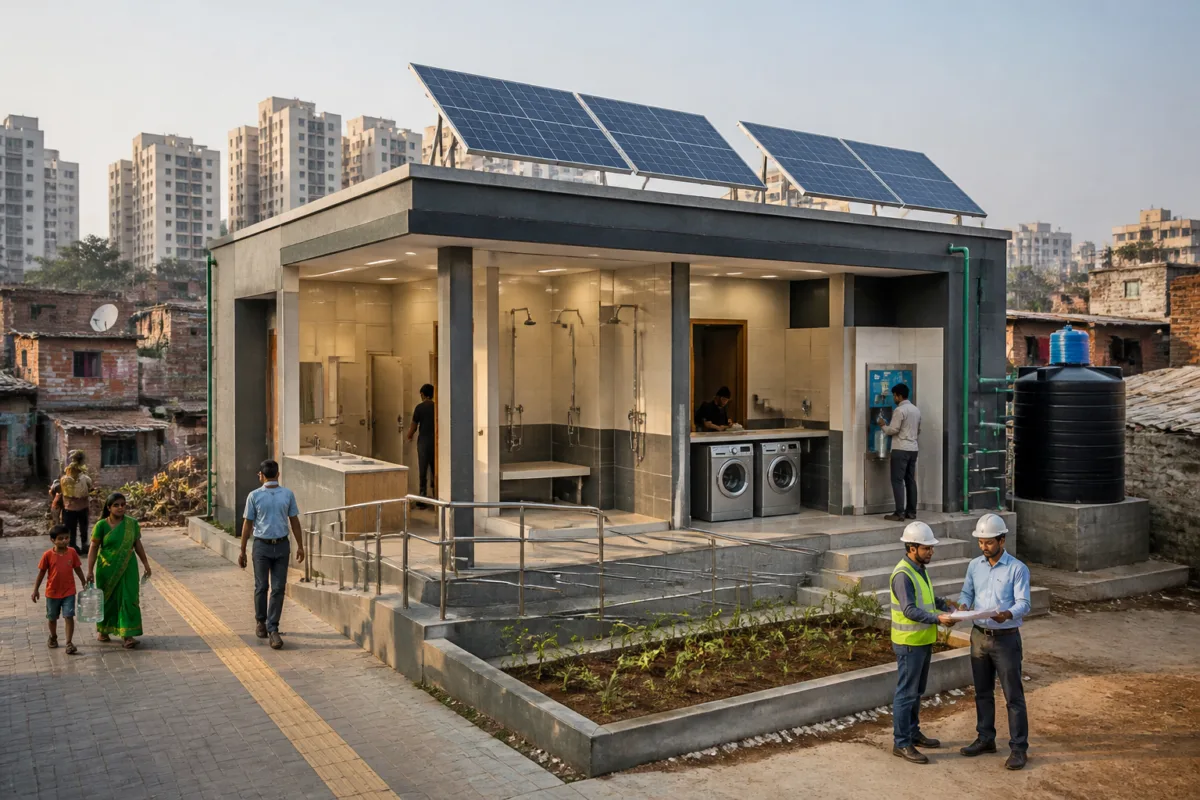
Delhi’s proposed Suvidha centres are being presented as a practical response to a problem that public toilets alone have not solved: access to sanitation, bathing, laundry and safe water in low-income settlements. The Municipal Corporation of Delhi plans to begin with a pilot at Ekta Camp in RK Puram, combining these services in a single facility near a low-income colony.
The pilot is being developed by Hindustan Unilever through its corporate social responsibility initiative, in collaboration with the Union ministry of housing and urban affairs. According to an MCD report submitted to the Delhi government, the centre is expected to be completed in three months and will cost Rs 2.5 crore. The project is modelled on Suvidha centres in Mumbai, where the company has operated 24 such facilities for 10 years.
The proposed facility will occupy around 160 square metres and include 46 toilet seats, four showers, eight washing machines and a water ATM. MCD intends to charge users Rs 3 for a toilet, Rs 10 for a shower, Rs 70 per laundry load and Re 1 per litre of water. These charges indicate that the centre is being designed as a paid service rather than as a conventional free public toilet complex.
That distinction matters because the facility is intended to address a wider set of everyday needs. Public sanitation infrastructure is often measured by the number of toilet seats or blocks constructed, but residents of informal settlements may also need access to bathing spaces, laundry facilities and affordable water. By bringing these functions under one roof, the Suvidha model attempts to treat sanitation as a service network rather than as a single piece of civic infrastructure.
Delhi already has a substantial network of public and community toilets. The MCD report says the city has 837 public toilets, of which 613 are under MCD jurisdiction. It also has 360 community toilet complexes, with MCD maintaining 128. Yet the existence of these assets has not guaranteed reliable use. The report notes that poor maintenance and unhygienic conditions have discouraged people from using some facilities. It also identifies the absence of bathing and laundry services as a limitation.
This gap between infrastructure provision and usable infrastructure is central to Delhi’s sanitation challenge. A toilet block can be counted as completed even when it is poorly maintained, lacks water or does not provide the privacy and cleanliness expected by users. The proposed centre therefore places operational features alongside construction. The facility is expected to use artificial intelligence-based monitoring every four hours to track hygiene and sanitation conditions, although the supplied report does not specify the technology, operator or enforcement mechanism behind that monitoring.
The project also incorporates water and energy systems that could reduce its dependence on external supplies. Wastewater will be treated and reused through a sewage treatment plant, while rainwater harvesting and solar energy facilities are planned. These measures are described by MCD as environment-friendly features. Their effectiveness will depend on whether the systems are installed, operated and maintained consistently after construction, a question that remains open in the information currently available.
The proposed charges also raise an important governance question: how will the city balance affordability with the cost of running a reliable facility? The listed rates are relatively low for individual services, but the total cost of repeated use can matter to households with limited incomes. The source report does not provide an eligibility framework, subsidy plan, projected daily footfall or operating budget. It also does not state how revenue will be collected, who will manage the centre or how service quality will be audited beyond the proposed monitoring system.
Those details are significant because Delhi has already experienced difficulties with the maintenance of public sanitation infrastructure. The Delhi Urban Shelter Improvement Board has traditionally been responsible for developing similar toilet facilities within or near slum clusters. The MCD report says these facilities have often been affected by poor maintenance and unhygienic conditions. The proposed Suvidha model shifts towards a more integrated facility, but it does not by itself resolve the institutional question of long-term responsibility.
MCD is also planning multi-storey structures on limited plots of land to accommodate sanitation and utility services under one roof. This approach responds to a familiar urban constraint: high demand for civic facilities in settlements where land is scarce. A compact, vertically organised facility can combine multiple uses without requiring separate sites for toilets, showers, laundry and water access. However, the source material does not establish whether this design will be applied uniformly across the city or only where local land conditions make it suitable.
The pilot is arriving alongside a larger toilet-construction programme. In September, the Delhi government announced plans to construct 2,000 modern public toilets across the city. MCD and the tourism department were each assigned a target of 1,000 toilets, with funds for MCD’s share proposed through the Chief Minister’s Development Fund. MCD’s review report dated October 21 said 173 additional sites had been identified, while standard designs and cost estimates had been prepared.
The wider programme also shows how Delhi’s sanitation infrastructure is moving through several delivery models at the same time. The MCD report says 51 toilet blocks developed under the build-operate-transfer model are operational and 10 more are under construction. MCD has received tenders for maintaining 180 toilets, while the process for another 350 is under way. This combination of construction, contracting and maintenance activity suggests that the city’s challenge is not simply a shortage of new facilities. It is also the management of a large and varied existing network.
The Suvidha centre pilot could therefore become a test of whether service integration improves outcomes. Its proposed footprint of around 160 square metres is small compared with the range of services it will provide. The facility is planned to contain 46 toilet seats, four showers, eight washing machines and a water ATM, while also incorporating wastewater treatment, rainwater harvesting, solar energy and hygiene monitoring. The design is ambitious in functional terms, but the supplied evidence does not yet show how capacity will be matched with demand at Ekta Camp.
The location is also important. By placing the pilot at Ekta Camp in RK Puram, MCD is testing the model in a low-income settlement rather than introducing it first as a general-purpose facility in a high-footfall commercial district. That makes the project relevant to questions of access and inclusion. At the same time, the source does not provide resident feedback, a local demand assessment or details of consultations with users. Whether residents adopt the facility will depend on factors such as opening hours, cleanliness, safety, water availability and the consistency of charges.
The central lesson from Delhi’s existing toilet network is that construction numbers are an incomplete measure of civic performance. The city has hundreds of public and community facilities, but MCD’s own review records maintenance and hygiene problems. The proposed pilot recognises this by linking multiple services with monitoring and resource-reuse systems. Yet the same governance test remains: someone must be clearly accountable for daily operations, repairs, cleaning, water supply and financial viability.
For Delhi, the next milestone is not merely the completion of the RK Puram building. It is whether the pilot can demonstrate that a compact, paid and integrated facility remains clean, affordable and operational over time. The MCD report provides the project’s proposed specifications, charges and sustainability features, but it does not yet establish performance results. Those will emerge only after construction, commissioning and sustained use.
The evidence currently confirms a significant shift in approach: Delhi is moving beyond standalone public toilets towards centres that combine sanitation, bathing, laundry and water services. It also confirms that the city is expanding toilet construction while attempting to improve maintenance through tenders and new operating models. What remains uncertain is how the Suvidha centre will be managed, how residents will use it and whether the model can be replicated without repeating the maintenance failures already identified in the city’s existing network.

