


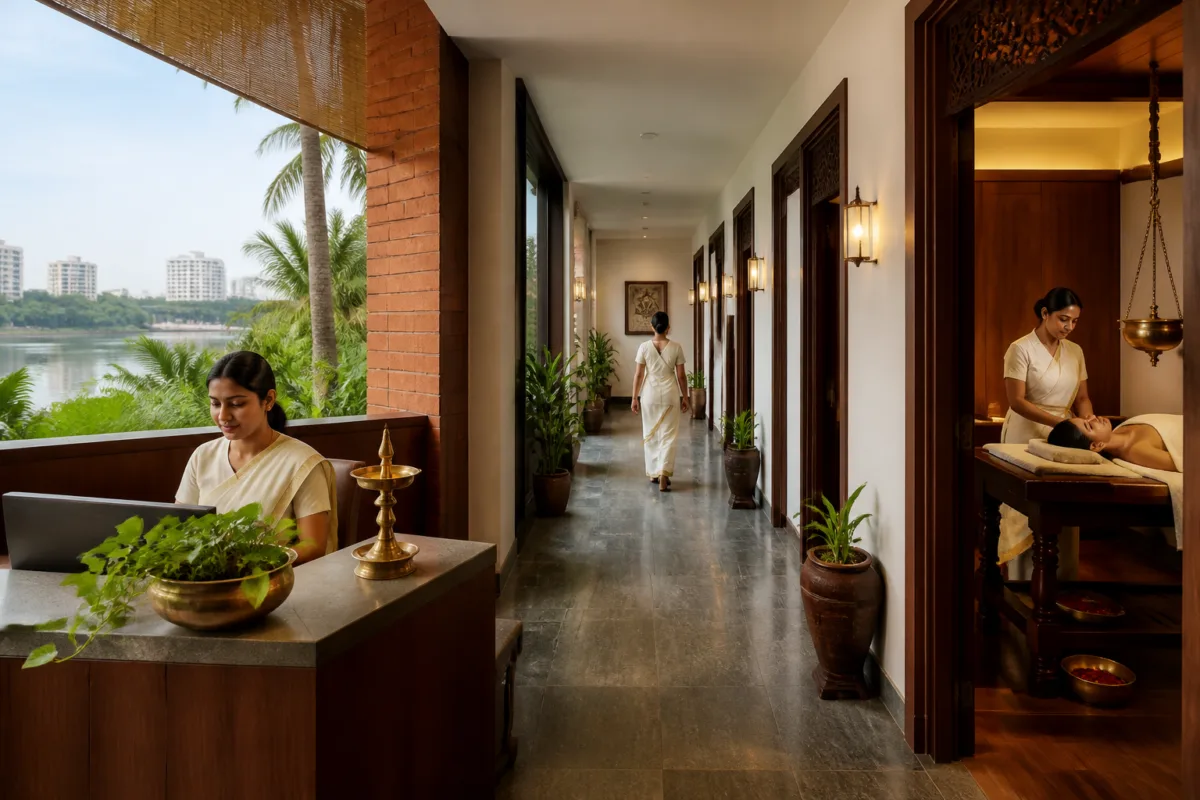
Kerala’s spa sector is caught between two competing realities: the state wants to sell Ayurveda, traditional healing and wellness tourism to the world, but many commercial establishments operate without a clear regulatory framework. Recent cases involving the alleged exploitation of a minor in Kovalam, the alleged sexual assault of a woman in Ernakulam and an alleged extortion scheme involving a police officer in Kochi have brought that contradiction into sharp focus.
The issue is not simply whether spas should exist. It is whether a sector that handles bodily services, private premises, vulnerable workers and paying clients can remain largely dependent on fragmented local permissions and policing after a crime is reported. The answer will shape not only public safety but also Kerala’s ability to distinguish professional wellness facilities from establishments that use massage services as a cover for illegal activity.
According to the report, two spa owners in Kovalam were arrested about a week before its publication after investigations allegedly found that a 16-year-old girl had been exploited at the premises. Earlier in the month, police in Ernakulam reportedly raided and sealed establishments after a woman applying for a manager’s position was allegedly lured to an interview and a subsequent selection party. Her beverage was allegedly spiked, and she was allegedly held captive at a nearby lodge for two days before being subjected to severe sexual assault. Four key suspects, including a woman, were arrested in that case, the report said.
A separate case reported from Palarivattom, Kochi, in November involved a civil police officer who allegedly became the target of an extortion conspiracy after visiting a wellness spa for a massage. The officer was allegedly accused of stealing a gold chain, while a sub-inspector was alleged to have threatened to disclose the visit to his family and superiors unless he paid money. These cases are allegations and will have to be established through due legal process. Their significance for regulation lies in the different forms of vulnerability they reveal: minors and jobseekers can be exposed to exploitation, while clients can also become targets inside opaque and poorly supervised premises.
The common institutional problem is the absence of a dedicated, consistently enforced framework for spas. Lawyer Jiyas Jamal, as quoted in the report, said soliciting is illegal, while cross-gender massage is not by itself illegal. He also pointed to the difficulty of proving commercial sexual activity when a client or therapist can describe a payment as a tip for massage. Police action, he said, generally follows allegations involving drugs, non-consensual acts or minors.
That distinction matters because a legal system cannot regulate a commercial activity effectively if it has no clear operational vocabulary for the activity itself. A massage, a wellness treatment, a tip, a private service and a criminal act may occur in the same physical setting, but they are not legally interchangeable. If rules focus only on the offence after it occurs, enforcement remains reactive. If rules define the premises, staff qualifications, consent procedures, hiring practices, payment arrangements, surveillance safeguards and inspection powers in advance, authorities have a clearer basis for prevention and accountability.
The sector’s representatives are asking the state to create that framework. Rinshad K, president of the Spa Wellness Development & Welfare Association, said continuous raids were affecting legitimate spas and argued that proper regulation and licensing could generate revenue for the government. He proposed an annual licence fee of Rs 10,000 or Rs 15,000 and said owners would be willing to pay it if legislation were enacted. The association also wants periodic inspections that respect the privacy of clients and therapists.
The demand for a licensing law reflects a broader governance principle: prohibition and regulation are not the same thing. Where an activity continues without a dedicated regulatory structure, the state may have limited visibility over who operates, where establishments are located, who they employ and what standards they follow. At the same time, indiscriminate raids can make professional operators uncertain and may push questionable activities into less visible premises. A licensing system would not eliminate crime, but it could establish a documented chain of responsibility between the operator, the local authority and enforcement agencies.
The report says spas currently fall under Ayurvedic treatment plans even though many services are primarily intended for pleasure and relaxation rather than clinical treatment. That mismatch creates a classification problem. An establishment may use the language of Ayurveda while functioning as a hospitality or personal-services business. It may operate from a rented commercial space, a hotel or another premises with different safety and accountability arrangements. Applying one broad category to all of them can obscure the differences that regulators need to monitor.
Kerala’s tourism and wellness sectors therefore have an interest in a more precise system. Jose Predeep, president of the Kerala Travel Mart Society, said mainstream hotels provide a model because their massage facilities are run professionally, with doctors and male and female therapists available in some establishments. He contrasted them with unregulated spas operating from rented spaces. The distinction is not necessarily between large and small businesses; it is between premises that can demonstrate standards and those that cannot.
A workable framework would have to address more than the licence fee. It would need to establish who can open a spa, what local-body approval is required, how workers are recruited, what training or identification is mandatory, how consent is recorded and how complaints are handled. It would also need to clarify the responsibilities of local governments, the police, health authorities and tourism agencies. Without a clear division of responsibility, licensing could become another registration exercise without meaningful oversight.
Other jurisdictions cited in the report show that regulation can be designed around different risks. In New York and Los Angeles, massage therapy is linked to individual state-board licences and more than 500 hours of accredited training. London requires premises to obtain a special-treatment licence from local borough councils, with attention to therapist credentials, hygiene and fire safety. Bangkok regulates spas under its health-establishment framework and requires certified training and licensed managers. Singapore uses a two-tier licensing system under its Massage Establishments Act, combining operating conditions with zoning and structural rules.
These examples do not provide a ready-made template for Kerala. They do, however, show that a spa can be treated as a regulated service establishment rather than an ambiguous extension of either healthcare or hospitality. The regulatory emphasis differs by place: professional qualifications, premises safety, zoning, operating hours, management responsibility and worker eligibility. The common feature is that the rules are explicit enough for both legitimate businesses and enforcement agencies to understand the boundaries.
The Rajasthan proposal mentioned in the report takes a more restrictive approach. Its draft model guidelines for spas, massage centres, beauty parlours and yoga therapy centres seek to prohibit sexual activity and cross-gender therapeutic services. They also propose self-closing service doors without internal locks or bolts and fully segregated, non-interconnected service areas for men and women. Such measures may address specific security concerns, but they also raise questions about whether structural separation alone can guarantee consent, worker safety or professional conduct.
Kerala’s proposed response will have to balance these competing considerations. Rules that are too vague leave room for exploitation and selective enforcement. Rules that rely mainly on gender segregation may restrict legitimate services without addressing coercion, trafficking, fraudulent recruitment or abuse of authority. The report’s examples suggest that the central requirement is not simply controlling who gives a massage to whom, but making the entire chain of operation visible and accountable.
The sector’s advocates also want Kerala to use its existing cultural and medical traditions more effectively. Dr Vinod Kumar Karicheri, who has conducted wellness retreats in Europe and studied destinations including Texas, Costa Rica and the Maldives, said integrating Naturopathy, Ayurveda and Kalari could help create a distinct spa culture. He described Kalari massage as having benefits related to arterial circulation, venous return, lymphatic drainage and pressure points known as marma. He proposed the involvement of registered Ayurveda and Naturopathy practitioners and a standardised accreditation system comparable to accreditation used in healthcare.
That proposal connects regulation with market positioning. Kerala already markets its backwaters and healing traditions as tourism assets, but a global wellness destination requires more than a recognisable cultural brand. Visitors also look for trained personnel, transparent services, hygiene, safety and credible certification. If the state cannot separate authentic wellness services from establishments associated with criminal allegations, the damage is not confined to individual businesses. It can affect the credibility of the wider tourism ecosystem.
The evidence in the report does not establish how many spas operate in Kerala, how many are licensed by local bodies, how frequently inspections occur or how many complaints are recorded. Those gaps are themselves important. Without a public register or reliable administrative data, it is difficult to measure the size of the sector, identify high-risk areas or judge whether enforcement is targeted or arbitrary. A new law would need a reporting and inspection system capable of producing that information while protecting the privacy of clients, workers and complainants.
Kerala’s spa debate is therefore a test of urban governance at a relatively small but revealing scale. Commercial premises that appear private can still involve public responsibilities: worker protection, recruitment safety, policing, health standards, building access and tourism reputation. The recent cases have made the risks visible, but the structural issue predates them. The state must decide whether spas will remain loosely classified businesses dealt with mainly through raids, or become a clearly regulated service sector with defined standards and accountable operators.
The report indicates that authorities have announced plans for legislation. The next meaningful test will be whether that legislation establishes enforceable licensing, coordinated inspections, professional standards, complaint mechanisms and transparent institutional responsibility. Until those details emerge, Kerala’s wellness ambition will remain ahead of the regulatory system intended to support it.

