


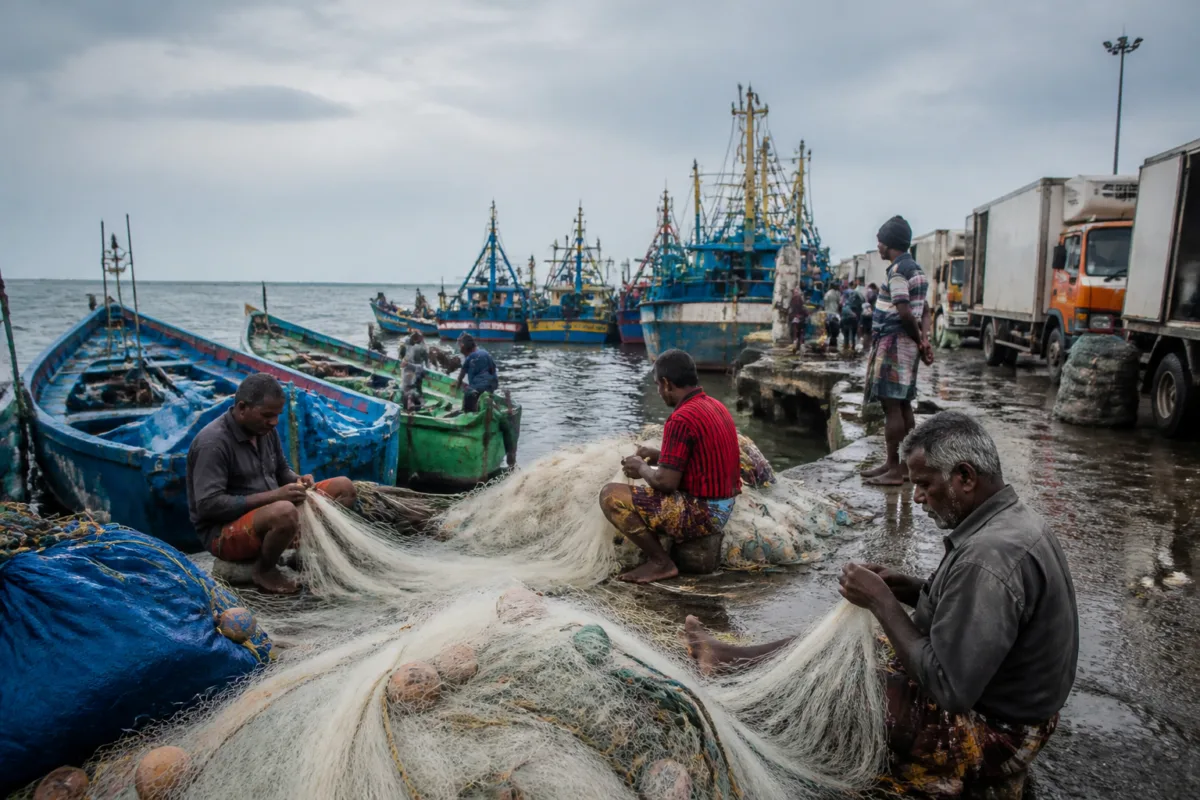
The Kerala fishing crisis is no longer only a question of declining catches. In the coastal settlements around Kochi, it is becoming a wider urban livelihood emergency shaped by unreliable incomes, rising fuel costs, climate shocks, industrial extraction and infrastructure that has not kept pace with technological change. A report by Mathrubhumi – Kochi, published as Kerala turns 70, describes how fishing families in Chellanam, Vypin, Kochi and Munambam are struggling even as the state’s fisheries sector is presented as technologically advanced and economically important.
The contradiction is central to the story. Fishing technology has changed substantially. Engines have reduced the physical effort involved in fishing, while larger vessels and nets have expanded the ability to harvest marine resources. Yet the report says these changes have not translated into a better standard of living for ordinary fishing families, many of whom remain below the poverty line. The expansion of productive capacity has therefore not been matched by livelihood security.
A fisherman from Chellanam, identified in the report as Pappachan, describes a sector where going to sea no longer guarantees a catch. Fish availability is said to be declining each year, and there are occasions when the catch does not cover even the cost of fuel. For a household whose income depends on daily or periodic landings, that uncertainty changes the economics of work. A failed trip is not simply a lost day; it can become debt because diesel or kerosene has already been purchased.
The decline of the purse-seine fleet around Kochi illustrates the pressure. The report says the city once had around 100 purse-seine boats, which generated income for workers and traders. This year, only about 30 went to sea, and even those did not operate every day. The figure does not by itself establish the full cause of the fleet’s decline, but the report links it principally to the shortage of fish. It shows how changes in marine availability are moving through the urban economy, affecting boat owners, crew members, auction markets, traders, transporters and coastal consumers.
The crisis is especially severe because the fish that traditionally supported coastal households are becoming less reliable. The report identifies sardines and mackerel as important species whose reduced availability has created a major disruption. These fish had helped sustain coastal communities, but their periodic disappearance has made household income more volatile. Workers in Chellanam, Vypin, Kochi and Munambam are described as going to sea without any certainty about what they will earn or whether they will return with enough fish to cover operating costs.
The cost structure of fishing has also become more difficult. Diesel and kerosene prices have risen, while subsidies are described as difficult to access. The report says fishers may have to depend on the black market for kerosene. Where fuel support is delayed, inadequate or inaccessible, the burden is transferred directly to households already exposed to fluctuating catches. This is an administrative issue as much as a market issue: a subsidy that exists on paper but cannot be reliably obtained does not provide effective protection.
Climate change has added another layer of instability. Citing studies by the Central Marine Fisheries Research Institute, the report says the number of working days available to fishers has fallen by around 50 per cent. It also points to a succession of cyclones and extreme events, including the tsunami, Ockhi, Pyaar, Gaja, Vayu, Nisarga and Tauktae, as well as flood impacts. The report’s account places these events within a longer pattern of disruption rather than treating each storm as an isolated disaster.
For coastal settlements, fewer workable days can have consequences beyond immediate income. Fishing communities require time at sea to earn, repay operating costs and maintain equipment. When storms or unsafe conditions interrupt that cycle, families may face borrowing, asset sales or dependence on welfare support. The supplied report does not provide household debt figures or details of the state’s relief mechanisms, but it makes clear that weather disruption and economic insecurity are reinforcing one another.
The report also raises a question about the scale and direction of fishing technology. The shift from smaller boats to larger engine-powered vessels has increased the capacity to extract marine resources. Mathrubhumi describes this as overexploitation of the sea’s resources and argues that technological progress has become a setback for the sector when it is not accompanied by resource protection. The underlying issue is not whether technology should be used, but who benefits from greater extraction and who bears the cost when the resource base weakens.
That tension is visible in the growing capture of small fish. According to the report, large quantities of juvenile fish are being landed and transported from harbours to factories. These fish are used as raw material for fish feed and poultry feed. The account describes large trucks waiting outside important district harbours to carry the catch to industrial facilities, with large companies behind the industry. The report does not provide catch volumes, company names or enforcement data, but it identifies a conflict between short-term industrial demand and the long-term regeneration of fish stocks.
This conflict is becoming more important as the blue economy expands as a policy and business idea. In the report’s description, fish is no longer treated only as food for local consumption. It is also an industrial raw material and part of a wider commercial landscape that includes tourism. That shift brings new investment and new markets, but it can also change access to coastal resources. A livelihood-based fishing economy and an industrial marine economy do not necessarily distribute value in the same way.
The institutional gap is most visible after the fish has been caught. The report says that despite improvements in fishing technology, workers do not have adequate facilities to preserve fish. It states that none of the district’s harbours has sufficient storage infrastructure for this purpose. Without cold storage or comparable facilities, fishers are forced to sell quickly, often at low prices. This means the people taking the greatest operational risk may have the least control over when and how their catch enters the market.
That missing infrastructure weakens the economic value of every other investment. Boats, engines, nets and navigation systems can increase the ability to catch fish, but they cannot protect income if the catch must be sold immediately. The result is an uneven value chain: production may be modernised while storage, bargaining power and market access remain underdeveloped. The report’s central institutional insight is that a sector can become more technologically sophisticated without becoming more secure for its workers.
The geography of the problem also matters. Chellanam, Vypin, Kochi and Munambam are not remote spaces detached from urban systems. They are connected to the city through harbours, roads, wholesale markets, fuel networks, transport fleets, processing units and consumer demand. When fishing income falls, the effects move through these systems. Lower earnings reduce spending in coastal neighbourhoods, while instability in landings affects traders, loaders, drivers, auction workers and fish markets.
Yet the available evidence in the report is stronger on lived experience and sectoral trends than on institutional performance. It does not specify the value of fisheries subsidies, the number of households affected, the capacity of each harbour, the volume of juvenile fish landed or the enforcement record against destructive fishing. Those gaps matter because they determine whether the crisis is primarily a resource-management failure, an income-support failure, an infrastructure failure or a combination of all three.
The evidence does, however, establish a clear pattern. Fishers are facing declining certainty about catches, fewer working days, higher fuel costs, inadequate preservation facilities and competition from larger vessels and industrial buyers. These pressures are not occurring independently. Climate-related disruption reduces the number of days at sea; low availability makes each trip riskier; fuel costs increase the cost of failure; and inadequate storage forces distressed sales when a catch is landed.
The larger urban question is whether Kerala’s coastal development is measuring production without measuring security. A rising fish production figure, a larger vessel fleet or greater industrial demand may indicate economic activity, but none of those measures can show whether fishing families have stable incomes or whether marine resources are being replenished. The Mathrubhumi report suggests that the benefits of modernisation have not reached the ordinary fishing household in proportion to the risks it carries.
As Kerala enters its seventh decade, the coastal economy therefore presents a test for the state’s blue-economy ambitions. The supplied evidence confirms a livelihood crisis at the intersection of marine depletion, climate vulnerability, fuel economics, industrial demand and missing harbour infrastructure. It does not establish the precise contribution of each factor or the effectiveness of current government interventions. Those are the questions that require closer examination through official catch data, subsidy records, harbour inventories, climate studies and fisheries regulation data. What is already clear is that technological change alone has not ended poverty on Kerala’s coast.

