


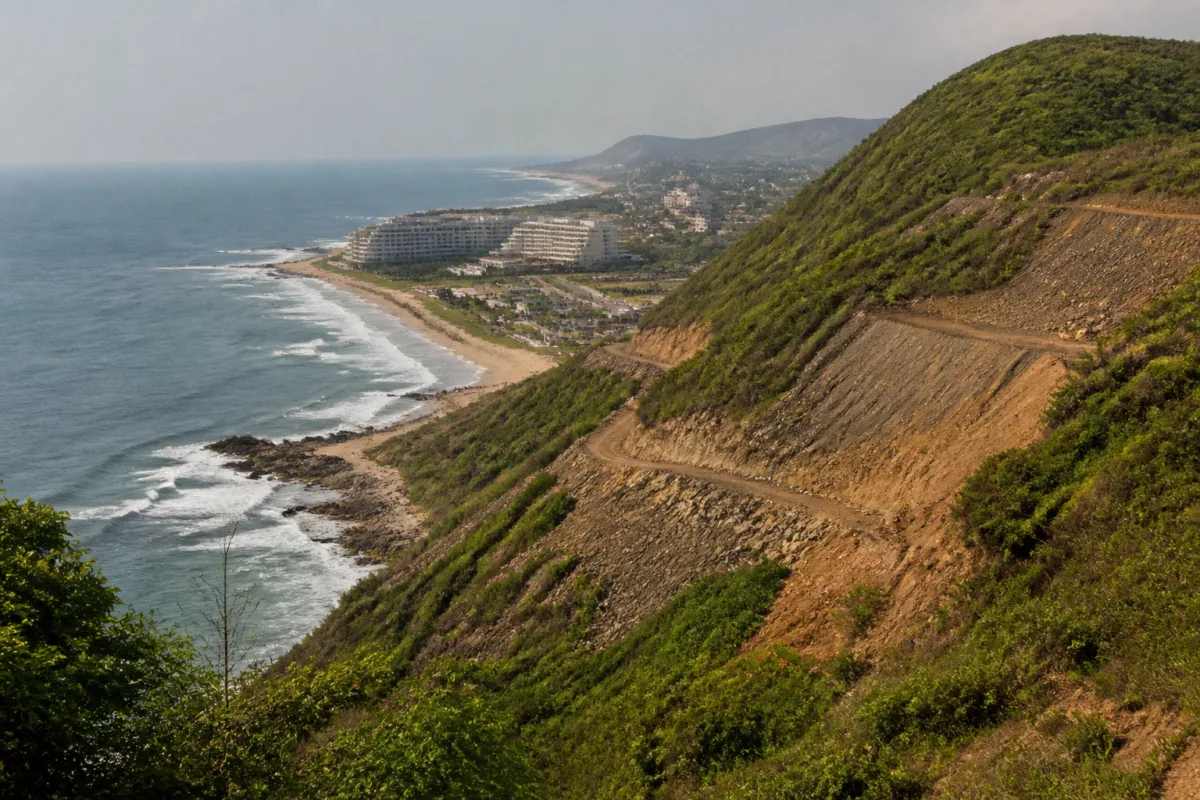
An expert committee constituted by the Union Ministry of Environment, Forest and Climate Change (MoEFCC), following directions from the Andhra Pradesh High Court, has recommended a comprehensive scientific restoration plan for Rushikonda Hill and adjoining coastal areas in Visakhapatnam.
The panel said the plan should address ecological damage linked to the Rushikonda tourism project and be prepared by institutions with expertise in coastal ecology, geomorphology, geotechnical engineering, biodiversity conservation and environmental restoration. Implementation, it recommended, should be overseen by regulatory authorities and periodically reviewed by a multidisciplinary team of scientific and regulatory organisations.
The recommendations are significant because they frame the Rushikonda dispute not only as a question of project permissions, but also as a long-term landform, slope-stability and coastal-ecology challenge. The committee called for continuous monitoring of slope stability, coastal geomorphology, shoreline changes, biodiversity and vegetation recovery to determine whether rehabilitation is working.
According to the committee’s assessment, extensive excavation, hill cutting and land levelling for the tourism project substantially altered the natural topography of Rushikonda Hill. It also reported that large quantities of excavated soil, muck and construction and demolition waste had been dumped at several locations, including areas within the Coastal Regulation Zone (CRZ).
The panel said these activities degraded land resources, altered the natural terrain, reduced ecological functions and affected the aesthetic and recreational value of the coastal landscape. It further observed that the effects extended beyond the immediate project area, requiring restoration based on scientific principles rather than isolated cosmetic landscaping.
The proposed restoration programme is expected to set out clear objectives, implementation strategies, monitoring protocols and measurable ecological outcomes. The committee also recommended adaptive management, under which restoration methods would be adjusted in response to periodic assessments.
The panel’s findings followed its review of project documents, submissions from the Andhra Pradesh Tourism Development Corporation (APTDC), Joint Committee reports, satellite imagery, statutory provisions and observations from a site inspection. The High Court proceedings arose from a petition filed by former Greater Visakhapatnam Municipal Corporation corporator and environmental activist PLN Murthy Yadav.
The Rushikonda project has faced sustained environmental scrutiny over hillside excavation, deforestation and alleged CRZ norm violations. Petitions and appeals before the National Green Tribunal and the Andhra Pradesh High Court have sought reviews by central environmental authorities and challenged aspects of the construction.
The project also remains linked to the state’s plans for the hilltop complex. The Andhra Pradesh government invited private players in July 2026 to develop the Rs 452-crore Rushikonda Hill Project into a luxury tourism destination and issued expressions of interest for the palace complex. However, state Tourism Minister Kandula Durgesh said in late September 2026 that no private bidders had come forward to take over the project.
A special government pleader has also submitted that no steps are being taken in pursuit of the floating expressions of interest. Against this backdrop, the committee’s recommendations place the immediate emphasis on documenting damage, stabilising altered slopes and restoring coastal ecological functions before judging the site solely by its tourism potential.
The recommendations do not themselves establish a restoration budget, a detailed execution schedule or a lead implementing agency. Their practical significance will therefore depend on whether the competent authorities convert the proposed plan into measurable actions, publish monitoring results and maintain oversight across the wider coastal landscape rather than limiting intervention to the built project area.

