


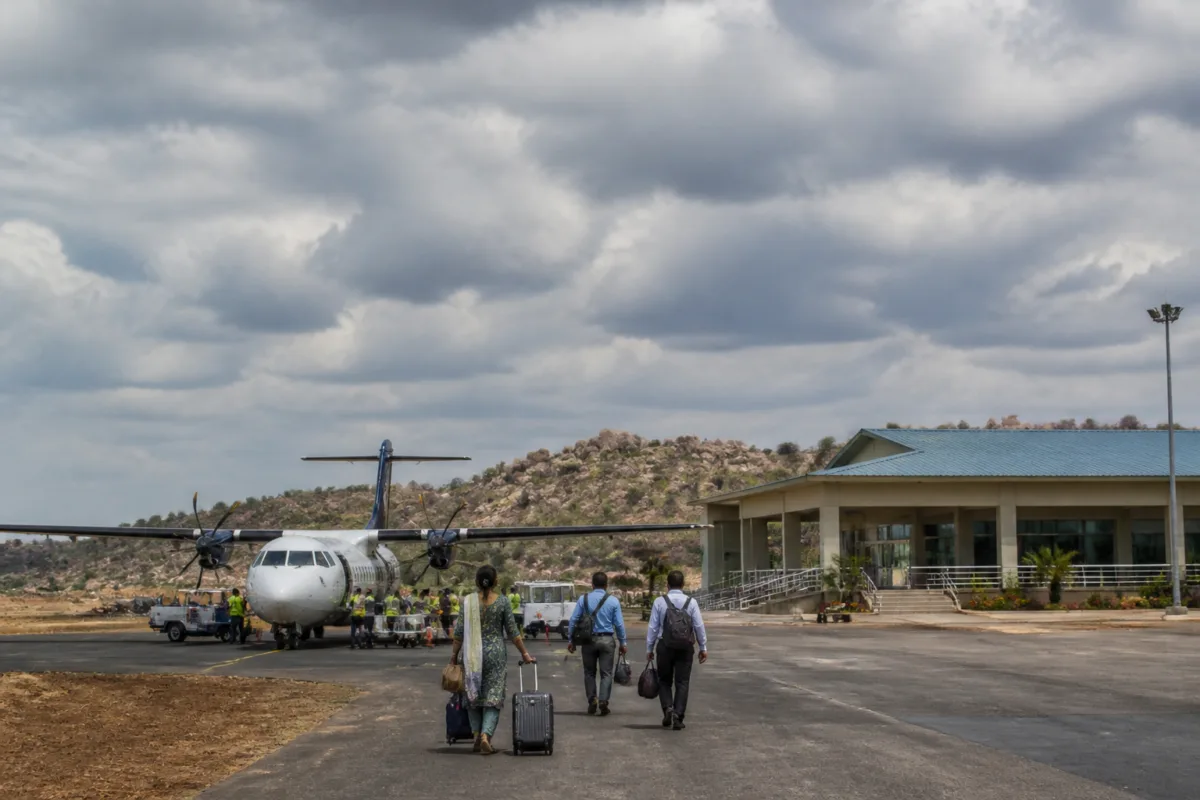
Karnataka’s regional airports are revealing the limits of a connectivity model that can launch flights more easily than it can sustain them. Of the 42 routes selected in the state under the Centre’s Ude Desh ka Aam Naagrik (UDAN) scheme, only 11 were operational as of January 2026. Thirty-one had become inactive after completing the scheme’s three-year viability gap funding period.
The pattern is not confined to one airport or one airline. It runs across Kalaburagi, Bidar, Shivamogga, Mysuru, Belagavi and Hubballi, where public investment has created aviation infrastructure but not consistently durable demand. The result is a growing gap between the physical presence of an airport and its ability to provide reliable scheduled connectivity.
The evidence points to a structural problem rather than a single operational failure. Airlines have withdrawn from routes because of poor occupancy, the end of subsidies, inconvenient schedules and limited commercial interest. State governments, meanwhile, are being pushed towards a difficult choice: continue funding services directly, redesign route planning, or accept that some airports may remain underused despite substantial capital expenditure.
### The subsidy cliff
UDAN was designed to make air travel more accessible by supporting selected routes through viability gap funding. The model helped airlines begin services on regional routes where passenger demand was not immediately strong enough to support operations on a purely commercial basis. But the end of the three-year support period has exposed how dependent several routes remain on public assistance.
In Karnataka, six of the 11 operational routes were still receiving support, while only five had survived beyond the subsidy period. The figures indicate that the scheme has been effective at creating initial connectivity in several locations, but less successful at ensuring that routes mature into commercially sustainable services.
That distinction matters for airport planning. A route can be operational during a subsidy period without demonstrating that passengers will continue to use it once fares, schedules and airline decisions are governed by market conditions. If the traffic base remains thin, the expiry of support becomes a sharp test of whether the underlying demand is strong enough.
The decline in airport activity illustrates the scale of that test. Aircraft movements at Kalaburagi, Hubballi, Mysuru and Belagavi fell from 13,180 in 2021-22 to 5,372 in 2024-25, a decline of 59.2%. Passenger traffic across these airports fell from 4.9 lakh to 3.3 lakh during the same period.
### Infrastructure has outpaced demand
Kalaburagi offers the clearest example of the mismatch between infrastructure spending and sustained utilisation. The airport, built at a cost of more than Rs 175 crore and inaugurated in November 2019, saw passenger numbers fall from 79,143 in 2022-23 to 30,924 in 2024-25. Services were suspended in October 2025 after airlines withdrew, citing poor occupancy and the end of UDAN support.
The state’s financial exposure is wider than the airport’s construction cost. Industries and infrastructure development minister MB Patil said Karnataka spent Rs 1,000 crore on Kalaburagi airport before handing it over to the Centre, without revenue accruing to the state. Star Air later resumed Bengaluru services with state assistance, with its published schedule listing daily flights until December 31, 2026.
The episode raises an institutional question about who carries the financial risk when regional infrastructure is built but demand does not develop as expected. The airport may deliver strategic or social value that is not captured through passenger revenue alone. Yet without a clearly defined long-term operating model, the cost of preserving connectivity can shift between the Centre, the state, regional development bodies and airlines.
Bidar has experienced a similar cycle. Bengaluru services suspended in December 2023 resumed in April 2025 with state support but were suspended again in April 2026. Star Air’s published schedule showed flights to Bengaluru four days a week until December 31. The repeated starts and stops make connectivity difficult for passengers to rely on and complicate the process of building habitual demand.
Shivamogga demonstrates that even improving traffic does not automatically secure airline continuity. Aircraft movements at Rashtrakavi Kuvempu Airport rose from 817 in 2024-25 to 1,400 in 2025-26. However, IndiGo withdrew its Bengaluru service in May and SpiceJet stopped operations in June 2026. Star Air, the last remaining operator, stopped accepting bookings beyond November 20, when the three-year UDAN support period ends.
### The route-planning problem
The passenger numbers also show why route selection and scheduling are central to the future of regional aviation. Mysuru, for example, has tourism and commercial potential but has struggled to retain airlines. As of August 2025, IndiGo operated only to Hyderabad and Chennai. The Mysuru-Bengaluru expressway has also weakened demand on the air route, demonstrating that airports do not compete only with other airports; they compete with improving roads and changing travel times.
This is an important planning constraint. Air connectivity is most valuable when it offers a clear advantage in time, reliability or access to destinations that cannot be reached conveniently by road or rail. Where a fast road connection exists, short-haul flights may find it difficult to attract enough passengers unless schedules, fares and onward connections are compelling.
Belagavi’s figures point to another dimension. Passenger traffic fell 7.6% to 1.5 lakh in January-June 2026, while aircraft movements declined 9.1% to 2,154. The airport, which had earlier connected 13 cities, served five destinations in August. At the same time, cargo movement increased nearly 2.5 times to 11.3 tonnes.
That divergence suggests that airport performance should not be assessed only through passenger services. Cargo, tourism, business travel and emergency access may each require different infrastructure and operating strategies. However, the supplied figures do not establish whether the rise in cargo is sufficient to offset the decline in passenger activity or whether it can support a stable aviation ecosystem.
Hubballi presents a related challenge. Infrastructure upgrades there cost about Rs 385 crore, but the airport continues to face inadequate flight frequency and the withdrawal of subsidised routes. Jindal Vidyanagar Airport near Hampi has a daily Bengaluru connection operated by Star Air, but the airport requires links to more cities to realise its tourism potential.
These cases show that building an airport is only one part of regional connectivity. Airlines need predictable demand, passengers need useful timings and destinations, and local economies need enough activity to generate repeat travel. Without alignment among these factors, capital investment can produce infrastructure that is operational in formal terms but weak in everyday utility.
### Karnataka’s proposed policy response
The Karnataka government is now considering a more direct role in sustaining regional aviation. Patil said the state would operate Shivamogga, Raichur and Vijayapura airports itself. He also said Kalaburagi flights had resumed with 80% of funding from the Kalyana Karnataka Region Development Board and 20% from the state.
A comprehensive civil aviation policy is expected to be placed before the cabinet. According to the minister, it will cover grants, viability gap funding and operating models for state-managed airports. The policy is intended to address a problem that the existing subsidy structure has not resolved: how to maintain services after the initial support period ends.
The state had proposed extending UDAN support from three to five years, followed by five years of 50:50 funding by the Centre and the state. Patil said the Centre rejected the proposal and that 17 airports across the country subsequently became non-operational. The statement places Karnataka’s difficulties within a wider national challenge, although the supplied material does not provide a complete list of those airports or details of their individual circumstances.
State management could give Karnataka greater control over schedules, route support and airport operations. It could also make the state more directly responsible for recurring costs. The policy question is therefore not simply whether the government should support flights, but how it will assess demand, define public-service obligations and decide when continued funding is justified.
### New airports, old risks
The state is continuing to plan and build additional aviation capacity. Vijayapura is targeting flight operations by the end of January 2027. Ballari’s proposed airport has been delayed, prompting the state to examine a common facility for Ballari, Vijayanagara and Koppal. Raichur and Hassan airports have also faced construction and funding delays.
These projects make the sustainability question more urgent. If existing airports are struggling with weak occupancy, limited frequency and subsidy dependence, new airports will need stronger demand assessments before construction and clearer operating plans after opening. A common facility for multiple districts could be one response to the problem of fragmented demand, but the supplied material does not establish whether that model has been finalised or how it would be financed.
Aviation expert B Vishwanath said the state must develop a sustainable funding model, attract airlines, improve route planning and night-landing facilities, and assess demand realistically so that airports do not become underused assets. His assessment identifies the central issue: airport infrastructure cannot be treated as an end in itself.
For Karnataka, the evidence confirms that regional aviation has expanded physical capacity without securing equivalent operational resilience. The immediate developments to watch are the state’s proposed civil aviation policy, the future of routes supported through state funding, the November end of Shivamogga’s UDAN support, and the planned opening of Vijayapura airport. These milestones will show whether the state is moving from subsidy-led connectivity towards a more durable operating model.

