


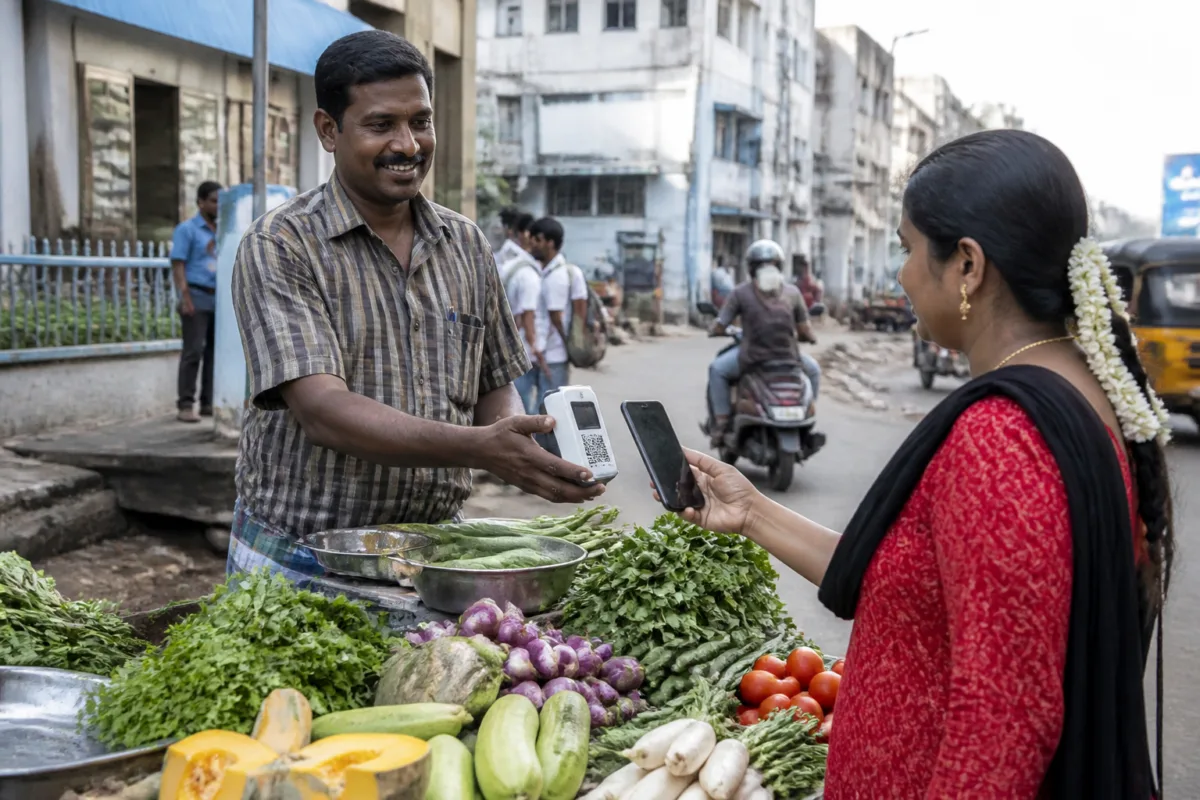
UPI digital payments have helped small traders, roadside vendors and residents in remote villages access formal banking, Vice-President C.P. Radhakrishnan said at Tamilnad Mercantile Bank’s 105th foundation day celebrations in Thoothukudi on Wednesday. He credited the banking sector and financial inclusion initiatives with driving India’s rapid shift towards cashless transactions.
Speaking in the presence of Tamil Nadu Governor Rajendra Vishwanath Arlekar, Radhakrishnan said the expansion of banking services over the past 15 years had taken formal financial facilities to remote villages. He cited the World Bank’s Global Findex 2025 report to say that nearly 89 per cent of Indian adults had bank accounts.
The Vice-President also said banking facilities were available within a five-kilometre radius of 99.92 per cent of the country’s villages as of March 6, 2026. The figure, as presented at the event, was cited as evidence of the reach achieved through the expansion of banking infrastructure and financial inclusion programmes.
Radhakrishnan said the Unified Payments Interface had made financial transactions more convenient for people operating at the smallest end of the economy. Small traders and roadside vegetable vendors could accept payments directly into their bank accounts, reducing the need to handle cash, he said.
The remarks place UPI within a wider change in how informal and small businesses receive payments. For vendors, direct account-based transactions can connect daily commercial activity with the formal banking system. The Vice-President attributed this transformation to the combined role of public-sector banks, private-sector banks and financial institutions.
Radhakrishnan also linked the expansion of financial services to India’s economic growth. He said the country had moved from being the world’s 10th-largest economy to the fourth position and was aspiring to become the third-largest economy, attributing the progress to economic initiatives of the Narendra Modi-led Union government.
The event also highlighted Tamilnad Mercantile Bank’s recent performance. Radhakrishnan said the bank’s total business had crossed Rs 1.30 lakh crore by September 2026, with annual growth of more than 27 per cent. Its quarterly net profit had crossed Rs 450 crore for the first time, while its non-performing assets had declined, he said.
He urged the bank to aim to become one of India’s leading private-sector banks over the next 50 years. He also called on the institution to expand its support for farmers, small traders, micro, small and medium enterprises and large businesses. The address concluded with a focus on widening the banking sector’s role across these customer groups.

