


Karnataka’s elderly voters are turning election accessibility into a major administrative challenge, with the Election Commission of India identifying nearly four lakh people aged above 85 years across the state. The figure is not only a demographic statistic. It represents the scale of coordination required to ensure that citizens with limited mobility can participate in elections without facing the physical burden of reaching a polling station.
The concentration is uneven across Karnataka. Belagavi has the highest number of voters aged above 85 years, with 34,475 recorded in the category. Mysuru follows with 25,165, while Tumakuru has 24,665. Mandya accounts for 16,263 and Hassan for 15,923. Together, these figures show that the requirement for accessible voting is particularly pronounced in a group of districts rather than being distributed uniformly across the state.
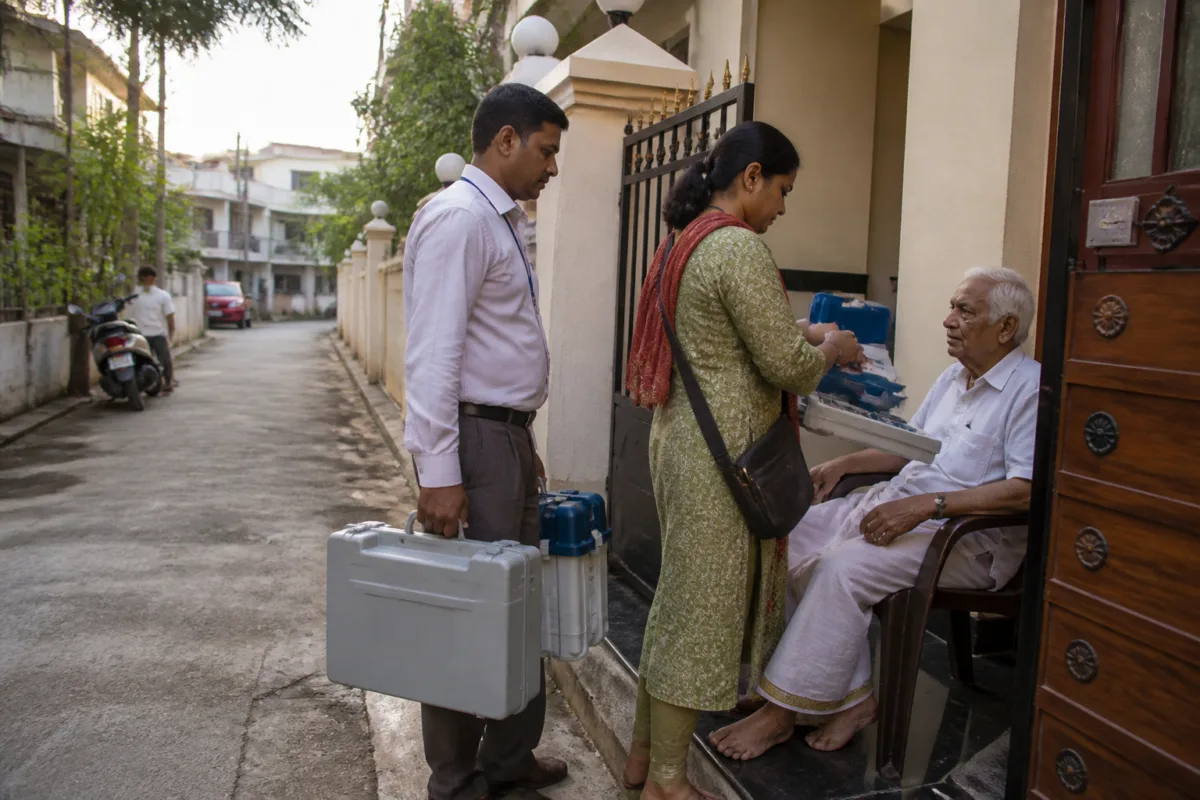
The ECI introduced home voting for the first time in a Lok Sabha election in 2024 for voters above 85 years of age and persons with disabilities with 40% benchmark disability. The facility is intended for eligible voters who face difficulty in visiting a polling station. Voters must inform polling officials in advance if they want to use the option, making prior identification and communication central to the process.
That arrangement changes the administrative geography of an election. The standard polling model brings voters to a designated booth, where officials manage voting within a fixed location and time. Home voting requires election personnel to reach eligible voters at their residences while maintaining the same procedural safeguards. It therefore adds a layer of movement, scheduling, verification and logistical deployment to an already large public exercise.
Mysuru illustrates the scale of the task. The district has 25,165 voters aged above 85 years, representing about 6.4% of Karnataka’s 85-plus voter base, according to the report. Officials must identify and facilitate eligible voters across nearly 2,900 polling booths in 11 assembly constituencies. The number of booths matters because the implementation challenge is not confined to one central office or one urban polling location. It is spread across the network through which election administration reaches citizens.
The distinction between eligibility and access is important. The existence of home voting does not by itself ensure that every eligible person uses it. Voters must know about the option, communicate their preference in advance and be included in the officials’ planning. Election personnel must then verify the request and organise the visit within the rules. Each stage creates a point at which information, timing or coordination can affect whether the facility works as intended.
The numbers also show why a uniform state-level approach may not be enough for operational planning. Belagavi’s 34,475 voters aged above 85 years and Mysuru’s 25,165 create a different workload from Kodagu’s 4,044. Dakshina Kannada and Kalaburagi each have more than 14,000 voters in the category. Bengaluru Urban has around 13,007, Bengaluru South has 10,443 and Dharwad has 10,117. Chamarajanagar, despite being among the smaller districts in this category, still has 7,943 voters aged above 85 years.
These figures do not establish how many voters will ultimately choose home voting. They do, however, identify where election officials may face greater demand for advance communication and field coordination. A high number of elderly voters does not automatically translate into an equivalent number of home visits, because the facility is for those who face difficulty attending a polling station and requires advance notification. The data is therefore best understood as a planning indicator rather than a final count of home-voting requests.
Karnataka’s overall electorate adds another dimension to the administrative challenge. The state has 224 assembly constituencies and 33,92,134 voters according to the ECI data cited in the report. Within that broad electorate, nearly four lakh voters are aged above 85 years. The proportion is large enough to require a distinct planning response, even though elderly voters remain part of the general electoral roll and the same election rules apply to them.
The issue is consequently not only about age. It is about how public institutions adapt a common process for citizens with different physical capacities. A polling station-based system assumes that voters can travel to a designated place, negotiate the journey and complete the process there. Home voting recognises that this assumption does not apply equally to everyone. It shifts part of the service from a fixed public site to the voter’s residence.
That shift has implications for the way election administration is organised at the booth level. Officials need accurate information about eligible voters, a mechanism for receiving advance requests and a system for assigning personnel and schedules. They must also ensure that the process remains secure and compliant with election rules when voting takes place outside the conventional polling station. The supplied report identifies communication, verification and logistical deployment as the central requirements for Mysuru and other districts with high concentrations of elderly voters.
The 2024 introduction of home voting also marks a policy change in the relationship between electoral inclusion and administrative delivery. Inclusion is often measured by whether a person is on the electoral roll or has the formal right to vote. The home-voting facility adds a practical dimension: whether the institution can deliver a voting opportunity to people for whom the ordinary route is difficult. In this model, accessibility is not limited to the design of the polling booth. It includes the arrangements made before polling day and the officials who carry the process to the voter.
This is especially relevant in districts with large and varied geographic areas. The report does not provide a detailed urban-rural breakdown of the elderly voter population, nor does it state the number of home-voting requests received in each district. It therefore cannot establish whether the greatest operational difficulty lies in dense urban neighbourhoods, dispersed settlements or particular types of terrain. What it does establish is the scale of the eligible age group and the number of booths through which officials must plan delivery.
The comparison between Mysuru and Bengaluru also complicates any assumption that the largest administrative workload will always be in the biggest city. Mysuru has nearly twice as many voters aged above 85 years as Bengaluru Urban according to the figures cited, while Bengaluru South has 10,443. This suggests that planning based only on population size or metropolitan visibility could miss districts where the concentration of older voters is higher.
For citizens, the practical value of the system will depend on whether information reaches them in time and whether the process is easy to understand. The requirement to inform polling officials in advance makes public communication a functional part of voting access. It is not merely an awareness exercise. Without timely information, an eligible voter who cannot travel may not be able to use the alternative even when the facility exists.
For election officials, the challenge is to combine individual accommodation with standardised procedures. Every home-voting request involves a particular voter and residence, but the process must still follow common rules across constituencies. The larger the number of eligible voters in a district, the more important advance planning becomes, because errors in lists, communication or scheduling can affect multiple households.
The data also points to a broader administrative lesson: ageing populations require public systems to be designed around actual ability, not only formal entitlement. In this case, the ECI has created an alternative route for voters who may be unable to reach a booth. The effectiveness of that route will depend on implementation details that are not available in the supplied report, including the number of voters requesting the facility, the time taken to process requests and the extent of district-level variation.
What the available evidence confirms is that Karnataka’s election machinery is serving a substantial elderly electorate through a system that now extends beyond fixed polling locations. Belagavi, Mysuru and Tumakuru face the largest recorded concentrations of voters aged above 85 years, while Mysuru demonstrates the booth-level scale involved in making home voting accessible. The next developments to monitor are the number of advance requests, district-wise deployment arrangements and whether the ECI reports completion and participation outcomes for the home-voting process.

