


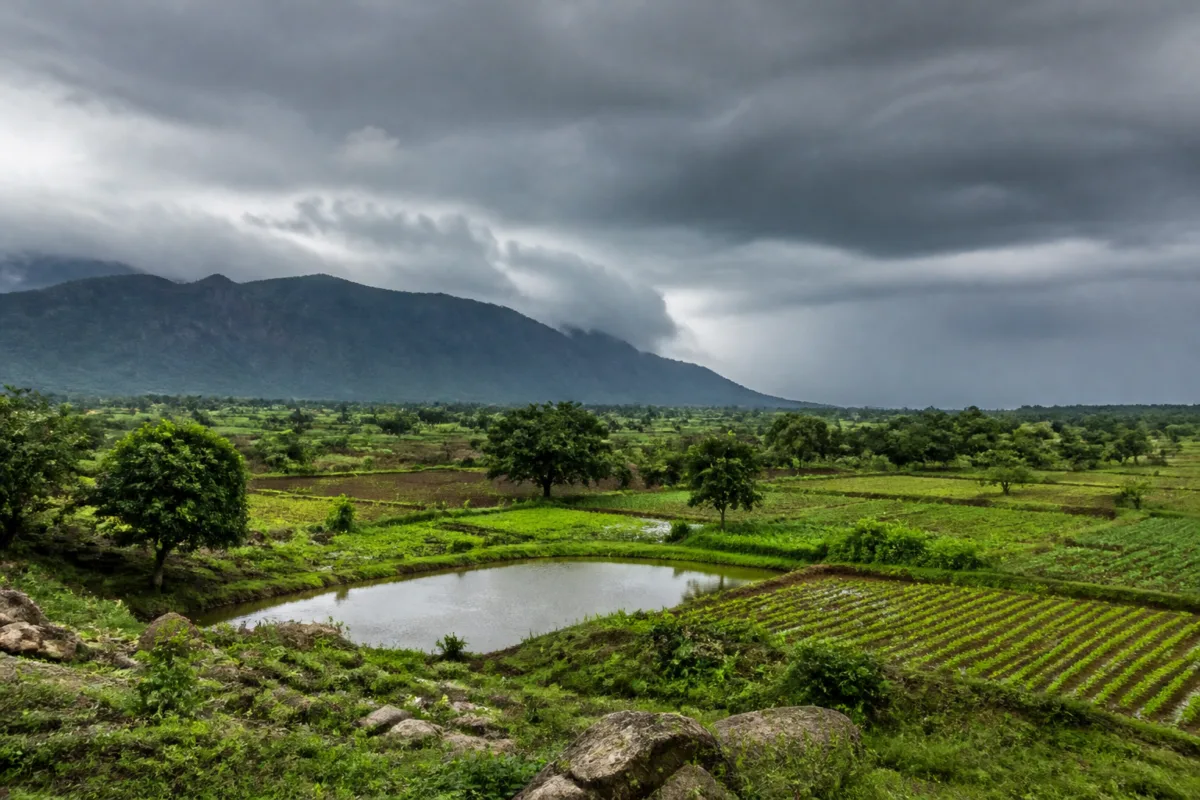
A research report led by GKVK agricultural-climate scientist Professor M.B. Rajegowda says Karnataka’s rainfall pattern has been changing in ways that could reshape the state’s agricultural planning. While rainfall has declined in coastal areas and the lower reaches of the Western Ghats, much of the state’s interior has recorded an increase, creating both new risks and a potential opportunity for water-sensitive farming.
The report, discussed by Rajegowda at a press conference, examines how the biodiversity of the Western Ghats affects Karnataka’s agriculture. Its central argument is that global warming has had a greater effect on the state’s rainfall, climate and farming sector than development activity in the Western Ghats. That conclusion places the rainfall shift within a wider climate system rather than treating it as a series of isolated changes across districts.
The distinction matters because Karnataka’s agricultural geography depends heavily on how monsoon rainfall moves through the state. The Western Ghats stand between the Arabian Sea and the interior districts. According to the explanation presented by Rajegowda, warmer conditions are affecting the monsoon clouds that originate over the Indian Ocean, cross the equator and enter the west coast through the Arabian Sea. The clouds expand because of higher heat, lose density and rise to greater altitudes. Incoming clouds then push the elevated clouds towards the eastern side of the Ghats.
After crossing the Ghats, the clouds disperse over a broader land area and move towards regions with lower pressure. The report links this process to the increase in rainfall being observed across parts of the interior. In the coastal belt and areas below the Western Ghats, by contrast, the reported decline is described as pronounced. The study therefore presents the state as experiencing a redistribution of rainfall, not simply a uniform increase or decrease.
### What the Karnataka rainfall evidence shows
The period examined by the report extends from 1900 to 2020. Rajegowda said the average temperature in Karnataka rose over that period, while the state’s annual rainfall increased by 1,218 millimetres. The report also says monsoon rainfall in districts of north and south interior Karnataka rose by between 100 and 200 millimetres.
These figures are the most consequential evidence presented in the supplied report, but they also require careful interpretation. The report describes a long-period increase in annual rainfall and a regional increase in monsoon rainfall; it does not establish that every district, season or farming community has benefited equally. Nor does the material supplied provide a district-wise table, details of the study’s methodology or a breakdown of how rainfall was distributed across individual years.
That limitation is important in a state where the timing and location of rainfall can be as significant as the total amount. A higher long-term average does not, by itself, establish that water is available when crops need it or that the additional rainfall is being captured. The report’s own recommendation—to create new agricultural plans to use the higher rainfall in interior regions—implicitly recognises that rainfall must be connected to storage, cropping decisions and local water management before it becomes a reliable agricultural gain.
The research also places the rainfall trend alongside a major expansion in cultivated land. According to the report, agricultural land increased from approximately 5 million hectares to twice that area over the period considered. The source does not provide further details on the timing or composition of this expansion, but the reported scale adds another layer to the planning challenge. More cultivated land alongside changing rainfall patterns increases the importance of deciding where water should be stored, which crops should be supported and how rainfall variability should be managed.
### From Western Ghats debate to farm planning
The Western Ghats have already been the subject of competing concerns about development, biodiversity and environmental protection. Rajegowda referred to the Madhav Gadgil and Kasturirangan committees, whose studies discussed how social development works could affect biodiversity and the environment. The new research, he said, focuses more specifically on the effects of the Western Ghats on rainfall and crops.
This shifts part of the policy conversation. Protection of the Ghats is commonly discussed through the language of ecological sensitivity and restrictions on development. The research described by Rajegowda adds a production and water-management dimension: changes in the Ghats and the atmosphere around them influence how rainfall reaches farming regions. The question is therefore not only how development affects the mountain ecosystem, but also how climate-linked changes in rainfall should alter agricultural policy across the state.
The report recommends that the Karnataka government formulate new agricultural schemes to take advantage of higher rainfall in the interior and use it to increase food production. That recommendation is presented as a direct response to the reported rainfall pattern. It does not, however, specify in the supplied material which crops, irrigation systems, storage structures or administrative programmes should be prioritised.
This leaves implementation as the critical institutional issue. A rainfall increase becomes useful to farmers only when public agencies can connect it with planning decisions on land, water and crops. The source identifies the need for new schemes, but it does not identify a government department that has accepted the recommendation, announce funding or provide a timeline for implementation. The report therefore marks a policy requirement rather than a completed policy response.
### The uneven geography of climate change
The most significant insight in the study is the contrast between the coast and the interior. Coastal Karnataka and the lower Western Ghats are reported to be receiving less rain, while most inland districts are receiving more. This creates different forms of climate pressure within the same state.
For coastal and foothill areas, declining rainfall could affect farming systems that have historically depended on the local monsoon regime. The supplied material does not quantify the effect on specific crops or identify affected districts beyond referring broadly to the coastal and lower-Ghats regions. It therefore cannot establish the extent of agricultural loss or the response required in each locality. It does establish that the decline is a central finding of the research.
For the interior, increased rainfall is described as a possible opportunity. Yet the opportunity depends on whether the additional water can be retained and used. The report calls for new projects to make better use of rainwater. This points to a familiar but unresolved administrative problem: rainfall is a natural input, while storage, distribution and farm support depend on public planning and implementation.
The report also suggests that the rainfall pattern has developed alongside rising temperatures. That combination complicates any simple reading of increased rain as a uniformly positive outcome. The supplied report does not provide evidence on evaporation, extreme rainfall events, crop losses or groundwater levels, so those issues cannot be inferred from its findings. What can be said is that the state’s climate baseline is changing and that average rainfall figures alone may not be sufficient for agricultural planning.
The long observation period strengthens the significance of the reported trend. A comparison covering 1900 to 2020 is intended to identify changes over a century rather than capture one unusually wet or dry season. At the same time, the source material does not explain the data sources, measurement locations or statistical methods used by the research team. Those details would be necessary to assess the precise strength of the conclusions.
### A planning problem across institutions
The implications extend beyond the agriculture department. If interior districts are to use higher rainfall for food production, agricultural schemes would need to work alongside water-resource planning and local implementation. The report does not set out an institutional framework, but its recommendations necessarily involve more than crop advice. Rainwater projects, land-use decisions and food-production targets are connected systems.
The same is true for the Western Ghats. The committees mentioned by Rajegowda examined development activity, biodiversity and environmental effects. The new research connects those ecological questions with rainfall and crops. That connection makes coordination important: decisions taken in the Ghats and coastal belt can have consequences for farming regions east of the mountain range, while agricultural expansion in the interior can increase demand for water-management infrastructure.
The reported doubling of agricultural land further raises the scale of the challenge. More land may create scope for higher food production, but it also means that rainfall planning must operate over a larger cultivated area. The report says new projects could help increase food production, but the source does not provide estimates of additional output or the investment required. Those remain questions for the next stage of policy design.
### What remains established—and what does not
The research report establishes a clear stated pattern: temperatures have risen over the period from 1900 to 2020; annual rainfall is reported to have increased by 1,218 millimetres; monsoon rainfall in north and south interior districts is reported to have risen by 100 to 200 millimetres; and rainfall has declined in coastal and lower-Western-Ghats areas. It also recommends that Karnataka develop agricultural schemes and rainwater projects to use the reported increase in interior rainfall.
The available material does not establish how the changes vary by district, whether rainfall has become more concentrated in shorter periods, which crops have gained or lost, or whether the government has begun implementing the recommendations. It also does not include the full research report or independent assessments of its findings.
Those gaps do not remove the public importance of the study. They define the work required before a broad climate signal can become a detailed agricultural policy. Karnataka’s rainfall shift, as presented by the research team, is no longer only a question of whether the state is getting wetter or drier. It is a question of where the rain is moving, how reliably it arrives and whether public planning can convert that change into usable water and secure food production. The next milestones are the publication and scrutiny of the full study, district-level evidence and any government decision on the proposed agricultural and rainwater-management schemes.

