


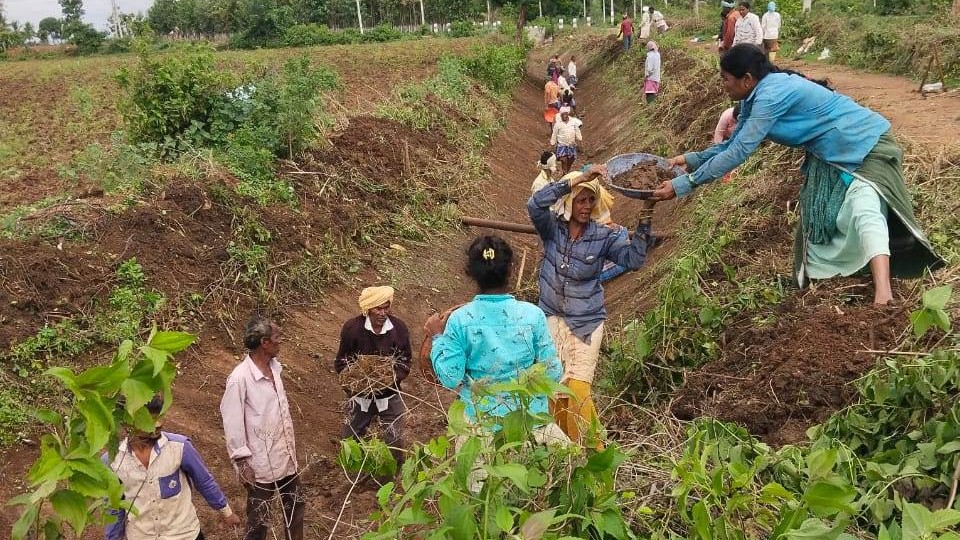
Karnataka is preparing to seek judicial approval to continue projects under the rural employment guarantee programme, a move that could significantly affect local infrastructure delivery, livelihood security and climate-resilient public works across the state’s rural and peri-urban regions.The state government’s intervention comes amid uncertainty surrounding the continuation of works under the Mahatma Gandhi National Rural Employment Guarantee Act (MGNREGA), one of India’s largest public employment and rural infrastructure programmes.
Officials are expected to request permission for ongoing and pending projects to proceed, citing their importance for local economies and community assets.The issue carries broader implications for Karnataka’s urbanising districts, including regions surrounding Bengaluru where rural and peri-urban communities remain closely tied to public employment schemes for water conservation, road maintenance and environmental restoration activities.Development economists say MGNREGA plays a dual role in supporting both income generation and local infrastructure creation.Beyond providing wage employment, the programme has increasingly contributed to drought mitigation, watershed development, rural connectivity and ecological restoration projects that strengthen long-term resilience against climate stress.In Karnataka, many MGNREGA-linked projects involve desilting water bodies, improving village roads, restoring drainage channels and supporting land productivity. Urban planners note that such interventions also indirectly influence metropolitan sustainability by protecting regional water systems and reducing distress migration toward already strained cities like Bengaluru.
The debate over project continuity reflects wider tensions around governance, funding and administrative oversight within large-scale public welfare schemes. Policy experts argue that interruptions in labour-intensive infrastructure programmes can disproportionately affect low-income households dependent on seasonal employment opportunities.The timing is particularly significant as climate variability and rural economic pressures continue affecting agricultural communities across parts of southern India.Researchers say public employment programmes are becoming increasingly important as adaptive social infrastructure capable of stabilising rural incomes during periods of economic or environmental disruption.The Karnataka employment works issue also highlights the growing interdependence between rural and urban development systems. Sustainable metropolitan growth, experts argue, depends not only on investments within cities but also on the resilience of surrounding rural regions that support food systems, labour markets and ecological resources.Labour rights groups and development specialists have stressed the need for predictable policy frameworks to ensure continuity in public works execution. Delays or uncertainty around approvals can slow project implementation, affect wage disbursement cycles and disrupt local planning efforts.
Authorities are expected to present their position before the court while emphasising the economic and social importance of maintaining ongoing works. Urban policy observers say the outcome could influence how employment-linked infrastructure programmes are managed in a period when India’s development priorities increasingly intersect with climate adaptation, regional equity and sustainable growth objectives.
Also Read:Bengaluru Biodiversity Park Restoration Work Finally Begins
Bengaluru Region Development Tied To Employment Scheme Relief
