


Karnataka’s 2025 Devadasi rehabilitation law marks an important shift in how the state addresses a practice it had prohibited on paper for decades. But the experience of families in north Karnataka shows that legislation is only the first stage: the harder task is ensuring that relief, housing, education, land and social acceptance reach people whose exclusion has continued across generations.
The story of Chandalinga Kalalabandi, a 38-year-old activist from Kushtagi taluk in Koppal, brings that institutional gap into view. The grandson of a Devadasi, he grew up watching women in his family and community face sexual exploitation, abandonment, poverty and stigma. He now leads the Vimukta Devadasi Mahila Vedike (VDMV), an organisation that has documented the condition of Devadasi families and pushed for state intervention.
The Devadasi system is described as a religious-social practice in which girls, often from Dalit and other marginalised communities, were dedicated to a local deity in a ritual resembling marriage. Once dedicated, a woman could not marry and was traditionally expected to serve the temple, perform ritual music and dance, and provide sexual services to patrons. In practice, the system became a form of caste-based sexual exploitation shaped by poverty, debt and superstition.
North Karnataka has remained the principal geography of the problem, with affected communities reported across Belagavi, Koppal, Raichur, Ballari, Vijayanagara, Bagalkot and Dharwad. The effects were not limited to the women who were dedicated. Their children often faced poverty, social stigma, uncertainty over legal paternity and difficulty accessing education and other public systems.
The 1982 Karnataka Devadasis (Prohibition of Dedication) Act formally outlawed the practice, but the law did not end it or provide adequate relief to families already affected. Chandalinga’s account suggests why prohibition alone was insufficient. Children grew up being treated differently from the moment their identity became known, while women who had been exploited were left without stable livelihoods, family support or social protection.
One of the most visible interventions came in 2018, when VDMV organised a mass marriage for 32 children of Devadasis in Kushtagi. Chandalinga told The Indian Express that the event attracted media and government attention. It also demonstrated the social barriers facing families whose children wished to marry and establish lives outside the inherited stigma of the system.
The government subsequently announced a survey of Devadasis, and the report identified about 23,395 women in the state. Chandalinga was appointed to the state survey committee. The findings recorded that 91.79 per cent of Devadasi women were illiterate. The committee recommended incentives for Devadasis for up to three generations and proposed that the father’s name should not be mandatory in school, college and other application forms.
These recommendations point to the administrative nature of the problem. The exclusion of children was not only social; it could also be reproduced through forms, records and eligibility requirements. When a child is required to provide a father’s name to enter an institution or access a service, a family structure created by exploitation can become an official barrier. Removing that requirement, where appropriate, is therefore a change in access to public systems rather than merely a symbolic reform.
What the Karnataka Devadasi rehabilitation law changes
In August 2025, the Karnataka government tabled the Devadasi (Prevention, Prohibition, Relief and Rehabilitation) Bill. Both houses of the state legislature passed it, replacing the 1982 law. The new legislation completely outlaws the Devadasi system in all forms and provides for relief and rehabilitation programmes, according to the report.
The change is significant because it expands the state’s stated responsibility beyond preventing new dedications. A prohibition law addresses the act itself; a rehabilitation framework must address the consequences that remain after the act has taken place. Those consequences include the loss of education, insecure livelihoods, lack of housing, social isolation and the vulnerability of children born into affected families.
The available account also shows that rehabilitation is not a single benefit. It involves several departments and forms of support, including land, housing, education, financial assistance and livelihood opportunities. That makes implementation dependent on coordination between state agencies and local administration. The survey can identify affected families, but identification alone does not guarantee that a person receives land, housing or an income-generating asset.
The figures cited in the report show both the scale of the challenge and the distance still to be covered. The state survey identified about 23,395 Devadasis, while 1,039 women had received land from the government. The two figures measure different things, but together they show that rehabilitation cannot be understood through a single scheme or one-time announcement.
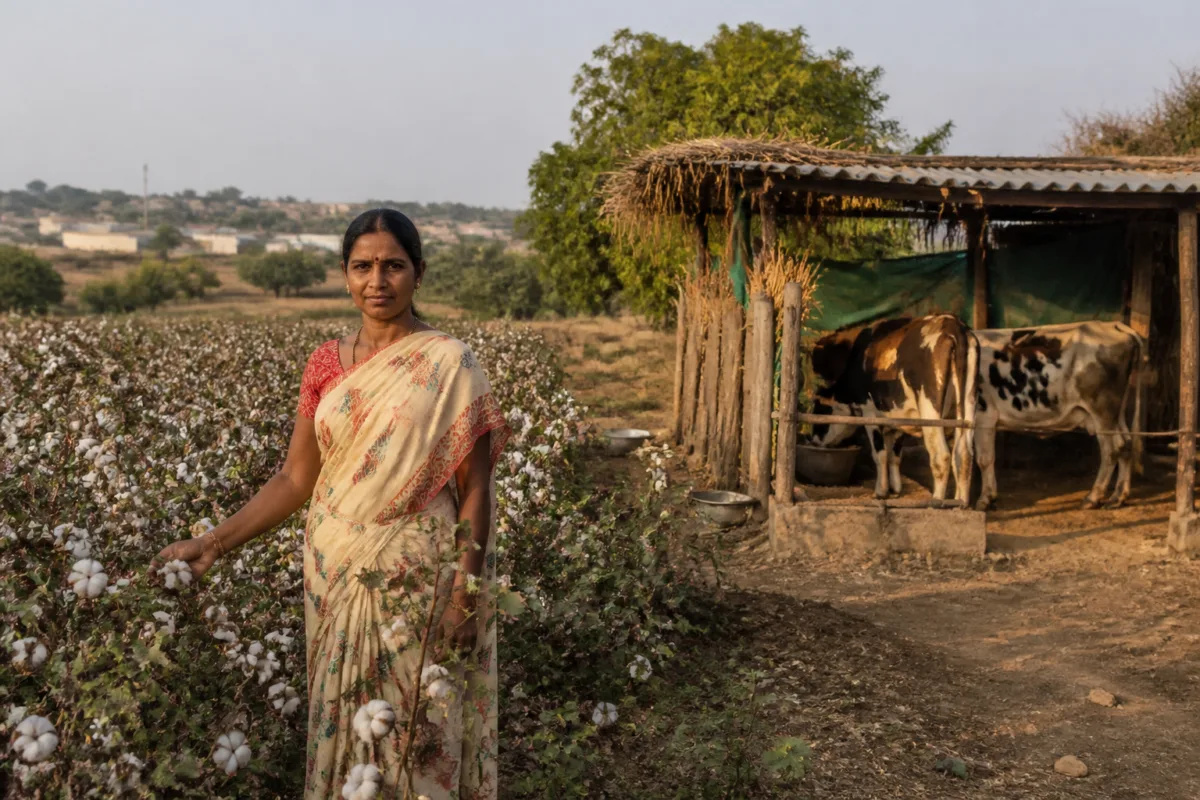
Vijamma’s experience illustrates what effective rehabilitation can mean at the household level. Forced into the system at about 12, she later received agricultural land and used it to grow cotton. She also runs a dairy business. Her account presents land not simply as an asset, but as a basis for a livelihood and a degree of independence that was unavailable earlier.
At the same time, Chandalinga said implementation remained incomplete. He stated that Devadasi children were receiving Rs 5 lakh, while housing and other schemes were still pending. The report does not provide details of the eligibility rules, delivery schedule or coverage of these benefits. That absence is important because the success of the law will ultimately be judged not by the existence of packages, but by whether eligible families can access them consistently.
The institutional gap after prohibition
The history of the Devadasi issue shows a recurring pattern in social policy: the state recognises a harmful practice, prohibits it, and then struggles to dismantle the economic and administrative conditions that allowed it to continue. A law can declare dedication illegal, but it cannot by itself provide a home, restore years of lost schooling, create a livelihood or remove stigma from official and community life.
The survey committee’s recommendations are therefore central to the new framework. Support extending to three generations recognises that the effects of the system do not end with the woman who was dedicated. Children may inherit the consequences through poverty, school exclusion and social discrimination. The proposal to remove mandatory reference to the father’s name similarly acknowledges that public institutions must accommodate families whose histories do not fit conventional documentation.
The implementation challenge is also geographical. The affected districts are spread across north Karnataka, and the families described in the report live in rural and semi-rural settings where access to government offices, land records, welfare schemes and livelihood support may depend on local administrative capacity. The law’s practical reach will depend on whether its benefits are delivered beyond state-level announcements and into individual taluks and villages.
Chandalinga’s activism has connected community documentation with legislative reform. His organisation’s work, including the 2018 mass marriage, helped bring visibility to an issue that had remained marginal despite the 1982 prohibition. But the state cannot outsource implementation to activists. Community organisations may identify gaps and press authorities to act, while government departments must provide transparent eligibility, processing and delivery mechanisms.
The story also raises a broader question about how governments measure rehabilitation. Counting beneficiaries is necessary, but it cannot capture whether women have secure livelihoods, whether children remain in school, whether families have adequate housing or whether documentation requirements continue to exclude them. The available evidence establishes that land has reached 1,039 women and that financial support has been announced for children, but it does not establish the full status of housing, education or other benefits.
A law whose success will be measured locally
Karnataka’s new law represents a stronger legal framework than the 1982 Act because it combines prohibition with relief and rehabilitation. Yet the evidence supplied in the report makes clear that the central test lies in delivery. The state has a survey, legislative approval and announced support packages, but affected families continue to report pending housing and other assistance.
For Devadasi families, rehabilitation is inseparable from the ordinary systems of urban and rural life: schools, land administration, housing programmes, welfare applications and local livelihoods. The issue is therefore not only one of social reform. It is also a test of whether public institutions can recognise vulnerable households, adapt their procedures and deliver benefits across generations.
What happens next will depend on implementation details that remain unresolved in the available account: how the new law will be administered, how pending housing support will be delivered, and whether the recommendations on education and documentation will be adopted across institutions. The experience of women such as Vijamma shows the potential of sustained support. Chandalinga’s continuing campaign shows why the legislation cannot be treated as the conclusion of the reform process.

