


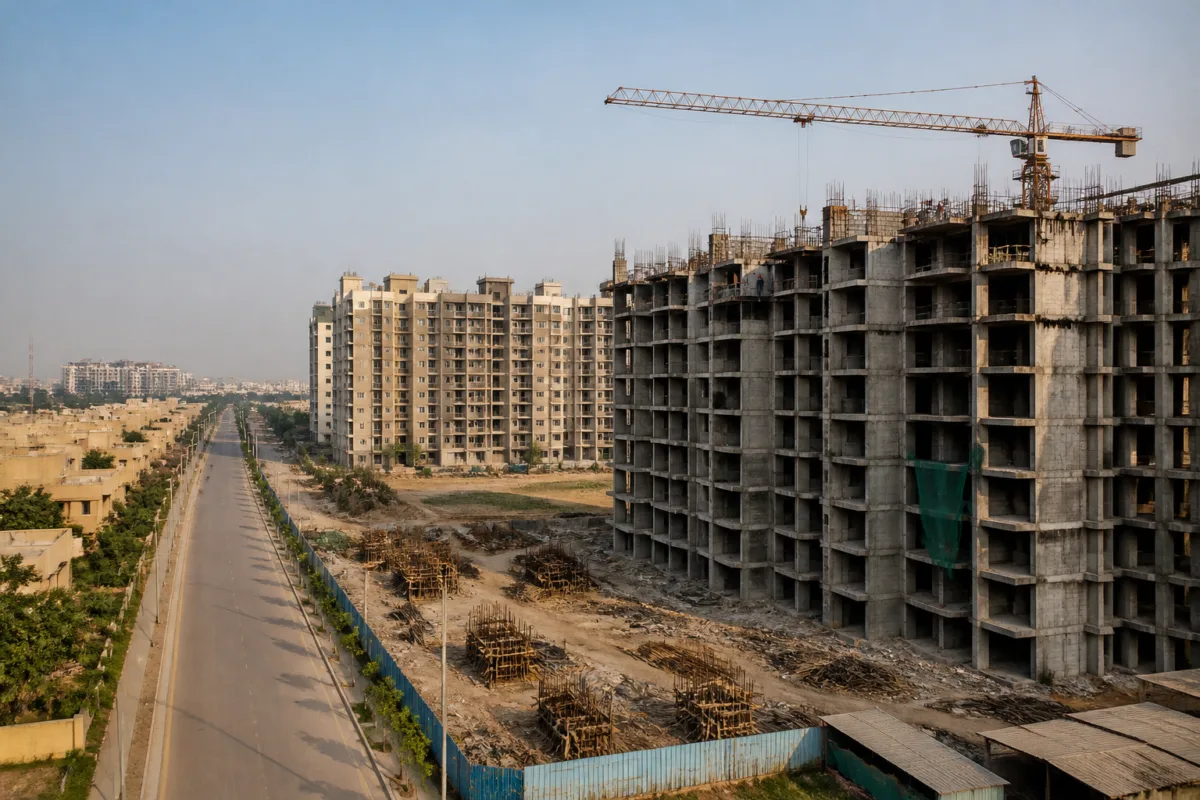
Noida affordable housing is set for a major policy reset after Uttar Pradesh approved the Model Building Regulations-2026, requiring group housing projects in the Noida, Greater Noida and Yamuna Authority areas to reserve 10% of their flats for economically weaker sections (EWS) and low-income groups (LIG). The rule is significant not only because it fixes the share and price of these homes, but because it links the approval of the rest of a project to the completion of its affordable component.
The framework, as reported by Navbharat Times – Noida, is intended to address a gap that has widened as private housing prices have risen and public affordable-housing supply has remained limited. The report says the state Cabinet approved the Model Building Regulations-2026 on October 9, after which the rules were sent to the development authorities. Noida Authority officials said the provisions would be studied and implemented after approval by the Authority board.
That sequence matters. The policy has been approved at the state level, but the report indicates that implementation at the Noida Authority level is not yet complete. The effectiveness of the framework will therefore depend on how the regulations are interpreted, incorporated into project approvals and enforced during construction and completion certification.
## The rule changes the approval bargain
The most consequential provision is the 10% reservation within group housing projects. Developers will have to construct EWS and LIG flats as part of the project rather than treating affordable housing as a separate or optional activity. The report states that developers must first obtain completion certificates for the EWS and LIG units. Only after that can the process for issuing occupancy certificates for the remaining flats begin.
This creates an administrative link between affordable housing and the commercial part of a project. In principle, the mechanism prevents a developer from completing and occupying higher-value homes while leaving the lower-cost units unfinished. It also gives the authority a clear point of control: the completion and certification of the affordable component becomes part of the wider project approval chain.
The reported rules also provide an alternative for residential projects smaller than four hectares. A developer may deposit a shelter fee instead of directly constructing the required affordable units. However, the report says the authority must use that amount to have an equivalent number of affordable flats built. The provision therefore does not remove the affordable-housing obligation; it changes the way the obligation may be fulfilled for smaller projects.
The effectiveness of this option will depend on the authority’s ability to calculate the fee accurately, secure land or construction capacity and ensure that the equivalent homes are actually delivered. The supplied report does not specify the amount of the shelter fee, the location of replacement flats or the timeline within which they must be constructed. Those details will be important when the rules are operationalised.
## Prices and sizes target a defined income group
The framework fixes the starting price of EWS flats at Rs 4.5 lakh and LIG flats at Rs 9 lakh, according to the report. It also sets size standards. In group housing projects, EWS flats will have a carpet area of 30 to 35 square metres, while LIG flats will have a carpet area of 35 to 45 square metres.
For plotted development schemes, the corresponding plot sizes are 35 to 40 square metres for EWS households and 40 to 50 square metres for LIG households. Parking provisions are also defined, with two square metres per EWS unit and four square metres per LIG unit.
These specifications matter because affordability is determined by more than the advertised price. The size of the home, the cost of access and the availability of basic project infrastructure all shape whether a household can realistically occupy and retain a dwelling. By fixing carpet-area ranges and plot sizes, the rules attempt to standardise what qualifies as an affordable unit rather than leaving the category entirely to project-level interpretation.
The eligibility thresholds are based on annual family income. EWS households are defined as those with annual income of up to Rs 3 lakh, while the LIG ceiling is Rs 6 lakh. The reported framework therefore establishes a defined target group for the reserved homes. It does not, however, set out in the supplied material how income verification, beneficiary selection, allotment, resale restrictions or occupancy monitoring will be handled.
Those administrative processes will be central to the policy’s outcome. A reservation requirement can increase the supply of designated homes, but access depends on whether eligible households can be identified transparently and whether the units remain available to the intended income groups after allotment.
## A response to a public-supply gap
The regulations arrive against a reported decline in authority-led affordable housing in Noida. Navbharat Times – Noida says that no affordable housing scheme has been launched by the authority in the city for the past 10 years. Earlier programmes such as Janata flats and Shramik Kunj had provided housing for lower-income groups, but the report says newer private-sector projects have seen steadily rising prices.
This history helps explain why the new approach relies on private group housing projects rather than only on standalone public schemes. Instead of waiting for the authority to assemble land, finance construction and launch a dedicated housing programme, the regulations place an obligation inside the development pipeline that is already producing homes.
That is a shift in the state’s role. The authority is not only acting as a land and project regulator; it is also using building regulations and completion approvals to secure a share of housing for households that may be excluded from the mainstream market. The policy consequently connects land development, building permissions, housing affordability and municipal-style enforcement within one approval framework.
The approach also reflects the geography of the wider region. The rule applies across areas controlled by Noida Authority, Greater Noida Authority and the Yamuna Authority. These territories are part of a rapidly developing urban corridor where housing supply is being shaped by large-scale planned projects and private group housing. A common framework can reduce variation between authorities, although the report indicates that each authority will still have to study and apply the provisions through its own administrative process.
## The implementation test begins after approval
The policy’s central promise is enforceability. Requiring completion certification for EWS and LIG units before occupancy approval for other flats gives authorities a formal instrument to pressure developers. But that instrument will work only if inspections, certification and project-level records are managed consistently.
The report does not establish how the 10% share will be calculated in mixed-use projects, whether it will apply to future approvals or ongoing projects, or how authorities will treat phased developments. It also does not provide the detailed rules for the shelter fee, allotment procedure or the treatment of common facilities. These are not minor technicalities: they determine whether the requirement creates integrated housing within projects or produces a separate, less connected affordable-housing stock.
The price ceilings will also require careful administration. The reported starting prices of Rs 4.5 lakh for EWS units and Rs 9 lakh for LIG units provide a clear entry point, but the supplied material does not explain whether the amounts include parking, infrastructure charges, registration, taxes or other costs. Nor does it state whether prices will be revised over time.
For households earning up to Rs 3 lakh or Rs 6 lakh annually, these additional costs can determine whether a nominally affordable home is financially accessible. The policy’s published implementation rules will need to make the full cost of purchase and occupation clear to applicants.
The immediate next step is therefore institutional rather than market-driven. Noida Authority officials have said that the regulations have been received from the government and will be examined before being placed for board approval. Until that process is completed, the framework establishes a state-approved direction but not yet a fully operational local delivery system.
The evidence currently confirms three changes: a 10% affordable-housing obligation in group housing projects, defined EWS and LIG sizes and income ceilings, and a certification sequence intended to prevent the affordable component from being delayed behind higher-value homes. What remains to be established is how the authorities will implement the shelter-fee option, select beneficiaries, calculate total costs and apply the rules to projects already in the pipeline. Those details will determine whether Noida’s new affordable-housing rulebook becomes a measurable increase in homes or remains primarily a regulatory commitment.

