


Artist and Visva-Bharati professor emeritus Jogen Chowdhury, who died at a private hospital in Calcutta on Sunday morning at the age of 87, is being remembered in Santiniketan not only for his art and teaching but also for his efforts to protect the town’s natural environment from unchecked construction.
Chowdhury, who had been battling cancer, was a lifelong teacher at Visva-Bharati’s Kala Bhavana, the institution’s centre for visual art practice and research. Although he retired in the early 2000s, he remained closely connected with the campus, guiding students and advising teachers on departmental initiatives. His last visit to Kala Bhavana was in March 2025, when he spent several hours sitting under a tree on the premises.
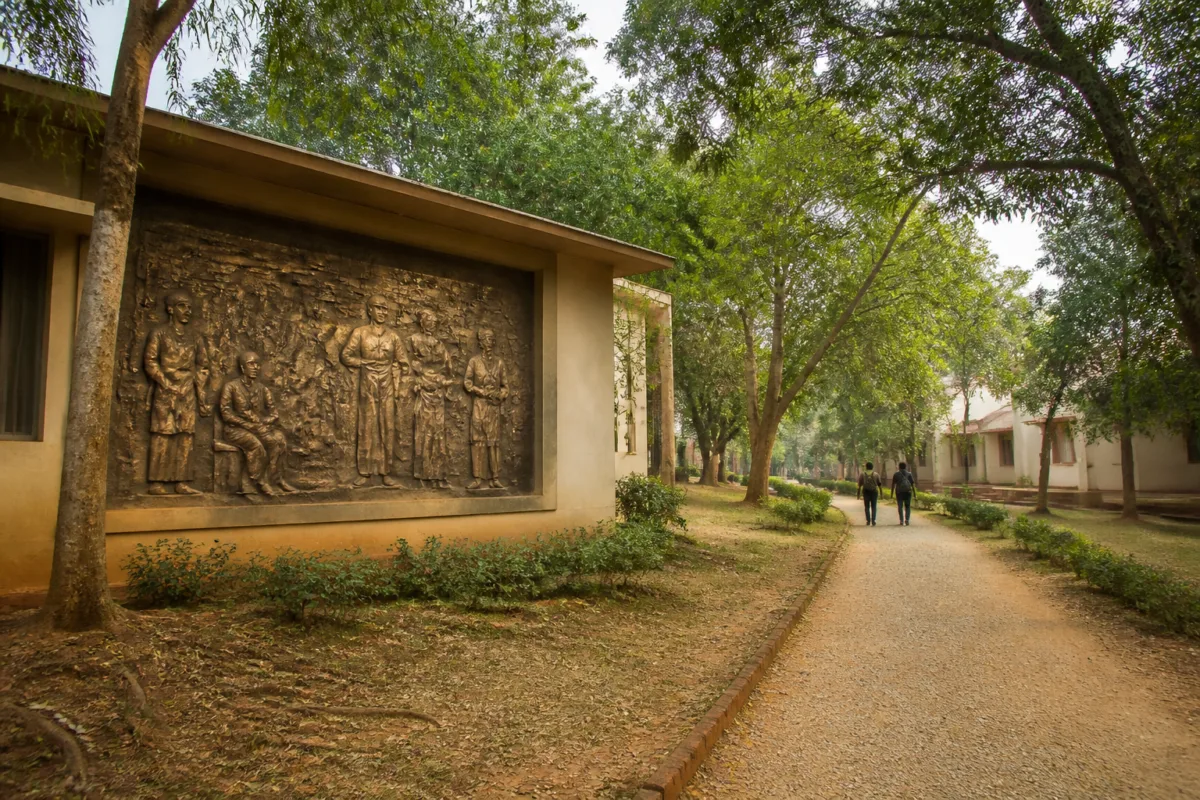
Kala Bhavana principal Sisir Sahana, who studied under Chowdhury, said the artist’s final artwork on campus was a bronze mural created four years ago on a classroom wall in the department of textile design. Sahana said Chowdhury continued to visit the campus and guide students, describing his contribution to Kala Bhavana as unparalleled.
“He was not only an internationally renowned artist but also a teacher whose contribution to Kala Bhavana was unparalleled. He was a teacher to all of us, and his loss is irreparable,” Sahana said.
Chowdhury’s connection with Santiniketan extended beyond the university. In the early 2000s, he became one of the prominent faces of the Khoai movement, which emerged in opposition to the growing number of constructions in the town. The movement reflected concern over the loss of Santiniketan’s open landscapes and natural character as buildings, hotels and guest houses multiplied.
In 2013, Chowdhury moved court against a residential complex that had come up near the Visva-Bharati campus. Although he was not always successful in stopping new construction, residents and longtime observers continued to remember him as a public figure who spoke against the transformation of Santiniketan into what many feared would become a concrete jungle.
His activism later extended to the Singur and Nandigram movements, where he became a prominent intellectual voice opposing the Left Front government’s land acquisition policies. In 2014, then chief minister Mamata Banerjee sent him to the Rajya Sabha as a Trinamool Congress member.
The political phase of his public life remained a subject of discussion among some Santiniketan residents. Nilanjan Bandyopadhyay, special officer at Rabindra Bhavana and one of Chowdhury’s close associates, said he had wondered why the artist entered electoral politics. Bandyopadhyay added that Chowdhury maintained cordial relations with political opponents and kept a “Parliament Diary” containing sketches of members from across party lines.
Chowdhury’s death prompted tributes from leaders across the political spectrum. Chief minister Suvendu Adhikari described his creations and architectural contributions to Parliament House, Rashtrapati Bhavan and other government buildings as an invaluable legacy. Former chief minister Mamata Banerjee called him the pride of Bengal and India. Leaders of the BJP, Congress and CPM also expressed condolences.
For Visva-Bharati and Santiniketan, Chowdhury’s legacy therefore combines three roles: internationally recognised artist, committed teacher and civic voice concerned about the town’s environmental future. His bronze mural remains on the Kala Bhavana campus, while his interventions against unplanned construction continue to be recalled by residents and former students.

