


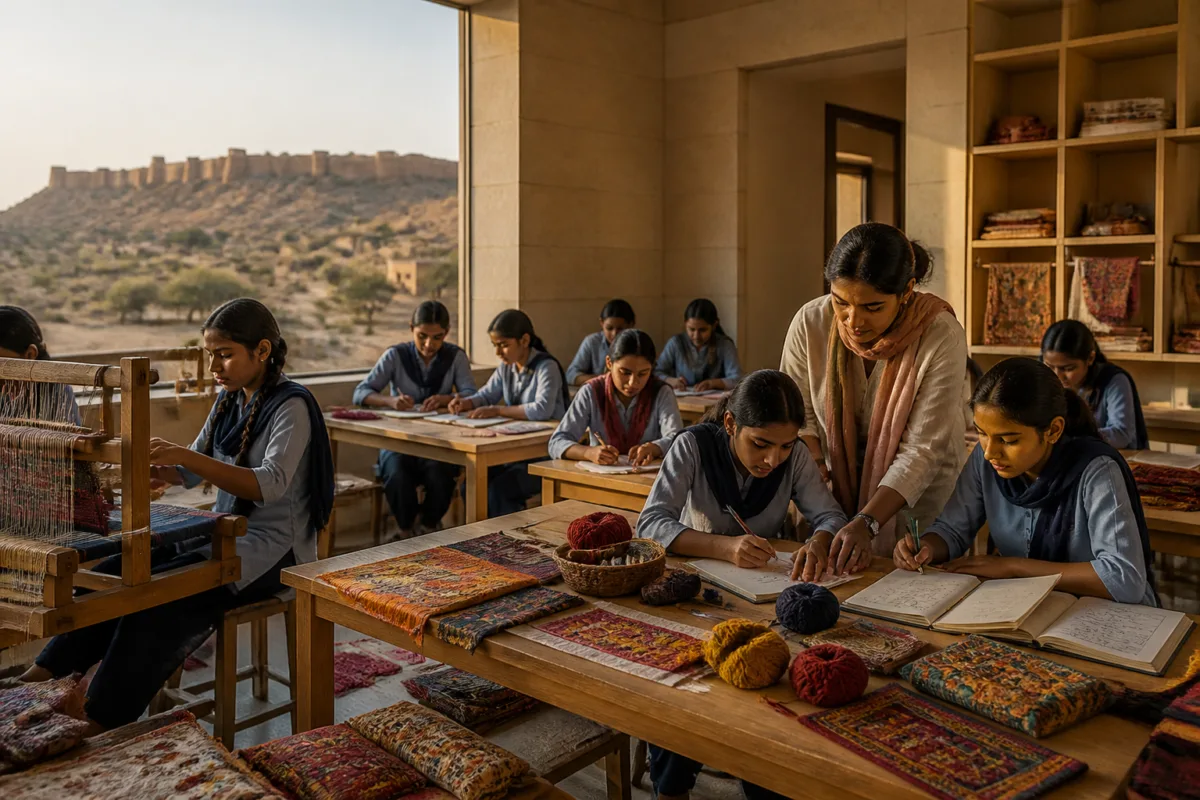
The new Indo-French partnership at Jaisalmer’s GYAAN Centre places girls’ education, vocational training and traditional craftsmanship within a single institutional model. Its immediate trigger is a Letter of Intent signed by French Ambassador to India Dr Thierry Mathou and CITTA Foundation India Director Chaitanya Raj Singh Bhati during the ambassador’s November 9-10 visit. Its larger significance lies in how the initiative attempts to connect formal schooling with the skills and cultural economy of the Thar region.
The GYAAN Centre is not presented as a standalone school project. According to the information released about the visit, it is designed as an integrated initiative comprising the Rajkumari Ratnavati Girls’ School, a Livelihood Centre under development and a proposed Cultural Centre. Together, these components seek to combine education, income generation and cultural engagement in one ecosystem.
That structure matters because the partnership is focused on a problem that conventional schooling does not always address: how education can translate into practical capabilities and sustainable livelihoods. The school’s model combines academic subjects with design, textiles, craftsmanship and creative learning. The proposed collaboration with French institutions is intended to add specialised expertise in fashion, haute couture and craftsmanship while retaining a local focus on traditional textile and craft techniques.
The school has already received the UNESCO Prix Versailles Award, and the ambassador visited the campus to interact with students and educators and understand its educational model. The award provides recognition for the institution’s design and architectural character, but the partnership described in the source material places equal emphasis on what happens inside the building: the relationship between learning, professional preparation and local economic opportunity.
This is the central institutional proposition behind the GYAAN Centre. The school is being positioned not only as a place where girls receive formal education, but also as an entry point into vocational skills and creative production. The Livelihood Centre, which is still under development, is expected to extend that approach beyond classroom learning. The proposed Cultural Centre would add another layer by connecting education and livelihoods with the preservation and presentation of regional heritage.
The Letter of Intent is therefore best understood as a framework for collaboration rather than evidence that the full programme is already operational. Under the proposed arrangement, the French Institute in India and CITTA Foundation India will facilitate expert missions from French institutions to the school. One named partner is Les Ateliers Alix, founded by fashion designer Mossi Traoré. The planned missions are intended to bring expertise in fashion, haute couture and craftsmanship to students.
The distinction between a signed intent and an implemented programme is important. The source material confirms the agreement and its broad objectives, but does not provide a detailed timetable, funding commitment, number of training missions, student intake or employment targets. It also does not establish how the proposed Livelihood Centre will be managed, how craft products will reach markets or how the Cultural Centre will be financed and operated. Those details will determine whether the initiative remains a partnership announcement or develops into a functioning skills and livelihoods system.
The model nevertheless highlights the institutional challenge of linking education to local economic opportunity. Traditional craft techniques can be preserved through teaching, but preservation alone does not guarantee income. For girls and women in Jaisalmer, the stated objective is to connect those techniques with contemporary design, professional expertise and potential livelihood opportunities. That requires an institutional bridge between learning and production, and between production and viable markets. The proposed collaboration is aimed at building that bridge, although the supplied material does not yet establish its commercial or employment outcomes.
The initiative also places design within a wider development framework. The Rajkumari Ratnavati Girls’ School has attracted international architectural recognition, but the GYAAN Centre’s stated purpose extends beyond the physical quality of its buildings. Its three-part structure attempts to use a school, a livelihood facility and a cultural institution as mutually reinforcing components. In that sense, architecture is being presented as part of an educational and economic ecosystem rather than as an isolated object.
This approach is particularly relevant to places where cultural heritage and livelihoods are closely linked. The Thar region’s textiles and crafts are identified in the source material as assets that need both preservation and professional development. The proposed French involvement is intended to add contemporary design and technical knowledge without removing the local basis of the work. The available information does not specify which crafts will be prioritised, how intellectual property will be handled or how local artisans will participate. Those unanswered questions will be significant for assessing whether the partnership strengthens existing capabilities or simply introduces an external design layer.
The governance structure is also still taking shape. The Letter of Intent was signed by the French ambassador and CITTA Foundation India, while the French Institute in India is expected to facilitate expert missions. This creates a multi-institutional arrangement involving a diplomatic mission, a cultural and educational institution, a foundation, specialist French organisations and the school itself. The arrangement may widen access to expertise, but it also makes roles and accountability important. The supplied report does not identify a formal monitoring mechanism, measurable milestones or a public reporting framework.
For the school, the immediate benefit described is access to specialised knowledge in fashion and craftsmanship. For students, the intended outcome is exposure to professional skills alongside conventional education. For women in the region, the broader objective is economic empowerment through livelihood avenues connected to traditional skills. These are distinct outcomes and should not be treated as interchangeable. A school can provide training without creating jobs; a craft programme can preserve techniques without raising incomes; and a cultural centre can showcase heritage without changing economic conditions. The GYAAN Centre’s integrated design seeks to address all three gaps, but its success will depend on how effectively the components function together.
The available numbers are limited. The source identifies three interconnected projects within the GYAAN Centre and describes a two-day ambassadorial visit on November 9 and 10. It names one French specialist institution and outlines the proposed involvement of the French Institute in India. However, no figures are provided for the number of students, teachers, trainers, artisans, planned expert missions or expected beneficiaries. There are also no reported budgets, implementation deadlines or outcome indicators. This makes the partnership’s stated direction clear while leaving its scale unestablished.
That evidence gap is not a reason to dismiss the initiative; it defines what should be monitored next. The next meaningful milestones would include the formalisation of expert missions, the development of the Livelihood Centre, clarity on the proposed Cultural Centre and evidence of how training will connect students and women to actual livelihood opportunities. Details on curriculum, certification, market access and participation by local craft practitioners would also show whether the programme is building a durable local institution.
The GYAAN Centre’s proposition is ambitious because it treats education, skills and cultural heritage as linked parts of the same regional development question. Its Indo-French partnership adds international expertise to a locally rooted initiative, while the school’s existing design recognition gives the project visibility. What the evidence confirms at this stage is a signed intent and a defined institutional direction. What remains unconfirmed is the programme’s implementation scale, financing, timeline and measurable impact on girls’ education and women’s livelihoods. The next phase will determine whether the model can convert recognition and partnership into sustained capability in Jaisalmer.

