


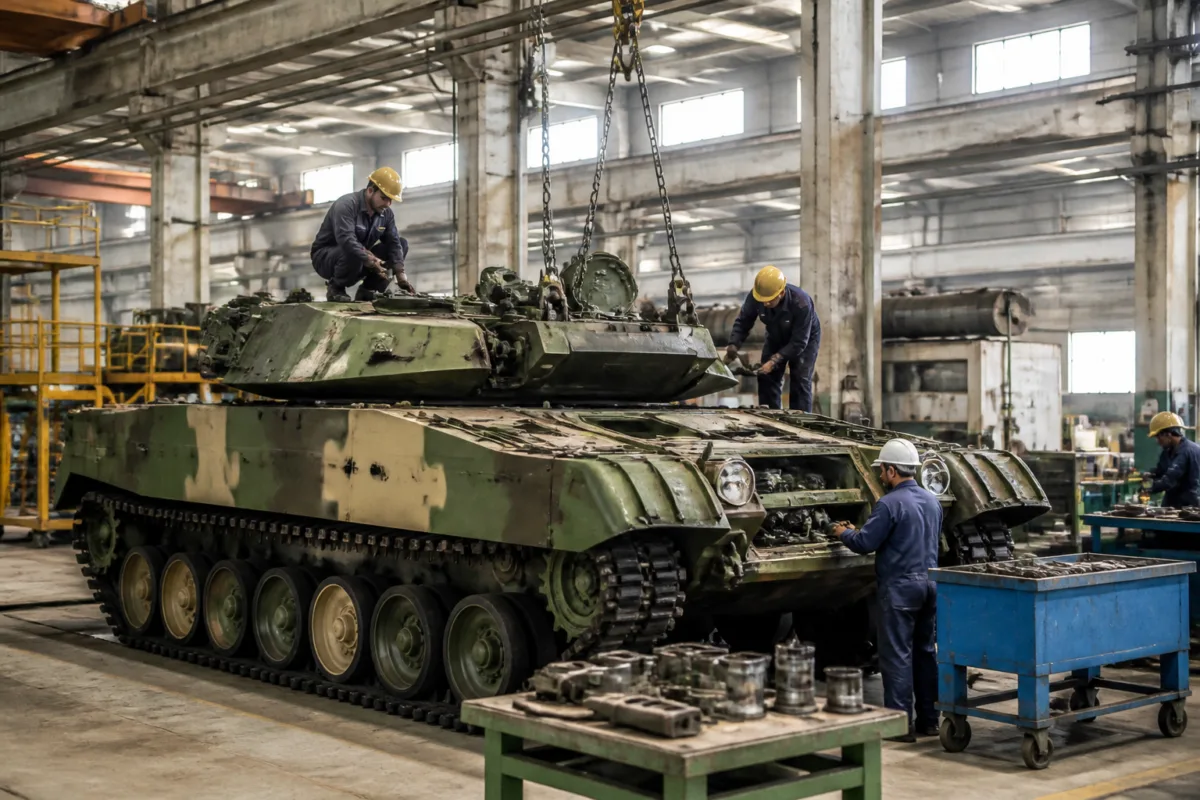
Vehicle Factory Jabalpur is being developed as India’s second major centre for overhauling its Soviet-origin T-72 and Russian-designed T-90 battle tanks, but the project is about more than repairing military vehicles. It shows how an older defence-manufacturing ecosystem is being asked to recover technical knowledge, recreate specialised equipment and build a new skilled workforce around industrial capability that was once dependent on foreign designs and expertise.
The facility is expected to begin overhauling 80 Army tanks annually from April 2028. The project, estimated to cost Rs 462 crore, is being developed by Vehicle Factory Jabalpur, or VFJ, in coordination with Heavy Vehicles Factory at Avadi in Tamil Nadu. Both units come under Armoured Vehicles Nigam Limited, a defence public sector undertaking.
The immediate task is technically demanding. An overhaul is different from routine servicing: the tank is dismantled, its systems are inspected, worn components are repaired or replaced, and the vehicle is then reassembled and tested. Each overhaul can take about four months. The planned Jabalpur facility will therefore need to manage a continuous industrial process involving dismantling, inspection, component work, reconstruction and testing rather than a simple maintenance operation.
That distinction matters for the city’s industrial economy. A target of 80 tanks a year implies a permanent production and maintenance system, supported by specialised fixtures, machinery, equipment layouts and trained personnel. VFJ currently estimates that it will require about 650 trained workers when the facility reaches full capacity. Around 80 people are working on the project at present, mainly on the hull and turret, while work on internal systems is planned for a later phase.
The project also reveals the institutional complexity behind what may appear to be a single factory upgrade. VFJ secured the assignment after completing a pilot project involving two T-72 tanks. Teams from Jabalpur have been sent to Avadi for training, while specialists from the two factories are working together to establish the new facility. This arrangement makes the project a transfer of operational knowledge within the public-sector defence manufacturing system, rather than an isolated expansion by one plant.
One of the central challenges is the age and origin of the technical documentation. Many of the original drawings are decades old and written in Russian. Engineers at VFJ have decoded nearly 70 per cent of Soviet-era drawings for the specialised fixtures required to dismantle and rebuild the tanks. Where drawings are unavailable, the factory is developing indigenous designs.
Harsh Bhatnagar, deputy general manager at VFJ, said the factory had conducted detailed studies of the specialised fixtures, equipment, machinery and facility layouts needed for the project. He described the process as complex and time-consuming, while saying that work was progressing in line with the timelines in the detailed project report.
This is the project’s most significant industrial feature. The ability to overhaul a vehicle depends not only on possessing the tank or having access to replacement parts. It also requires the tooling, layouts, test systems, technical drawings and trained teams needed to take the platform apart and return it to operational condition. Reconstructing that system from ageing documentation is therefore a form of industrial capability-building.
The requirement has its roots in the long history of India’s T-90 programme. The Army’s armoured fleet includes the Soviet-origin T-72 Ajeya and the Russian-designed T-90 Bhishma. India signed a contract in 2001 for the licensed production of 1,000 T-90 tanks at Avadi, following an earlier agreement to procure 310 tanks that included technology transfer. Russian experts helped establish the production processes, and Indian engineers travelled to Russia for training.
That history explains why Avadi is central to the Jabalpur project. The older production relationship created a technical base in Tamil Nadu, while the new facility seeks to distribute overhaul capacity across another public-sector factory. Jabalpur is consequently being positioned not as a replacement for Avadi, but as a second centre capable of handling a defined annual workload.
The arrangement also illustrates the difference between technology acquisition and technology retention. Earlier agreements brought production processes and training into India, but the continued use of older platforms requires the supporting knowledge to remain available decades later. Documents can become difficult to interpret, specialised fixtures can fall out of production, and experienced personnel can retire or move on. The Jabalpur project is responding to that maintenance and knowledge challenge by rebuilding capability inside the domestic system.
The workforce requirement is equally important. VFJ has been training personnel for two years, and teams are continuing to learn at Avadi. The eventual requirement of approximately 650 trained workers is substantially larger than the current project team, indicating that the facility’s most difficult expansion may be organisational as much as physical. The factory will need people capable of working across mechanical systems, vehicle structures, testing and the specialised equipment used in the overhaul process.
The available information does not establish whether the project will create a wider supplier network in Jabalpur or how many indirect jobs could emerge around the facility. It does, however, show that the plant’s future role will depend on skills development and coordination between institutions. The stated workforce plan provides a measurable indicator of the facility’s intended scale, while the current training programme shows that capacity-building began before the plant reaches its planned operating date.
The project’s schedule is organised around April 2028, when VFJ aims to begin annual overhauls. Before that milestone, the factory must complete the remaining design work, establish the equipment and facility arrangements, expand training, and move from work on hulls and turrets to the internal systems of the tanks. The DPR timelines cited by VFJ provide the project’s administrative framework, although the supplied report does not detail individual procurement or construction deadlines.
For Jabalpur, the facility adds a new layer to the city’s role as a location for defence manufacturing. VFJ already manufactures specialised military vehicles, and the tank overhaul assignment builds on that industrial base. The project links the city to Avadi, to the Army’s armoured fleet and to a longer history of licensed production and technical transfer. Its importance is therefore not limited to the number of tanks processed each year.
The larger urban question is whether a public-sector industrial city can convert legacy capability into a durable, high-skill manufacturing ecosystem. In this case, the evidence points to a factory trying to do so through technical reconstruction, inter-factory training and a planned expansion of its workforce. The outcome will depend on whether the project can translate decoded drawings and pilot experience into a reliable full-scale operation.
What is established is that VFJ has completed a two-tank pilot, decoded nearly 70 per cent of the relevant Soviet-era drawings, begun training and set a target of 80 annual overhauls from April 2028 at an estimated cost of Rs 462 crore. What remains to be demonstrated is the facility’s performance at scale, including the completion of internal-systems work and the recruitment and training of the planned workforce. Those milestones will determine whether Jabalpur becomes a functional second overhaul centre for India’s T-72 and T-90 fleet.

