


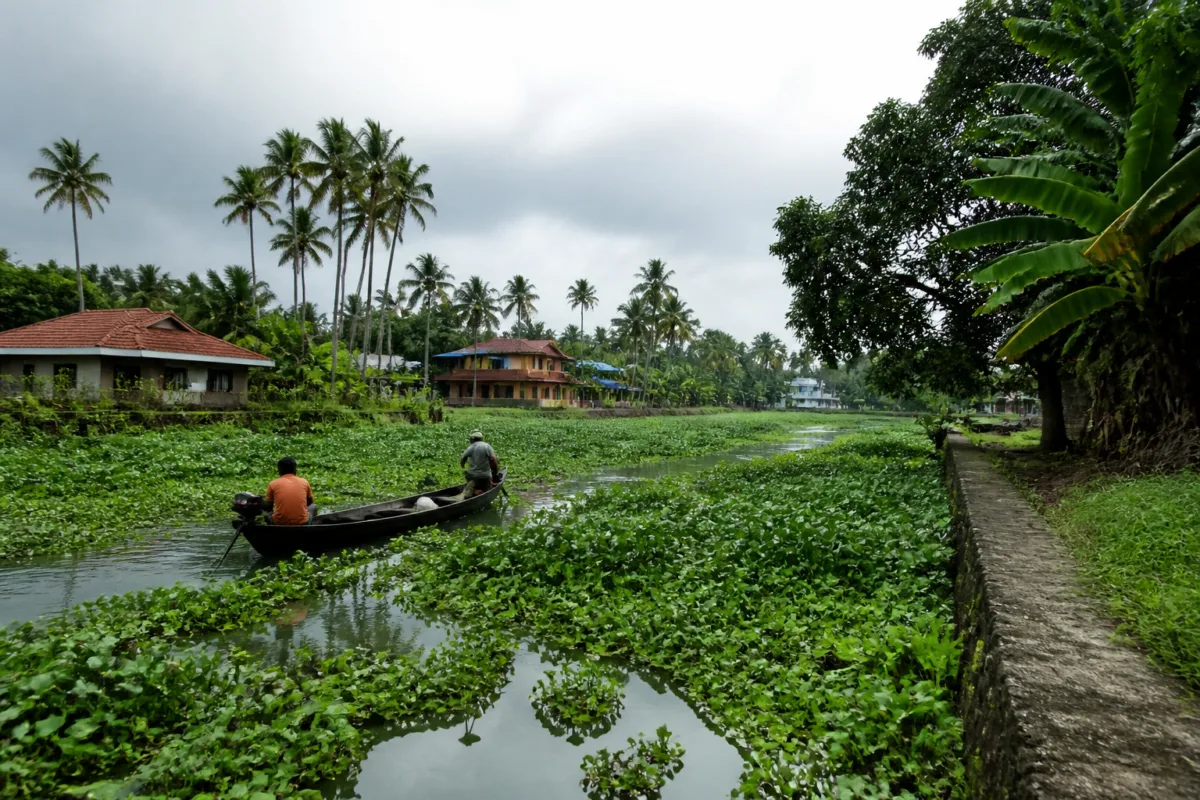
Invasive weeds in Kerala are no longer only a problem for forest managers or farmers. Their spread across forests, wetlands, agricultural land, backwaters and canals is being described as an ecological and economic threat that can weaken local biodiversity, reduce food availability for wildlife, damage fisheries and obstruct water transport. The issue also exposes a wider governance challenge: Kerala’s landscapes are connected, but the institutions responsible for forests, agriculture, waterways and public health often address their consequences separately.
A report by Kerala Kaumudi, citing environmental experts and Dr C.M. Joy, president of the Kerala Nature Protection Council, says invasive plant species are displacing native vegetation and reducing local biological diversity. Some of these plants release allelopathic chemicals that inhibit the growth of grasses and undergrowth around them. In forests, that can leave the lower layer of vegetation depleted, affecting the availability of food for herbivores such as elephants and gaur.
The reported damage is not confined to remote forest areas. Aquatic weeds can form dense green mats across lakes, backwaters and canals. These mats block sunlight from reaching the water, reduce oxygen levels and can put pressure on fish populations. They can also interfere with navigation and damage local fishing activity. In a state where inland water networks serve ecological, economic and transport functions at the same time, a weed infestation can therefore become a water-management problem as well as an environmental one.
The central difficulty is that invasive species do not respect administrative boundaries. A plant that spreads through a canal can affect a wetland, a fishing settlement and a transport route. A species that alters soil conditions on agricultural land can affect crop output and the quality of produce. A forest weed can change the availability of forage for wildlife and increase the cost of habitat management. The consequences appear in different departments, while the underlying ecological process remains the same.
The report links the spread of some invasive species in Kerala to the period after floods, when such plants became more widely visible or expanded into new areas. Floods can move plant material through waterways and disturb land surfaces, but the supplied report does not establish the precise pathway for every species. What it does show is that post-flood landscapes can carry a long tail of ecological change. Recovery, in such cases, is not limited to repairing roads, houses or embankments; it can also involve identifying and controlling species that alter the structure of wetlands and farmland.
That distinction matters for urban planning. Wetlands and canals are often treated as drainage infrastructure, open space or transport corridors, depending on the department examining them. Their ecological condition, however, directly influences the performance of all three functions. Dense aquatic growth can restrict water movement and navigation. Reduced oxygen can affect fisheries. Changes in wetland vegetation can alter habitat conditions. If invasive growth is allowed to become established, the cost of restoring a waterbody may rise beyond the cost of early detection and removal.
The report also points to changes in soil and groundwater conditions. According to the cited experts, invasive species can alter the natural chemical composition of soil, reduce its quality and adversely affect groundwater availability. These claims are presented as broad ecological impacts rather than as measurements from a specific site, and the supplied material does not provide a district-wise assessment or quantified groundwater loss. Even so, the concern is structurally important because soil, surface water and groundwater are managed as connected systems in practice, although policy responses may remain divided.
Agricultural losses are another part of the problem. The report says invasive weeds can reduce crop yields and crop quality. For cultivators, the impact is not limited to the cost of removing plants. Dense growth can compete with crops for space and resources, alter field conditions and require repeated intervention. Where treatment involves cutting, clearing or chemical control, the cost is transferred to farmers, local bodies or government agencies. The report does not provide a statewide estimate of the resulting farm losses, but it identifies a direct link between biological invasion and agricultural productivity.
Human health adds another layer. Some of the species mentioned in the report are associated with skin allergies, respiratory problems or poisoning risks. The material does not identify the number of affected people or distinguish between species and exposure pathways. That limitation makes it difficult to calculate the public-health burden. It does not, however, remove the need to treat invasive vegetation as a community issue, particularly when it grows near homes, farms, canals and frequently used public spaces.
The list of plants identified in the report includes thottappayaru, water hyacinth, kakkapola, African payal, black wattle, kudamaram, yellow oleander, giant sensitive plants, lantana and several other species. The report describes water hyacinth and kakkapola as plants that spread across water surfaces, African payal as a species found in backwaters, black wattle as undergrowth and kudamaram as an African tree that can grow up to 30 metres. It describes yellow oleander and giant sensitive plants as species of American origin, with the latter growing up to 18 metres. These descriptions are supplied by the source and are not presented as a comprehensive scientific inventory of Kerala’s invasive flora.
The variety of habitats in which these plants occur underlines why a single removal strategy is unlikely to be sufficient. Aquatic weeds require approaches suited to canals, lakes and backwaters. Forest undergrowth requires attention to habitat recovery and wildlife food availability. Agricultural infestations must be addressed without damaging crops, soil or farm livelihoods. Chemical treatment may be relevant in some circumstances, but the report specifically notes that large resources are required for cutting, controlling and chemically treating dense invasive growth. The method, timing and agency responsible would need to vary according to the site and species.
This creates an institutional question for Kerala. The report says the Forest Department faces substantial expenditure in controlling invasive weeds. But forest authorities cannot alone manage infestations in agricultural fields, canals, backwaters and settlements. Effective control would require coordination among forest, agriculture, local-government, water-resources and public-health institutions, along with communities that encounter the plants first. The report’s call for public participation reflects that practical reality: many infestations become visible at the local level before they become part of a formal departmental programme.
Public participation, however, is not a substitute for a defined administrative system. Community groups may help identify, remove or monitor invasive plants, but sustained control also requires mapping, technical guidance, safe disposal and follow-up. The supplied report does not identify a statewide monitoring platform, dedicated budget or common protocol. Those absences are important because removal without monitoring can leave the source of regrowth untouched, while poorly managed disposal may allow aquatic or seed-bearing plants to spread again.
The economic question is therefore larger than the immediate cost of clearing vegetation. Expenditure may arise in several places: forest management, waterway maintenance, fisheries, agriculture, health services and flood-recovery work. A dense aquatic weed mat can affect navigation and fishing at the same time. A forest infestation can reduce wildlife forage and increase management costs. A crop infestation can lower yields and quality. Without a common accounting framework, these losses may appear as unrelated local expenses rather than as the combined cost of ecological invasion.
The evidence supplied in the report confirms the breadth of the threat but leaves several questions unanswered. It does not establish the area affected by each species, the rate at which infestations are spreading, the districts facing the greatest risk, or the annual public expenditure on control. It also does not provide measurements of changes in fish populations, groundwater availability, crop yields or health impacts. Those gaps prevent a precise assessment of scale, but they also show what future public reporting and government monitoring would need to document.
Kerala’s invasive-weed problem is ultimately a test of whether environmental management can follow the movement of ecological systems rather than the boundaries of departments. Forests, farms, wetlands, canals and settlements are not separate in their impacts on water, food, mobility and livelihoods. The report’s warning is clear: unchecked invasive growth can weaken each of these systems simultaneously. The next step is to establish where the problem is concentrated, which species are responsible, how control is being funded and whether local participation is being integrated into a sustained management programme.

