


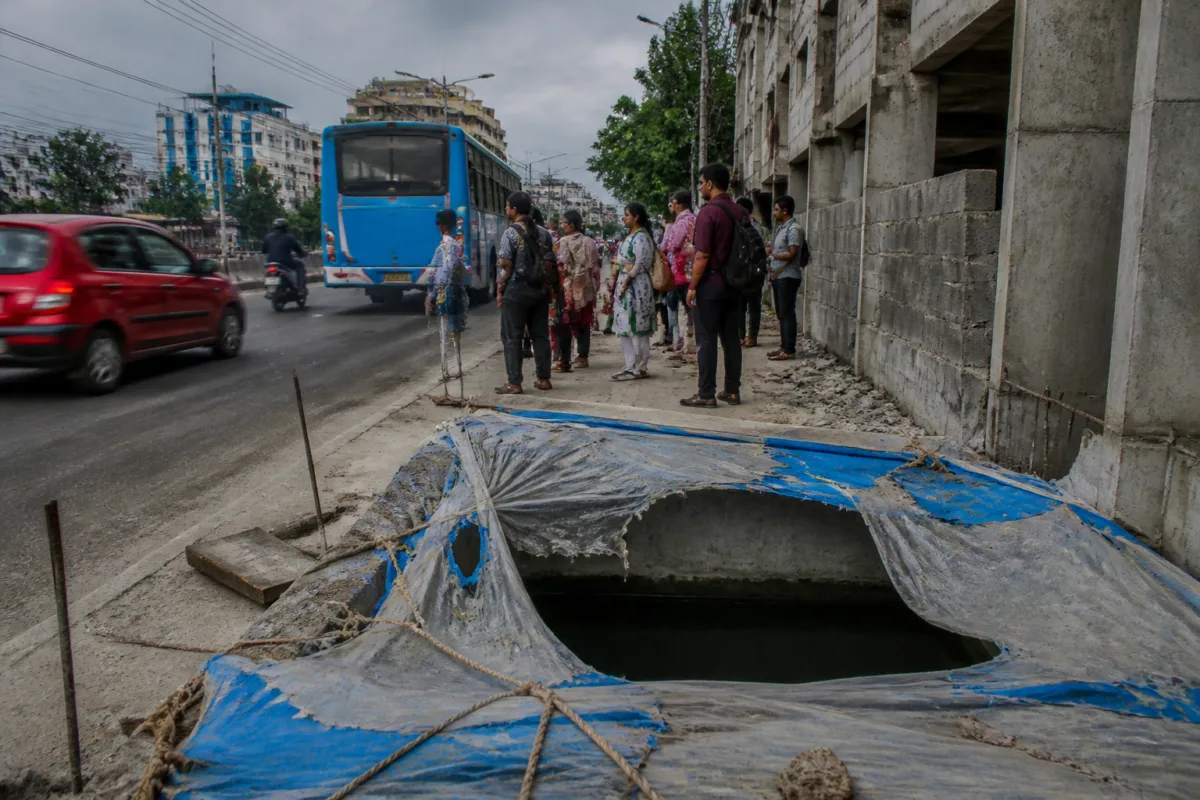
A pedestrian’s serious injury after falling into an inadequately covered water-tank manhole near Kundannoor Junction has exposed how construction-site hazards can become part of the everyday walking environment in Kochi’s urban areas. The incident also raises a basic administrative question: who is responsible when a private construction property becomes an unavoidable waiting space for pedestrians because the adjoining road is too narrow and traffic is too heavy?
Alex Dominic, 40, from the 11th ward of Arookutty, suffered a spinal fracture after falling into the approximately one-and-a-half-person-deep tank on Saturday at around 5.30 pm, according to a report by Mathrubhumi. The accident occurred near a building under construction at Kundannoor Junction in Maradu. The tank’s manhole had reportedly been covered only with a plastic sheet, making the opening difficult to identify.
The incident was not described as a fall inside a formally designated public footpath. Instead, the report shows how pedestrians had begun using the compound of the unfinished private building to wait for buses. The road was narrow, and vehicles were moving through the area. With no wall separating the property from the roadside, people entered the compound while waiting for transport. That informal adaptation to inadequate road space placed pedestrians directly beside an unprotected water-tank opening.
This is the central urban issue in the case. A city’s pedestrian-safety system does not end at the edge of a carriageway. Where pavements are absent, narrow or obstructed, people routinely occupy whatever marginal space is available: building setbacks, shopfronts, parking edges, vacant plots and unfinished properties. If those spaces contain open pits, tanks, construction materials or unstable surfaces, an ordinary act such as waiting for a bus can become a serious safety risk.
The account also illustrates the difference between a property being privately owned and a hazard being privately contained. The manhole was part of a water tank constructed in front of a building under construction. Yet the location was immediately next to a road and was being used by members of the public because of local traffic and road conditions. The supplied report does not establish which authority approved the tank, whether the construction site had received any safety notice, or whether an inspection had taken place. Those details remain important to determining responsibility.
According to the report, Alex was returning after meeting a friend in Aluva and was waiting for a bus to Arookutty. He moved backwards after noticing vehicles approaching at high speed and fell into the tank. The plastic sheet reportedly gave no visible indication that an opening lay beneath it. The sequence matters because it shows how a pedestrian can be forced to choose between moving towards traffic and stepping into an apparently usable space. The accident was therefore shaped not only by the uncovered tank but also by the interaction between road width, vehicle movement, public transport dependence and the absence of a safe waiting area.
The immediate rescue was carried out by employees who noticed the incident and placed a ladder into the tank to bring Alex out. He was later taken by auto-rickshaw to Lakeshore Hospital, where examinations found a spinal fracture. He underwent spinal surgery on Monday, the report said. The injury also disrupted his planned return to Abu Dhabi, where he works as an electrician at a private company.
The personal circumstances make the cost of the infrastructure failure visible. Alex had returned to India 10 days earlier for his daughter’s first birthday and was scheduled to travel back on the 17th. The accident prevented that journey. These details do not change the technical cause of the fall, but they show how a defect in a small piece of the built environment can quickly affect employment, travel, household arrangements and medical expenses.
The family has submitted a complaint at the Maradu police station seeking action. The supplied report does not include a police response, a statement from the property owner, the contractor, the local body or the building regulatory authority. It also does not state whether the site has since been secured. Those unanswered questions are significant because the accident occurred at a location where public movement had become foreseeable.
The numbers in the report are modest but revealing. The tank was about one-and-a-half persons deep. The accident happened at approximately 5.30 pm, when road movement and bus travel were active. Alex was 40 years old. The road was described as narrow, and the area was affected by vehicle traffic. None of these facts alone explains the incident. Together, they show how a relatively small hazard can become dangerous when it is placed beside a busy urban road without a visible, load-bearing cover or a physical barrier.
Construction sites frequently change the relationship between private land and public movement. Hoardings, walls, temporary access points and covered drains can either separate hazards from the street or allow them to spill into the path of pedestrians. In this case, the report says the property was not walled off. That condition enabled pedestrians to enter the compound, but it also meant that the tank remained within reach of people who had no reason to expect an open cavity beneath a plastic sheet.
The episode also raises questions about the meaning of temporary safety measures. A plastic sheet may conceal an opening visually, but concealment is not the same as protection. A safe cover must prevent a person from falling through, while a barrier should stop people from reaching a hazard where a cover is not yet available. The supplied material does not identify the specification of the sheet, its condition or whether any warning signs were present. It does, however, state that the opening could not be recognised before Alex stepped on it.
For municipal and enforcement agencies, the practical challenge is likely to lie in the spaces between responsibilities. The property may be private, the road may fall under a local authority, traffic conditions may involve enforcement agencies, and the injury has been reported to the police. The source does not identify the formal jurisdiction of the site or any inspection procedure. But the incident demonstrates why fragmented responsibility can leave hazards unaddressed when they sit at the boundary between a construction plot and a public road.
The case should not be treated only as an isolated personal accident. It is also a warning about how people navigate cities that do not provide continuous pedestrian space. When sidewalks are missing or unusable, pedestrians make their own routes. When bus stops lack sufficient waiting space, they occupy edges of private properties. When traffic moves close to people on narrow roads, pedestrians retreat into whatever space appears available. Each adaptation can be reasonable from the individual’s point of view while creating new exposure to risk.
At the same time, the available evidence does not establish how widespread this specific type of hazard is in Maradu or elsewhere in Kochi. It does not provide a record of similar accidents, inspection data, construction permits, complaints or enforcement action. It would therefore be inappropriate to claim that the incident represents a citywide pattern based on this report alone. What can be established is narrower and more concrete: a pedestrian waiting for a bus near Kundannoor Junction entered an unfinished property because of road and traffic conditions, stepped onto a plastic-covered opening and suffered a spinal fracture.
The family’s police complaint is now the formal next step identified in the report. The response to that complaint should clarify the ownership and construction status of the tank, the safeguards required at the site, whether the property had been inspected and what action, if any, will be taken. The condition of the site after the accident is also relevant. Until those facts are established, the case remains both a serious injury and a clear example of how an overlooked construction hazard can become a public safety problem.

